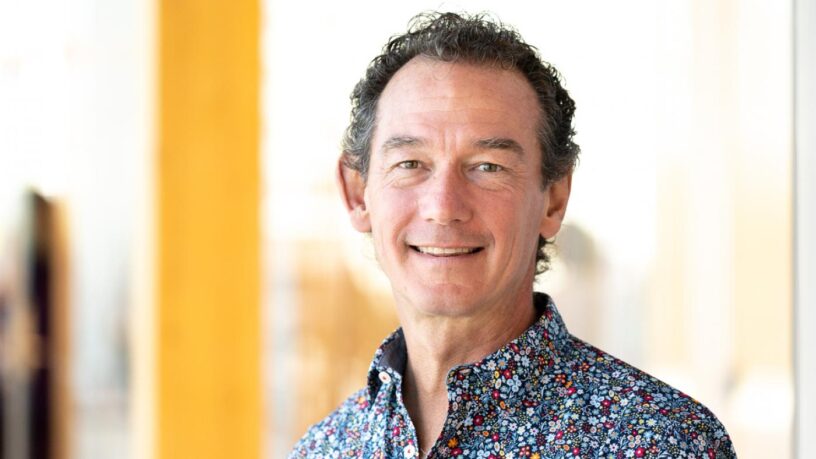


Our faculty are industry professionals who bring a wealth of current knowledge to their students. We love to celebrate these incredible people whenever we can, and our most recently retired instructor Dan Robinson is no exception. Dan was profiled in The Canadian Ergonomist and we felt compelled to share this great story. We are looking forward to Dan staying in touch with us!
Dan Robinson is a Canadian Certified Professional Ergonomist (CCPE) with an active consulting practice as Robinson Ergonomics Inc. and is part-time Faculty in the Wilson School of Design at Kwantlen Polytechnic University in British Columbia. Consulting in ergonomics for over 30 years, Dan’s focus at KPU is teaching an evidence-based, human-centred design approach within Technical Apparel Design and Interior Design programs. Prior to incorporating Robinson Ergonomics Inc. in 2000, Dan worked in the Ergonomics and Human Factors Group at BC Research Inc. for nine years and was Coordinator of the Institute for Human Performance at SFU for 3 years. Dan’s doctoral research at Simon Fraser University investigated the human response to whole-body vibration with mechanical shocks. His Masters research explored the effects of pesticide exposure on silviculture workers.
Dan facilitates the optimization of work and play for productivity, usability, safety and health – in any environment where people work or play.
Professional affiliations include: Past-president and Fellow of the Association of Canadian Ergonomists; Practicing Kinesiologist (BCAK); Chair of Canadian Standards Mirror Committee to the International Organization for Standardization (ISO) on Ergonomics (TC159) and Member of several SMC, including: Biomechanics and Anthropometry (TC159/SC3), Ergonomics of the Physical Environment (TC159/SC5), Human System Interaction (TC159/SC4), and Human Response to Vibration and Mechanical Shock (TC108/SC4). Dan is retiring from teaching at KPU in September 2022 to focus on ergonomics consulting and to free up more time for paddling BC’s west coast, riding his bike, or gardening.
At your last dinner party or gathering with new people, how did you explain what you do?
I get paid to watch other people work… (pause for effect)… with the goal of making them more effective at what they do and safer while doing it. Anywhere that people might work – from high tech office to heavy industry. Sometimes as simple as adjusting a chair or workstation, but sometimes requiring more elaborate redesign of the equipment or workstation.
What are you working on now? What question are you trying to answer or what goal are you trying to achieve?
Two focus areas at the moment. Teaching human factors, user-centred design and research methods to Technical Apparel Design students at Kwantlen Polytechnic University. Developing methods to fully understand the functional apparel needs for outdoor recreation, athletic performance or occupational safety, and to prove that a design concept works through testing with real people. The second focus area is independent assessment of musculoskeletal risk factors in work to inform the fair adjudication of workplace injury claims or to support corporate MSI/MSD prevention efforts within the workplace. Oh, and a third focus area… how to wind down a career towards retirement. Not yet sure how that will play out but I need to find a way to use more of that outdoor recreational apparel.

How has failure, or apparent failure, set you up for later success? Do you have a “favourite failure” of yours and why did you get into (a career in) HFE?
My favourite failure is not getting accepted to medical school following undergraduate studies. When that door closed, it set the stage for many other doors to open. Ergonomics wasn’t my second choice or my “plan B”. It was a choice that I didn’t even know existed when considering medical school. It was a discovery that happened because of failure to get into med school and because I poked my head through other doors that opened to see what was on the other side. Employment as a lab tech in the SFU School of Kinesiology lead to grad school, which lead to finding employment that could combine ergonomics consulting with doctoral research, and eventually launching my own business as a consultant in ergonomics. I am who I am today, in part, because of that failure, the subsequent career path, and because of the people I met along the way – as teachers, mentors, colleagues, clients and students. One failure leads to a different path. I like the path that I took.
What have you found to be most satisfying about your work?
Seeing positive outcomes. Client companies excelling and succeeding at what they do and knowing that ergonomics played a role in that success. Following up with prior clients and finding people who are more satisfied with their work, able to return to work after an injury, or able to carry on with ergonomics initiatives on their own as a result of assessments, training or ergonomics programs. Seeing workstations or products that I played a part in during the design process and that are effective enough to have staying power through several decades of use. And watching others who I have taught, mentored or worked with succeed in their career progression.
What advice do you have for aspiring HFE professionals? What advice should they ignore?
Get involved in your professional association, volunteer, collaborate with competitors, continue your education (it never ends), open doors and walk through even if you are unsure of where you are going, find a mentor, be a mentor, be curious, be kind. Ignore everything in the previous line. Find your own path. There is no right or wrong way to do it. HFE is a diverse field with many entry points and many paths through it. Find your own path. And regardless of which path you take, get outdoors and stay active in your personal, non-work pursuits. There is more to life than work.

To read the original article, click here.
