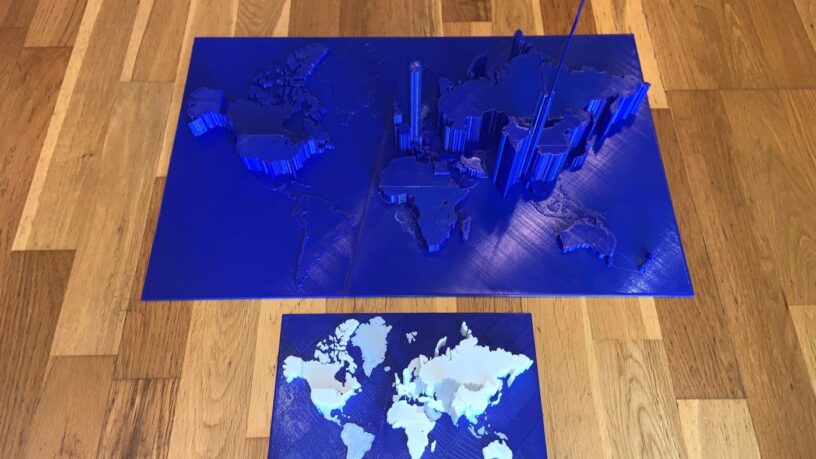


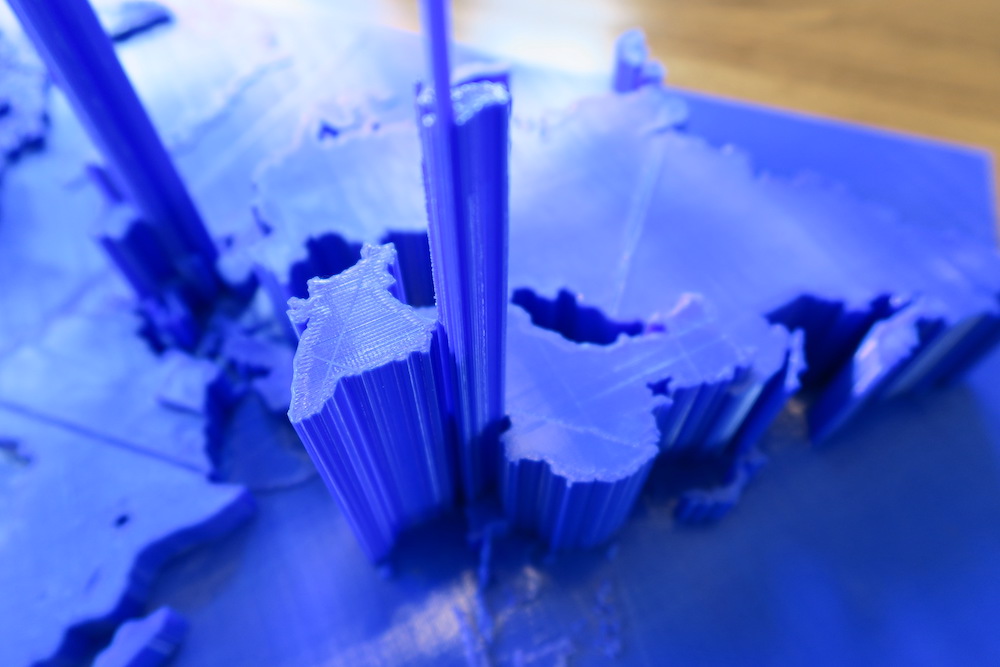
The university’s history department teamed up with the Wilson School of Design for the first time to 3D print a world map showing every mention of each country in a regional newspaper over three decades in the early 1900s.
Via KPU Newsroom
The connectedness of north east India to the world 100 years ago has been strikingly demonstrated through a pioneering history project at Kwantlen Polytechnic University.
“One of a historian’s main roles is to challenge stereotypes,” says history instructor Dr. Kyle Jackson. “In Mizoram, the region I study in north east India, one of the most enduring stereotypes is that the peoples of this upland mountain in the eastern Himalayas are somehow remote, isolated, or cut off from the dynamic processes happening elsewhere, in South Asia and the rest of the world.”

The map produced by the team visually challenges that stereotype. While neighbouring countries like China stand raised on the 3D map, Germany, some 7,000 kilometres away, soars like a skyscraper as a result of thousands of young men from Mizoram being drafted into First World War labour forces.
Using a collection of early volumes of Mizo leh Vai Chanchina, a regional newspaper, the project team scanned the documents into a software program to accumulate the data.
“In essence, the software we used allowed us to take over 1.6 million words of text, not all in English, and isolate, and track the frequency of the specific terms which we had imputed into the program,” says second-year history major Lucas Akai. “What we lacked, however, was a way to show the data in a more engaging and visual level.”

Thanks to KPU’s Teaching and Learning Innovation Fund (TLIF), Dr. Jackson and Akai were able to engage the help of two 3D printing experts from the Wilson School of Design, fourth-year product design student Birk Zukowsky and divisional lab coordinator Melanie Bland. Birk’s 3D sculpture reveals people in this region of India were highly interested in reading and writing about wider-world regions. Birk always viewed the world from a different perspective, which inspired him to study abroad in Birk, Denmark during his second year of the program to gain an alternative outlook on design, culture, and history. Birk has since graduated from the product design program and continues to work in the industry as a 3D Printing Research Assistant.
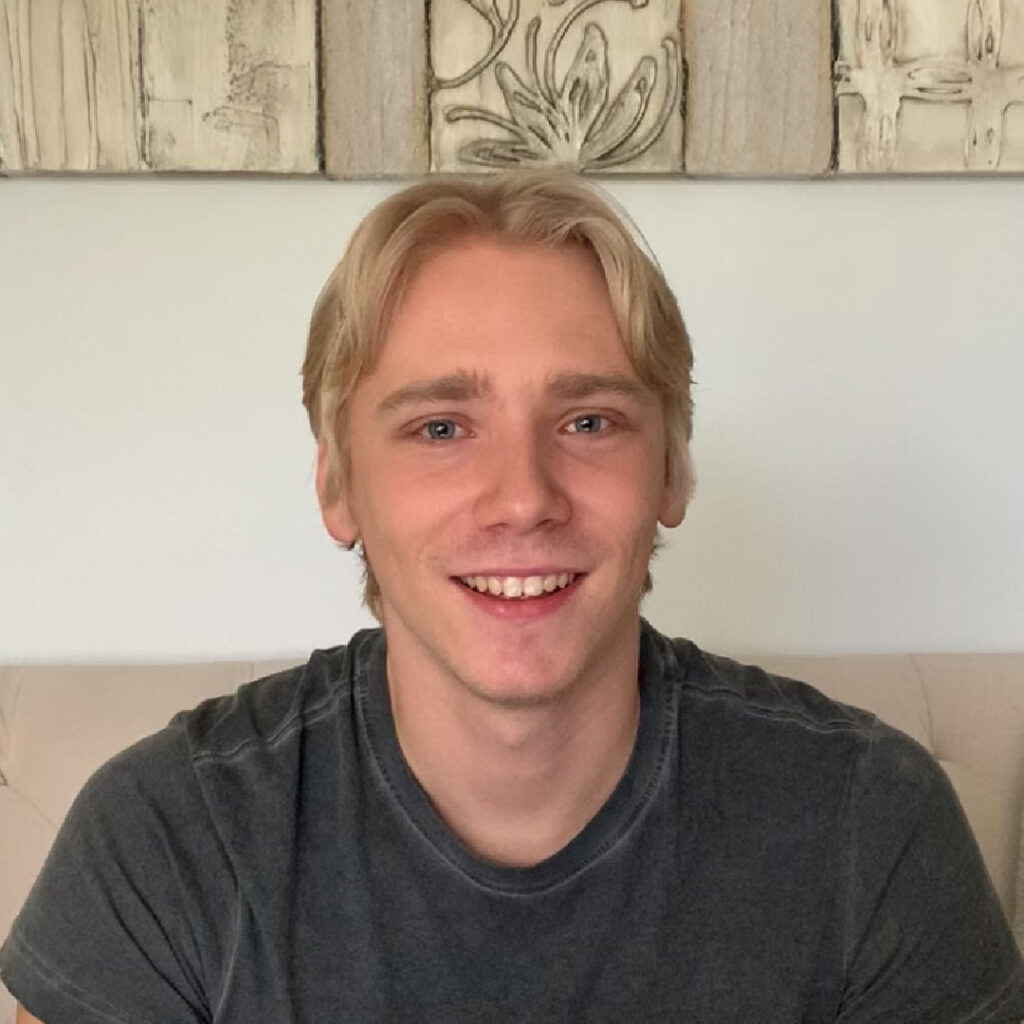
When asked about the opportunity to collaborate with a non-design-focused partner, Birk explained, “The project was a nice change of pace from other design projects at school. I was able to partner with Dr. Kyle Jackson and Lucas Akai to form a relationship between the Wilson School of Design and the KPU History department, It was very empowering as a designer to be able to fill a need with my expertise in 3D printing to help bring an already fascinating project into the tangible world”.
Andhra Goundrey, Dean of the Wilson School of Design also offered her perspective on cross faculty collaboration by stating “I fully support collaborations like this and I hope that we have the opportunity to do more in the future.
It fosters enhanced engagement and mutual respect for other disciplines and further strengthens our polytechnic mandate. The Teaching & Learning Innovation Fund (TLIF) has helped support a wide range of initiatives since its inception and we are most appreciative of the support for students and to showcase excellence in teaching practices.”
She also explains how design and design thinking can have a place in non-design focused projects by explaining “Design methodology can definitely be applied in other disciplines as the concept of design thinking incorporates an iterative process of testing out solutions to address problems”.
“We were able to quantify the newspaper’s geographic coverage and come up with a shape of the world it had been presenting to its readership,” adds Dr. Jackson.
“This project has shown us how the methods of digital history can allow students to go beyond the traditional 2D research essay and how starting conversations with people beyond the history department can help us change and enrich and be more creative with how we do history.
“The past is so rich and staggeringly diverse, and trying to incorporate art into it as a way to express our study of history has been wonderful.”
To read the original article, click here.
