

[The 3D printing market] will rise from $5.8 billion in 2016 to $55.8 billion by 2027, an aggressive annual growth rate of 23.0%. The 3D printing market is beginning to transition into a maturing business environment and has earnt an important position as a design and prototyping tool, and in the production of complex tooling and moulds.
Smithers, 2017
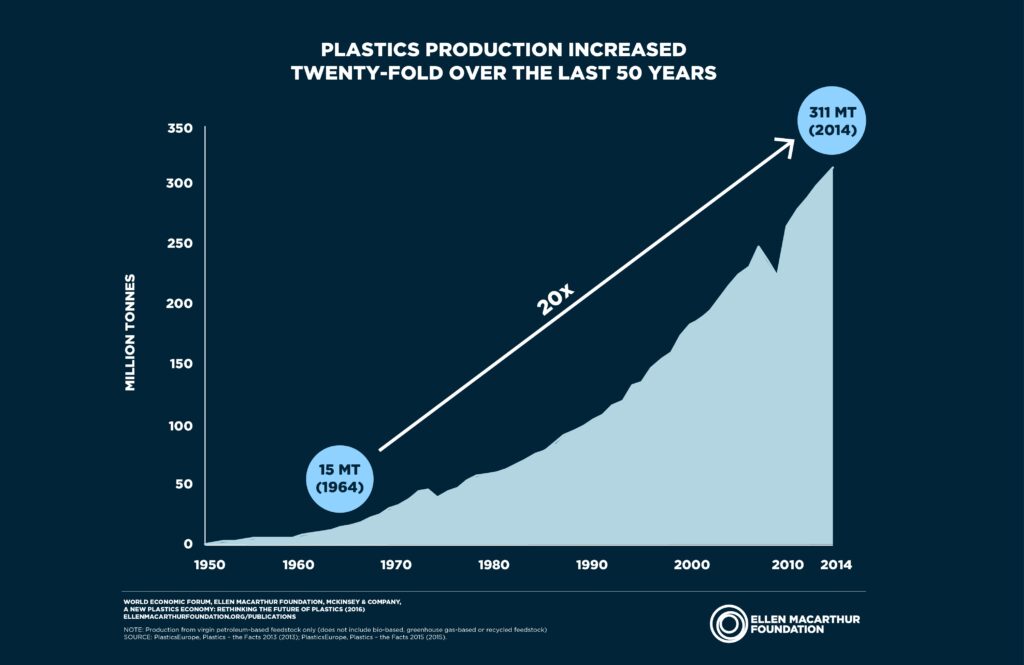
Credit: Ellen MacArthur Foundation
Plastics are the workhorse material of the modern economy – with unbeaten properties. However they are also the ultimate single-use material. Growing volumes of end-of-use plastics are generating costs and destroying value to the industry. After-use plastics could – with circular economy thinking – be turned into valuable feedstock. Our research confirms that applying those circular principles could spark a major wave of innovation with benefits for the entire supply chain.
Ellen MacArthur Foundation
With the popularity increase of 3D printing comes the increase of filament usage. Ravi Toor, founder and CEO of Filamentive, says that “8 million kilograms” of waste will be produced in the year 2020 out of the “more than 80 million kilograms of plastic filament [that] is needed to sustain the market.” These numbers are hard to conceptualize, so to put them to scale, 8,000,000kg of PLA equates to approximately 1067 elephants, or nearly 80% of the weight of the Eiffel Tower (University of Georgia, 2017).
You really shouldn’t be throwing away plastic. It’s sad because 3D printing is, you know, supposed to be this green technology that only uses a certain amount of material to build the object, but the truth is there’s waste, and nobody’s dealing with these waste streams. [It] almost brings a tear to my eye.
Tyler McNaney, founder and CEO of Filabot
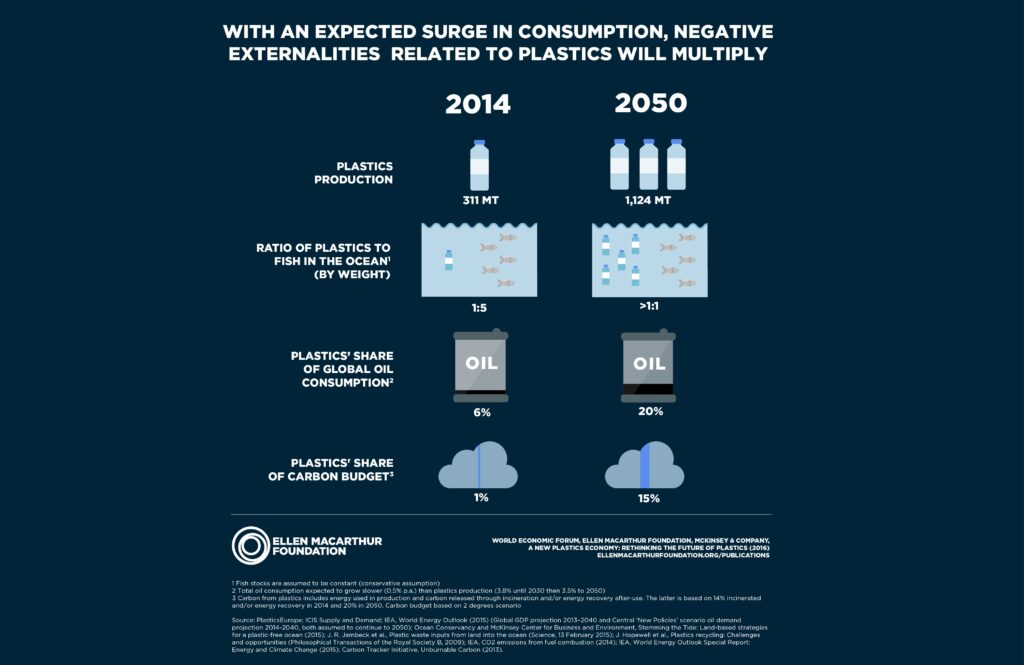
Credit: Ellen MacArthur Foundation
[Plastic] use has increased twentyfold in the past half-century and is expected to double again in the next 20 years.
Ellen MacArthur Foundation
Networking is important for small communities, especially when combined efforts benefit the whole group. There are currently over one hundred hobbyists/business using 3D printers in the Greater Vancouver Area (GVA), which means that there are probably hundreds of kilograms of PLA and other 3D printing materials just in the GVA. Without a local filament recycling facility, individuals are left to either throw scraps and broken prints in the garbage or invest in expensive machines to recycle the plastic themselves. With an established network between local printers, a 3D printing recycling hub would be beneficial for not only the environment, but also for people donating their scraps and broken prints that could potentially buy back the recycled filament at a discounted price. This hub might set an example and inspire other 3D printing communities in other cities to do the same.
Future Opportunities
Research on creating PLA for textiles from food scraps is being conducted by the City University of Hong Kong and the School of Energy and Environment. More information can be found on one of my blog posts by clicking here.
PLA is a common food-safe plastic used in 3D printing, food packaging, utensils, water bottles, and more. Although the scope of this project only includes recycling 3D printed scraps to create reusable filament, there exists an opportunity to follow the same principle of recycling and/or composting all PLA products in the future.
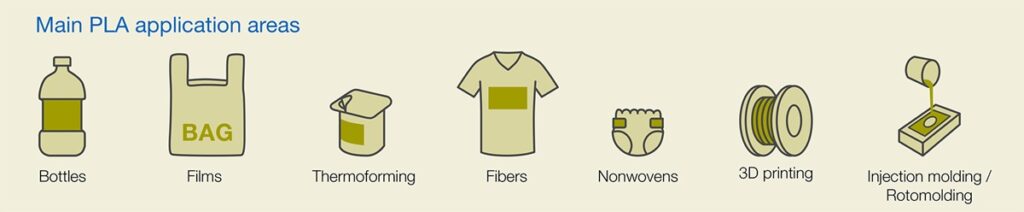
Sulzer, 2018
Filabot. (November, 2017). Extruding Plastic. Retrieved from https://www.youtube.com/watch?v=TYOHwaZPQ3c
MacArthur, (Dame) E., Waughray, D., & Stuchtey, M. R. The New Plastics Economy: Rethinking the future of plastics. World Economic Forum. Retrieved from https://www.ellenmacarthurfoundation.org/publications/the-new-plastics-economy-rethinking-the-future-of-plastics
Smithers. (May, 2017). Three Reasons Why 3D Printing is Reaching the Mainstream. https://www.smithers.com/resources/2017/jul/reasons-why-3d-printing-is-reaching-the-mainstream
Sulzer. (October, 2018). Leading technology for biobased PLA plastics. Sulzer Technical Review, (4). Retrieved from https://www.sulzer.com/en/shared/about-us/leading-technology-for-biobased-pla-plastics
Toor, R. (November, 2019). The 3D Printing Waste Problem. Filamentive. Retrieved from https://www.filamentive.com/the-3d-printing-waste-problem/
University of Georgia. (July, 2017). 8.3 billion metric tons: Scientists calculate total amount of plastics ever produced. Retrieved from https://phys.org/news/2017-07-billion-metric-tons-scientists-total.html