

Connect, collect, and redirect.
Proceeding the research section of this project, we looked at three different plans of action to potentially pursue. The three paths included: Plan #1 – Collecting and Recycling 3D printing PLA Scraps, Plan #2 – Collecting and Recycling Different Types of Plastic, and Plan #3: Collecting and Composting PLA (more information can be found in blog posts on the Updates page). After further research, constructive criticism, expert interviews, and feedback, Plan #2 was chosen as it encompasses Plan #1 (although, more complicated) and Plan #3 was rejected for being unfeasible within the scope of the project.
For more information on the background of the project and archived versions of the plans (on the Updates page), you can check out other pages on the website in the menu above, or by clicking on the buttons below.
Problem Statement:
A system is needed to connect FDM 3D printing users in Metro Vancouver to collect scrap filament for recycling and reusing to help promote a circular economy within the 3D printing filament market.
Canada recycles less than 10 percent of its disposable plastics, and is on track to throw away $11 billion worth of disposable plastic by 2030 unless things change.
Justin Trudeau
On Monday, June 8th, 2019, Justin Trudeau announced that Canada aims to ban all single-use plastic by 2021, partly due to the fact that Canada has the longest coastline in the world, and a quarter of the world’s freshwater (Parker, 2019). Canada is one of over 60 countries with a similar goal of trying to reduce single-use plastics.
The Current Plan
Based on Plan #2 (an archived version can be found here), the current Action Plan entails the connection of local 3D printer owners, the scrap collection of multiple 3D printing materials, the shredding and recycling of these materials, the creation of recycled filament, and the distribution of the filament to individuals, companies, and institutions that can use them. These steps are shown below in an early storyboard.

Zukowsky, 2020
[The 3D printing market] will rise from $5.8 billion in 2016 to $55.8 billion by 2027, an aggressive annual growth rate of 23.0%. The 3D printing market is beginning to transition into a maturing business environment and has earnt an important position as a design and prototyping tool, and in the production of complex tooling and moulds.
Smithers, 2017
The world population is “growing at a rate of around 1.05% per year,” meaning that 3D printing is not increasing at a proportional rate to population growth, but immensely surpassing it by approximately 22% every year (Worldometer, 2020).
Establishing a recycling system based around filament recycling is imperative now more than ever before. With an estimated “6.7 million 3D printers sold by the year 2020,” and assuming an “average of 10% waste per 3D printer” (lower end of the test results), more than “8 million kilograms” of waste will be produced in the year 2020 out of the “more than 80 million kilograms of plastic filament [that] is needed to sustain the [3D printing] market” (Toor, 2019). For reference, 8 million kilograms of plastic equates to approximately 1,067 elephants weighing around 7.5 (metric) tonnes each (University of Georgia, 2017).
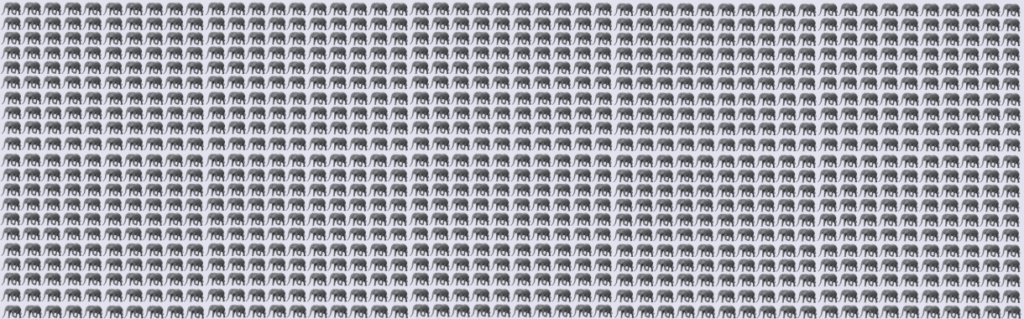
Modified from Luce, 2016
Currently, there are very few filament recycling systems in place, and the ones that are, are not feasible to the mass market for various reasons like geographical limitations, the infancy of the market leading to highly expensive equipment, and a lack of awareness and interest by the majority of the 3D printing community (more information on the Current Plastic Recycling Systems for 3D Printing here).
FABCYCLE, a local company founded by Irina McKenzie, is already doing what this project hopes to achieve but with textiles. FABCYCLE focuses on diverting “textile waste from the landfill by engaging [the] community, connecting with the industry and working with national and international partners” (FABCYLE). More information is available on FABCYCLE.shop, or on the FABCYCLE blog post here.
Attempting to create a network of local 3D printer owners would help engage the local 3D printing community and would be beneficial for all those involved, enabling individuals, companies, and institutions to dispose of their 3D printing scraps in a responsible way into a zero-waste and circular economy to create multiple lives for the material.
Below are links to more information on Plan #1 and the topics mentioned above in the form of blog posts.
Plastics are the workhorse material of the modern economy – with unbeaten properties. However they are also the ultimate single-use material. Growing volumes of end-of-use plastics are generating costs and destroying value to the industry. After-use plastics could – with circular economy thinking – be turned into valuable feedstock. Our research confirms that applying those circular principles could spark a major wave of innovation with benefits for the entire supply chain.
Ellen MacArthur Foundation
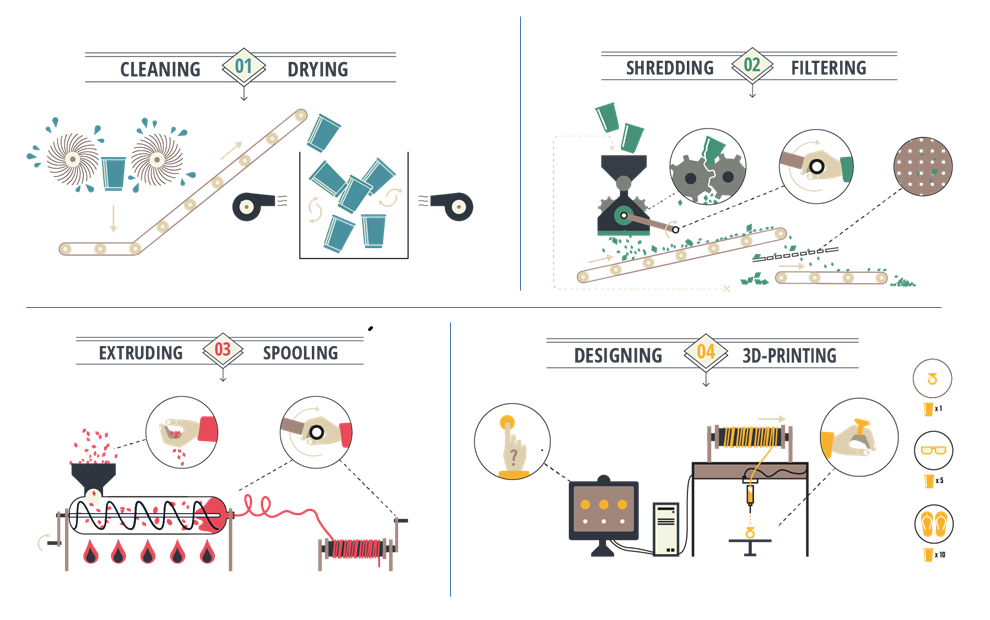
bramhallo, 2015
Attempting to recycle different 3D printing materials to 3D print with again will be a challenge, although the most impactful out of the three former plans in its full potential. A plethora of variables exist such as if it is even identifiable (if it is not organized by the donor), how the material was stored and how the different materials react to each storage climate, as well as what is was used for (potentially decreasing the mechanical strength or another aspect of its quality). Below are some benefits and downsides (formerly used to compare the three plans) for a quick overview of the pros and cons of trying to recycle multiple types of 3D printing materials.
Benefits:
– A small step in trying to reduce the amount of plastic in the world
– Experimenting with different types of plastic extrusion
– Filabot’s machine is capable of achieving this (more information on Filabot on my blog post here)
– More possible options of plastics that can be recycled and reused
Downsides:
– Unknown degree of degradation
– Potentially unknown substance (i.e. food) contaminating the plastic
– Complicated recycling process as each plastic is different
– Potentially damaging the extruding machine due to improperly cleaned plastic
– Not enough output of a certain type of plastic to be able to 3D print with
– Some plastics release harmful off-gasses
– Potentially unidentifiable plastic
Compositing is not the best alternative disposal method for 3D printing scrap material as most materials are petroleum-based, taking thoughsands of years to decompose, if ever, meaning PLA is one of the few materials that can actually be composted. This does not mean it is easy or realistic. PLA “requires an industrial composting facility, of which there are only 113 in the U.S. Only about 25 percent of those facilities accept residential waste,” usually because of the oxygen required to execute it (Molitch-Hou, 2019). The energy of composting the material is also another large factor. In a study conducted on the Life Cycle Assessment of different recycling methods for the 3D printing material PLA, it was discovered that the total energy depletion in the composting process of 1kg took 42.20MJ (megajoules), as opposed to 3.29MJ from mechanical and 8.03MJ from chemical recycling (Cosate De Andrade, M. F., Souza, P. M. S., Cavalett, O., & Morales, A. R., 2016). To conceptualize, 42.20MJ is the amount of energy it takes to brew approximately 140 cups of coffee, while the total energy used to create and recycle PLA mechanically, 3.29MJ, is equivalent to brewing less than 12 cups of coffee (12 cups = 1 kilowatt-hour = 3.6MJ) (Arcadia).
More information on PLA in general, Plan #3: Collecting and Composting PLA, and PLA Recycling: Mechanical vs. Chemical vs. Compost can be found by following the buttons below.
In summary, this path is more complicated than recycling strictly PLA as there are a number of variables that may result in hiccups along the way, although still feasible. The options are more extensive compared to recycling strictly PLA from 3D printing, which leads to more potential impact. To fit the project scope, the plan had to be limited to three plastic types in order to ensure the project’s success within the resources/time frame available. There could be potential for exploration after this project to look into accepting multiple types of plastic to convert it into 3D printable material.
If you want to have a look at research presentations for other capstone projects being conducted by my classmates, you can click here.
Arcadia. (n.d.). How to visualize one kWh. https://www.arcadia.com/energy-101/energy-bills/how-to-visualize-one-kwh/
Cosate De Andrade, M. F., Souza, P. M. S., Cavalett, O., & Morales, A. R. (July, 2016). Life Cycle Assessment of Poly(Lactic Acid) (PLA): Comparison Between Chemical Recycling, Mechanical Recycling and Composting. Journal of Polymers and the Environment, 24(4), 372-384. https://doi.org/10.1007/s10924-016-0787-2
MacArthur, (Dame) E., Waughray, D., & Stuchtey, M. R. (n.d.). The New Plastics Economy: Rethinking the future of plastics. World Economic Forum. https://www.ellenmacarthurfoundation.org/publications/the-new-plastics-economy-rethinking-the-future-of-plastics
McKenzie, I. (February, 2020). Founder Story: The Beginning of FABCYCLE by Founder Irina McKenzie. FABCYCLE. https://www.fabcycle.shop/blogs/journal/beginnings
Molitch-Hou, M. (April, 2019). What They Don’t Tell You About 3D Printing PLA. Engineering.com. https://www.engineering.com/3DPrinting/3DPrintingArticles/ArticleID/18956/What-They-Dont-Tell-You-About-3D-Printing-PLA.aspx
Parker, L. (June, 2019). Canada aims to ban single-use plastics by 2021. National Geographic. https://www.nationalgeographic.com/environment/2019/06/canada-single-use-plastics-ban-2021/
Smithers. (May, 2017). Three Reasons Why 3D Printing is Reaching the Mainstream. https://www.smithers.com/resources/2017/jul/reasons-why-3d-printing-is-reaching-the-mainstream
Toor, R. (November, 2019). The 3D Printing Waste Problem. Filamentive. https://www.filamentive.com/the-3d-printing-waste-problem/
University of Georgia. (July, 2017). 8.3 billion metric tons: Scientists calculate total amount of plastics ever produced. Phys.Org. https://phys.org/news/2017-07-billion-metric-tons-scientists-total.html
Worldometer. (2020). World Population. https://www.worldometers.info/world-population/
Bramhallo. (July, 2015). Recycling Process PPP [PNG]. https://www.3dhubs.com/talk/t/which-shredding-and-extruding-machines-are-available-part-3/2008
Luce, L. (August, 2016). Conceptual image of 1,000 elephants for reference [PNG]. Medium. https://medium.com/@leanne_luce/waste-in-garment-manufacturing-explained-three-ways-fd5eb3bdd3d8
Zukowsky, B. (September, 2020). Re-Print Vancouver Storyboard [JPG]. Richmond, BC. https://wordpress.kpu.ca/birkzukowsky/project-scope/