
By the U.S. Department of Justice Office of Justice Programs
Eric H. Holder, Jr.
Attorney General
Karol V. Mason
Assistant Attorney General
William J. Sabol, Ph.D.
Acting Director, National Institute of Justice
Why Wear Body Armor?
“Modern police body armor was introduced into practice in the 1970s” (P3)

“Between 2002 and 2011, the FBI reports that between 1,800 and 2,300 officers were assaulted with firearms annually. Of the 543 officers feloniously killed during the same period, 498 were killed with firearms. In 2011 alone, 72 officers were feloniously killed; of those 63 were killed with firearms.” (P3)
“An officer who is not wearing body armor is 3.4 times more likely to suffer a fatal injury if shot in the torso than an officer who is wearing body armor.” (P4)
What Is Body Armor?
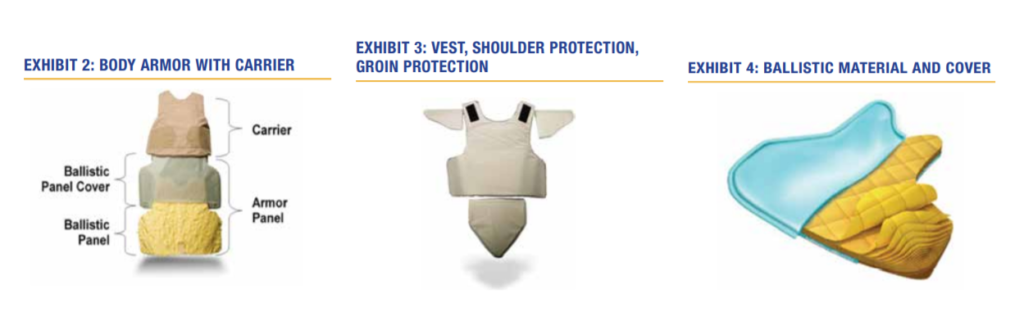
“The term body armor is usually associated with vests designed to provide ballistic protection to the vital organs in the torso. Usually, a vest contains two armor panels held in place by a carrier.” (P5)
“It may also refer to accessory panels that are intended to provide ballistic protection to the groin, coccyx (aka tailbone), neck, sides and shoulders (see Exhibit 3.)” (P5)
“Soft armor panels are typically constructed of multiple layers of ballistic-resistant materials (see Exhibit 4). The number of layers within the panel and the order in which these layers are placed influence its overall performance. Additional energy is absorbed by each successive layer of material.” (P6)
“As the fibers in a panel “catch” a bullet, they deform in the direction that the bullet was traveling into the body. That pushes panel material into the body of the wearer, resulting in injury to the torso. This type of nonpenetrating injury can cause severe contusions (bruises) and can cause damage to the internal structures of the body (musculature, bones, ligaments, organs, vascular system) that may result in death.” (P6)
” Hard armor plates (see Exhibit 5) may be constructed from ceramics, compressed laminate sheets, metallic plates or composites that incorporate more than one material. Generally speaking, hard armor plates work in one of two ways: They can capture and deform the bullet, or they can break up the bullet. In both instances, the armor then absorbs and distributes the force of the impact.” (P6)
“They are not designed to be used alone. Such armors are called IC armors. They are constructed by adding pockets to the front and rear of a soft armor’s carrier (see Exhibit 6).” (P7)
“It is important not to confuse trauma packs or plates with soft armor panels or hard armor plates (see Exhibit 7). “(P8)
“They are intended to reduce blunt force trauma injury to the torso resulting from a bullet’s striking an armor.” (P8)

Standards
“NIJ Standard-0101.06 incorporates major changes from previous versions that are intended to accomplish three major goals:
■ To improve the level of protection afforded by body armor.
■ To provide greater confidence in its continuing performance while in service.
■ To ensure that the requirements contained in the standard are relevant to the needs of officers in the field.” (P10)


Considerations
“Female soft body armors differ in that they can incorporate curved ballistic panels to accommodate the female bust. Male or gender-neutral models may be suitable for female officers with smaller busts. Depending on design and materials, they may not be suitable for those with larger busts because their busts tend to push the front armor panel forward, enlarging the underarm gap and therefore lessening the ballistic protection between the front and rear panels. “(P22)
“Officers or agencies may have preferences regarding design features offered with a body armor model. These include:
■ Weight. Heavier body armor will increase the amount of fatigue an officer experiences during his/her shift.
■ Thickness. Thickness is closely tied to the weight of a body armor. Thicker armors may trap more heat against the body and may be stiffer.
■ Covert carrier vs. overt carrier. Some agencies prefer body armor to be worn under the duty uniform; others, over their duty uniform. The choice is a matter of agency policy.
■ Fastener type. Determine whether zipper or hook and loop closures are preferred. There is no performance difference; however, operating environment (dust/sand can impact hook and loop), personal preference, ease of fastening and noise may all be considerations.
■ Other features. Pockets, cargo loops, etc., that may assist an officer in the execution of his/her duties.” (P22)

What To Do When an Officer Wearing Body Armor Is Shot
“Any officer shot while wearing body armor should receive a prompt medical evaluation. Even though the officer may only exhibit soreness and bruising, there may be more serious internal injuries that have not yet manifested themselves.” (P39)
