

How Does Body Armor Work?
When a handgun bullet strikes body armor, it is caught in a “web” of very strong fibers. These fibers absorb and disperse the impact energy that is transmitted to the vest from the bullet, causing the bullet to deform or “mushroom.” Additional energy is absorbed by each successive layer of material in the vest, until such time as the bullet has been stopped. (p13)
Methods of Construction
Typically, concealable body armor is constructed of multiple layers of ballistic fabric or other ballistic-resistant materials, assembled into the “ballistic panel.” The ballistic panel is then inserted into the “carrier,” which is constructed of conventional garment fabrics such as nylon or cotton. The ballistic panel may be permanently sewn into the carrier or may be removable. Although the overall finished product looks relatively simple in construction, the ballistic panel is very complex. Ballistic fabric is available from a number of manufacturers in various styles and compositions, each type having unique ballistic-resistant properties. The body armor manufacturer may construct a given model of ballistic panel from a single fabric style or from two or more styles in combination. The location and number of layers of each style within the multiple-layer ballistic panel influence the overall ballistic performance of the panel.” (P13)
Materials Used
DuPont has developed law enforcement protection products for more than 25 years.
Its Kevlar® brand fiber, first developed in 1965, was the first material identified for use in the modern generation of concealable body armor. Kevlar® is a manmade organic fiber, with a combination of properties allowing for high strength with low weight, high chemical resistance, and high cut resistance. Kevlar® is also flame resistant; does not melt, soften, or flow; and the fiber is unaffected by immersion in water. (P14)
Kevlar® 29, introduced in the early 1970s, was the first generation of bullet-resistant fibers
developed by DuPont and helped to make the production of flexible, concealable body armor practical for the first time. (P15)
Spectra® fiber, manufactured by AlliedSignal, is an ultra-high-strength polyethylene fiber. Ultra high molecular weight polyethylene is dissolved in a solvent and spun through a series of small orifices, called spinnerets. This solution is solidified by cooling, and the cooled fiber has a gellike appearance. (P15)
According to AlliedSignal, the resulting nonwoven fabric is incredibly strong, lightweight, and has excellent ballistic protection capabilities. Spectra Shield® is made in a variety of styles for use in both concealable and hard armor applications. (P15)
Another manufacturer, Akzo Nobel, has developed various forms of its aramid fiber TWARON® for body armor. According to Akzo Nobel, this fiber uses 1,000 or more finely spun single filaments that act as an energy sponge, absorbing a bullet’s impact and quickly dissipating its energy through engaged and adjacent fibers. Because more filaments are used, the impact is dispersed more quickly. Akzo claims their patented Microfilament technology allows maximum energy absorption at minimum weights while enhancing comfort and flexibility. (P15)
Lastly, another fiber used to manufacture body armor is Dyneema®. Originated in the Netherlands, Dyneema® has an extremely high strength-to-weight ratio (a 1-mm-diameter rope of Dyneema can bear up to a 240-kg load), is light enough that it can float on water, and has high energy absorption characteristics. (P16)
The introduction of several new fabrics used to make the permanent protective cover for the ballistic element and the removable outershell carrier have greatly enhanced the comfort and wearability of body armor. GoreTex®, a fabric made of expanded Teflon®, is a water-resistant fabric that, according to the manufacturer, allows perspiration to evaporate but prevents moisture from reaching the ballistic material. By using GoreTex®, some manufacturers have eliminated the water-repellent treatment on the ballistic material, which they claim improves the “breatheability” of the vest. (P37)
CoolMax®, a fabric originally developed for use in athletic apparel, is now being used by some manufacturers in place of traditional cotton and nylon fabric in manufacturing the removable outershell carrier of the vest. According to the manufacturer, CoolMax® acts like a wick, drawing perspiration away from the body to the outer surface of the garment, where it can more easily evaporate. (P37)
The NIJ Standard
The National Institute of Justice (NIJ) Standard for the Ballistic Resistance of Police Body
Armor was developed by the National Institute of Standards and Technology’s (NIST’s) Office of Law Enforcement Standards (OLES) and issued by NIJ as a voluntary national standard. This is a performance rather than a design standard, as are most OLES standards. Performance standards clearly specify a minimum satisfactory level of performance for each attribute that is critical to the equipment’s intended use. (P17)
In contrast, design standards specify the manner in which an item of equipment must be manufactured. Performance standards encourage design innovation and the use of advanced technology, addressing critical requirements only and not such attributes as comfort, color, or style—which are generally matters of user perception or preference. (P17)
Armor Classification
NIJ Standard–0101.03 establishes six formal armor classification types, as well as a seventh special type, as follows: (P18/19)
- Type I (.22 LR; .38 Special)
- Type II–A (Lower Velocity .357 Magnum; 9mm)
- Type II (Higher Velocity .357 Magnum; 9mm)
- Type III–A (.44 Magnum; Submachine Gun 9mm)
- Type III (high-powered rifle)
- Type IV (armor-piercing rifle)
- Special type
Requirements
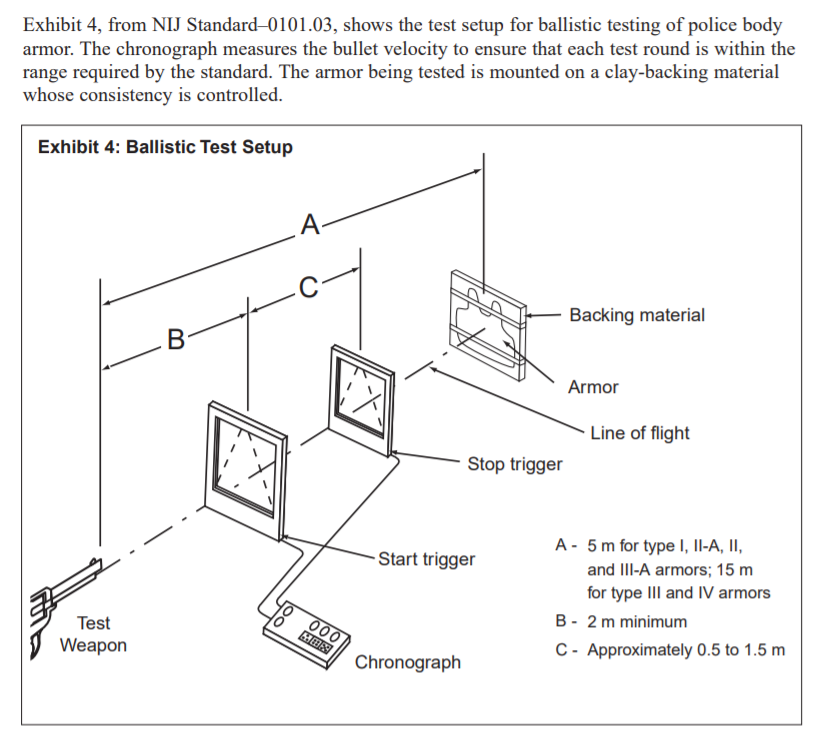
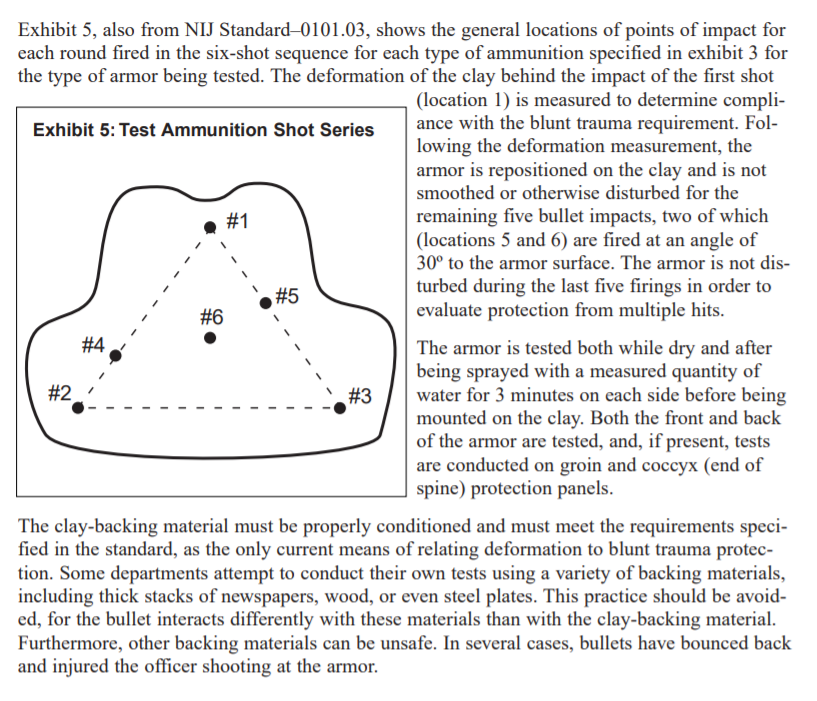
Types I, II–A, II, and III–A armor are required to prevent penetration from the impact of six bullets at specified velocities and locations for two types of ammunition. Two of the impacts in each six-shot sequence must be at a 30º angle. Furthermore, the deformation of the backing material (a measure of blunt trauma protection) must not exceed 44mm (1.73 in). The armor must meet these requirements while both dry and wet.
Type III armor requirements are identical to those above, except that only one type of ammunition is specified, and all six test rounds are fired perpendicular to the surface of the armor.
Type IV armor is required to resist penetration from only a single type of ammunition (armor piercing) and is only required to prevent penetration from a single perpendicular impact. (P22)
Wet testing. Certain ballistic fabrics lose ballistic-resistant efficiency when wet, but fully return to normal ballistic efficiency upon drying. Laboratory tests of non-water-repellent treated vests soaked in water have shown a reduction in ballistic efficiency of more than 20 percent compared to that of dry vests. The cause of this phenomenon is not known, but it is theorized that water acts as a lubricant, which allows the bullet to pass through the fibers more easily (P24)
Angle shots. All Type I through Type III–A body armors are required to resist the penetration of bullets striking at an angle to the surface, because the probability of being hit exactly perpendicular to the surface is low. Certain fabrics are less efficient ballistically by as much as 20 percent when a bullet strikes at an angle. Armor must provide the rated level of protection regardless of the angle of impact. (P24)
Performance Testing
The “Takeaway” Problem
Coverage
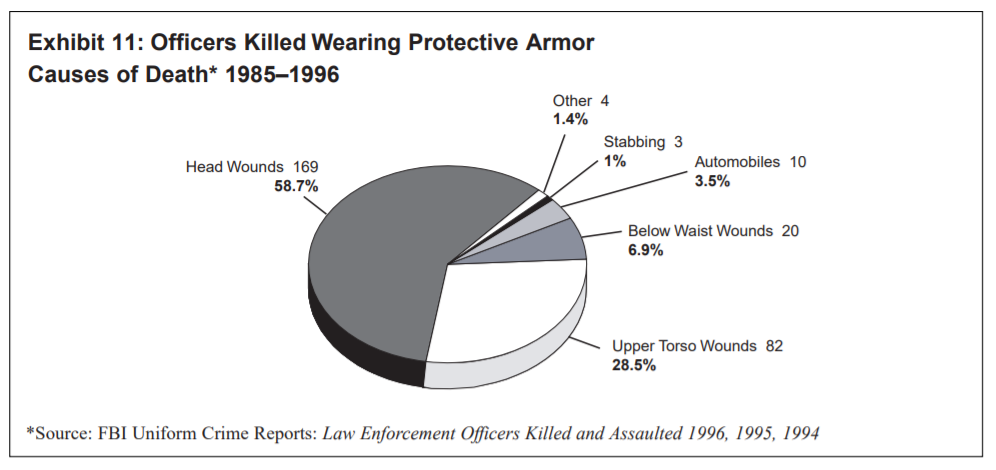

One thing is certain: the only armor that is absolutely guaranteed to fail to protect the wearer is the armor that is not worn. (P63)
Read More Here
Interested in learning about the protocol of purchasing and replacements of body armour? Click HERE