
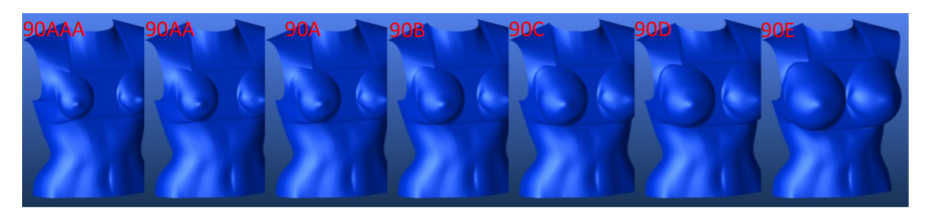
Significant efforts have been made so far to improve the overall performance of female soft body armor. However, still designing female soft body armor which accommodates the bust area for different women morphological differences with good comfort, fitness, and better ballistic protection is in its great demand. This research paper presents an efficient reverse engineering approach (2D-3D-2D pattern generation) for developing appropriate 2D patterns from 3D female adaptive virtual mannequin for female soft body armor seamless front panel.

Moreover, an optimal covering of the breast in the greatest respect of the morphology of the women is another very important condition not only in the vests’ ballistic performances point of view but also if one wishes to improve the comfort of the product due to the sensitivity of the breasts. This fundamental situation inspires to create the front basic bodice directly on a 3D virtual model with 90B bust size as shown in Fig. 5a, in which we will apply a reverse process of 2D/3D/2D flattening in order to clearly predict the deformation of the material between the 3D and 2D spaces.

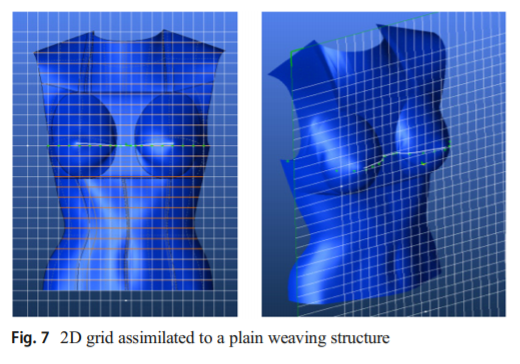
After obtaining the 3D block pattern surface on the front part of the mannequin, it is time to apply the new reverse 2D/3D/2D flattening process. This new pattern design starts with the creation of both horizontal and vertical grid structures positioned in front of the 3D block pattern as illustrated in Fig. 7.
In the final stage of the new 2D-3D-2D pattern flattening process, we could able to flatten the 3D surface of the block pattern as shown in Fig. 11. The illustrated figure (Fig. 11) shows the front and side views of the flattening elements with the pattern.

Flattening 3D surfaces is mostly a challenging problem in the different product design sectors. The triangulated surface methods are the common flattening with its limitation of
existing gaps and overlaps in the resulting meshes. Distortion is also another problem that appeared while obtaining 2D pattern through deformation
However, in the case of our new 2D-3D-2D pattern flattening process, the method already consider and check how the weave (grid) structure performs during deformation both in
the horizontal (weft) and vertical (warp) directions.
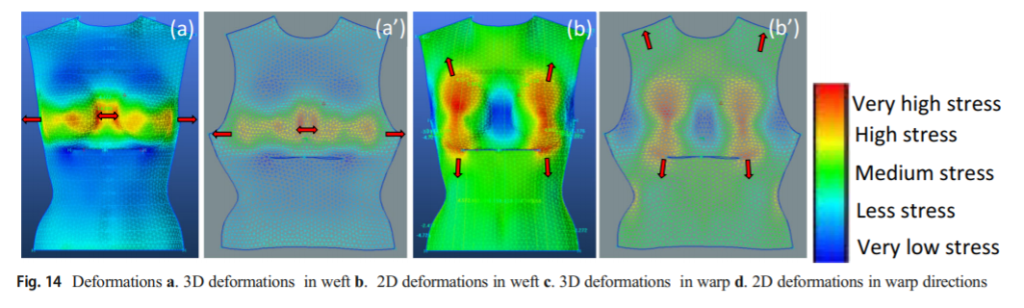
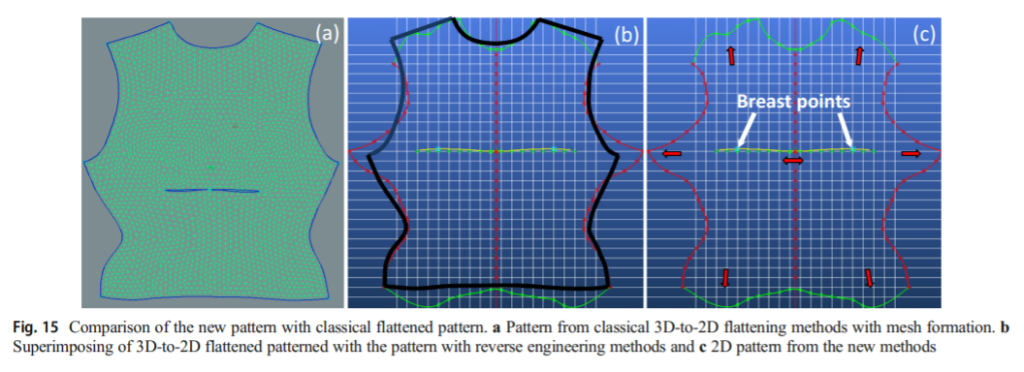
Based on the above features, in the classical 3D-2D flattened pattern, as shown in Fig. 14 (a) and (a’), the deformation of the horizontal (weft) yarns is directed outwards to the side of the bust area. Similarly, as shown in Fig. 14 (b) and (b’), the vertical (warp) deformation is directed up towards the shoulders and down towards the waist of the pattern. This flattening deformation induced in the mentioned direction can be easily observed and maintained by our method with the use of direct measurement from the 3D contour as shown in Fig. 15c. Moreover, Fig. 15b shows the result of both the traditional 2D-3D flattens pattern with our newly designed pattern using a 3D-2D-3D flattening process. The overlapping of the results of the two methods shows that both pattern flattening methods have an extending pattern contour.
Continue Reading The Case Study HERE