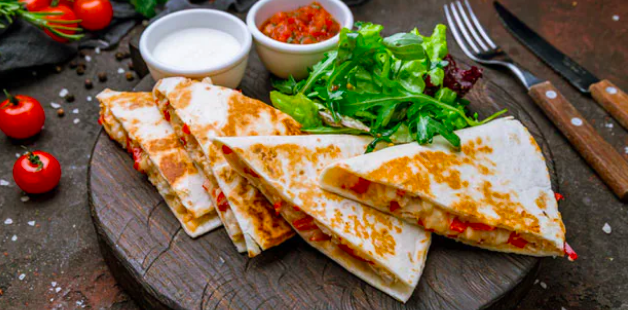
Quesadilla has always been a dish that changed my view on western food since I was a child. More specifically, knowing the fact that Western food can be spicy or even seeing tortilla was a surprise for me as I only thought of pasta or pizza when thinking about western food at the time. Due to this part of my experience back in my childhood, this made me curious with the history behind the dish and how it became enjoyed worldwide.
In the origin of the name’s dish, it is believed that quesadilla is a combination of two words, ’queso’ (cheese) and ‘tortilla’. In the classic style of Mexican quesadilla, ingredients mainly include corn tortilla filled with many kinds of vegetables and meat, and is folded in the middle at the end. In addition to this, there are many other toppings such as guacamole, salsa, and sour cream to further enjoy the dish. Although, quesadilla may seem as a dish that is mostly eaten for lunch or dinner, it is known that this is famously eaten for breakfast. To trace back in history, it is evident that the origin of quesadilla came from south-central Mexico. In the oldest style of this dish, it is believed that is was called as an empanada and was mainly filled with “pumpkin, mushroom, and spices” (Janssen). In the current style eaten today, the taste seems to have changed due to “Spanish settlers [bringing in] sheep, lambs, and cows […] to colonial Mexico” (Janssen), which dates back to the 16th century. Furthermore, quesadilla used to have a sweet taste to it, however, due to the occurrence of evolution with many new ingredients being introduced and added to the dish, the taste has changed to a much more savoury one since 1521. In terms of American food culture, although quesadilla may be a Mexican dish, it is known that the reason behind this dish becoming famous in America was mainly because Spanish settlers who came to colonise Central America in the past has brought the tradition of Mexican quesadilla along their trip. For this, American food culture has most likely given an impact to this movement and has created an American style which serves the dish with large amounts of cheese in order to satisfy American’s tastebuds.
As for the history of tortilla, it is believed that it got its name from the meaning “little cake” as “it is a flat circle of corn masa that has been previously cooked [,] warmed up and softened to the point that it could be folded up” (Backyard Taco, Robison). In Mexican culture, it is evident that corn tortilla was mostly eaten by Native Americans during the pre-Columbian period since these people were known to have been very skilled agriculturists and knew how to “[harvest] maize” (Backyard Taco, Robinson). Due to this part of history, dishes that use flour tortilla have increased in number and have become popular in Mexican cuisine. Although, corn tortilla has always been a staple in Mexican cuisine, including quesadilla, the easy access of getting flour made flour tortilla much more convenient and popular to eat.
In the study and research of Mexican quesadilla, I was surprised to see how much the history of quesadilla has evolved and changed since its very origin with empanada that is filled with mainly pumpkin, mushroom, and spices. However, with “Spanish settlers [bringing in] sheep, lambs, and cows […] to colonial Mexico” (Janssen), a new evolution seems to have been made with the introduction of filling meat into the dish. In today’s generation, there are various quesadilla styles that will not only be localised to suit the country’s tastebuds, but also tastes that can be enjoyed around the world. As stated above, American style quesadilla includes a lot of cheese where as the traditional Mexican quesadilla does not. From personal experience, I was surprised to see a Japanese style tacos, which had fish with umeboshi sauce (a traditional Japanese sour plum) on it. From this experience and research, I am interested to see more of the diverse taste that quesadilla can offer in the future.
Bauer, Elise. “The Ultimate Quesadilla.” Simply Recipes, 3 May 2022, https://www.simplyrecipes.com/recipes/quesadilla/. Janssen, Noa. “The Origin Of Quesadillas And Its Evolution.” Dining on the Rocks, 19 Dec. 2022, https://www.diningontherocks.com/the-origin-of-quesadillas-and-its-evolution/. Laura. “The History And Origins Of Quesadillas.” Mexicali Blue, 17 Oct. 2022, https://www.mexicali-blue.com/the-history-and-origins-of-quesadillas/. Robison, Tyler. “The History of the Quesadilla.” Backyard Taco, 18 June 2021, https://backyardtaco.com/blog/history-quesadilla/. “The History of the Quesadilla: How Did This Famous Mexican Pastry Come To Be?” NachosMexican Grille&More, 18 Aug. 2021, https://www.nachosmgm.com/post/the-history-of-the-quesadilla. Tomky, Naomi. “Where There's No Queso in Quesadilla.” BBC Travel, BBC, 29 May 2019, https://www.bbc.com/travel/article/20190529-where-theres-no-queso-in-quesadilla#:~:text=Yestheword'quesadilla',thesumofitsparts.

