
Few Italian dishes are beloved around the world as a Spaghetti Bolognese, with its hearty meat sauce, but have you ever wondered the history of this delicious sauce? Originating from Bologna in Northern Italy, Italians called it Ragù Bolognese. It is a tomato-based meat sauce today, but in the past was very different. Since roughly the 1930’s the sauce has been served with the spaghetti noodle, which is why it is usually referred to as ‘Spaghetti Bolognese’. But, in Northern Italy it is traditionally eaten with a flat noodle, like fettucine or pappardelle, and always best with fresh rather than dried pasta. The first cookbook to include a “Ragù Bolognese” recipe was published in 1891 by Pellegrino Artusi called La scienza in cucina e l’arte di mangiar bene (Science in the Kitchen and the Art of Eating Well). Artusi was not the one to create the recipe though, it was passed onto him by Alberto Alvisi, a cook who later became Pope Pius VII. The recipe was then called ‘Maccheroni Alla Bolognese’ and was recommended to be eaten with a pasta called ‘denti di cavallo’ that translates to “horse’s teeth”. Artusi’s recipe had 12 ingredients: veal, pancetta, butter, onion, carrot, celery, flour, broth, salt, pepper, nutmeg, and Parmesan cheese. He also mentions that, if you’d like, you may add dried mushrooms or sliced truffles, chopped cooked chicken liver, and cream just before serving the dish. Today there are many different versions of the sauce.
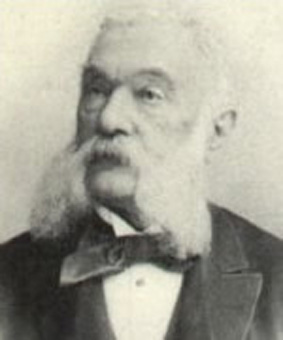
Photograph of Pellegrino Artusi from 1891.
Image taken from: https://commons.wikimedia.org/wiki/File:Pellegrino_Artusi.jpg
Many chefs claim that veal is needed to really make the sauce delicious, others say that you can do veal along with pork, ground beef, and ground pork. Pancetta, prosciutto, and chicken livers have been seen in some recipes as well. Chefs in Emilia-Romagna have said that serving Bolognese with tagliatelle, which is an egg noodle, is best because the consistency of the pasta allows the sauce to really stick, giving you a nice amount of sauce with each noodle. Ragù is derived from the French word “ragout” which is used to describe the process of stewing meat and vegetables for a significant amount of time. This style of cooking can be dated all the way back to the 1700’s in the Vatican.

Photograph of the original cookbook by Pellegrino Artusi that included the recipe for Ragù Bolognese.
Image taken from: https://commons.wikimedia.org/wiki/File:Ricettario_La_scienza_in_cucina_e_l%27arte_di_mangiar_bene_-_Musei_del_cibo_-_Parmigiano_-_168a.tif
Bolognese sauce was believed to have been brought over to North America by the Italians in the early 20th century and in 1982 the Italian Academy of Cuisine submitted an official recipe for Ragu Alla Bolognese with the Bologna Chamber of Commerce. This was done so that the recipe would not go through any more severe changes. This recipe only called for a few tablespoons of tomato, and no garlic, herbs, or Worcestershire sauce, as opposed to most of the Bolognese sauces you’ll find at restaurants here today. It is believed that soldiers in WW2 can be credited for the spread of spaghetti Bolognese. They were likely introduced to the dish during the invasion of Sicily, Calabria, and Apulia. One writer believes that pasta with Bolognese was introduced to North America and Germany before the war because there was a recipe from 1912 for “macaroni with meat and sauce (Maccheroni Al Sugo Di Carne) from Mabel Earl McGinnis in “Simple Italian Cookery”, as well as another recipe from 1917 in Julia Lovejoy Cuniberti’s cookbook called “Practical Italian Recipes for American Kitchens”. Both recipes have a few differences from Artusi’s original recipe, pointing to the evolution of Bolognese sauce. When Italian immigrants came to North America in the 19th and 20th centuries, they brought with them their recipes and ways of cooking. There were pizza, pasta and other Italian food restaurants popping up all over the place. Lots of those restaurants adjusted the original Bolognese recipe to be “budget friendly”. For at home cooking, ready-made Bolognese sauce was starting to be sold in cans. Bolognese sauce was seeing many changes in a quick amount of time as it spread through the Americas, with many ingredients being added that were never included when it was first introduced in Bologna. These ingredients include, but not limited to crushed red pepper, Italian sausage, spinach, and tofu to name a few. All these changes to the traditional Bolognese ragu sauce could have been the reason that the original recipe was registered with the Bologna Chamber of Commerce.
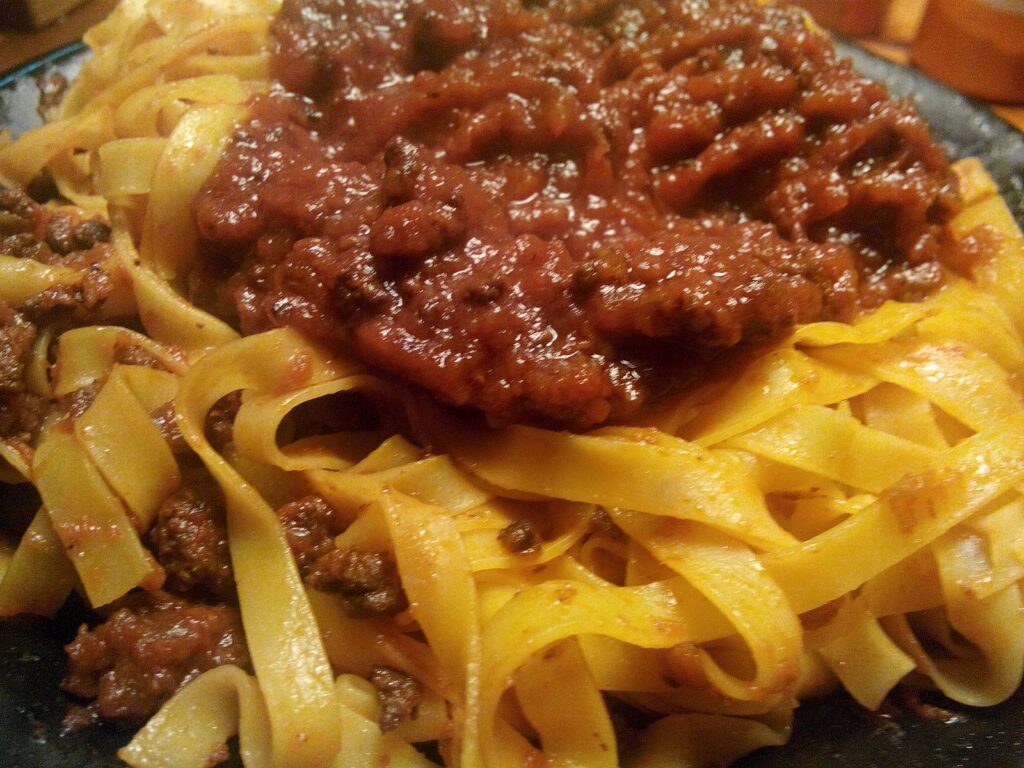
Traditional Ragù Bolognese.
Image taken from: https://commons.wikimedia.org/wiki/File:Tagliatelle_al_rag%C3%B9_03.jpg
In my home growing up Spaghetti Bolognese was a regular staple. It has been my favourite meal for as long as I can remember. I remember coming home after school and smelling my mom’s sauce cooking on the stove. It smelled heavenly! Nothing beat my mom’s Bolognese sauce. My mom is an amazing cook, we always ate a delicious home made meal for dinner, but Spaghetti Bolognese was the most requested by my siblings and I. I would always sneak a small bowl of sauce before it was ready, she let it simmer for hours. Now that I live on my own, I’ve had to try to replicate the sauce on my own. A few years ago I came across a simple recipe on my daily scroll through Pinterest and decided to give it a try. Today that sauce is now a staple in my home. I make it probably twice a month and it reminds me of home. The recipe is a little different than my mothers, and very different from the one Artusi published in 1891. Here’s a little look into the process of making this delicious sauce.


Images taken by Hannah Williams.
The process from start to finish is quite simple. You really just need to throw everything into the pot and let it simmer for a few hours. Now I’m off to enjoy this beautiful bowl of pasta… Bon Appetit !
Bibliography
Gwinner, Thomas. “The Origin and Evolution of Ragù Bolognese (Bolognese Sauce) .” Center for Global Research Development . International Journal of Arts and Humanities , July 2018. chrome-extension://efaidnbmnnnibpcajpcglclefindmkaj/https://ijah.cgrd.org/images/Vol4No3/3.pdf.
Ko, Cerise. “The History of Spaghetti Bolognese.” Milan Italiano – 4898 San Felipe Rd. San Jose, CA 95135, June 27, 2023. https://www.cucinaventi.com/blog/the-history-of-spaghetti-bolognese.
McNamee, Gregory Lewis. “Bolognese Sauce.” Encyclopedia Britannica. Encyclopedia Britannica, inc., October 13, 2022. https://www.britannica.com/topic/Bolognese-sauce.
Sibela, Angela. “Bolognese History: Origins of This Global Favorite.” FOODICLES, June 28, 2021. https://foodicles.com/bolognese-history/.

