
Academic Integrity and GenAI: Courage, Curiosity and Care
GenAI is one of the first topics that comes up when someone learns that I work in the field of academic integrity. They’re curious what people are doing about GenAI in the classroom. They wonder how GenAI use can be detected and how prevalent it is. They want concrete answers, reduced uncertainty, and to be able to keep up in this ever-changing landscape.
The honest answer is often “It depends.” GenAI use sits in a gray area where context is key. It depends on the discipline, the learning objectives, the assessment design, and the expectations set out, among other factors. Amid this complexity, it can be paralyzing to decide on a course of action.
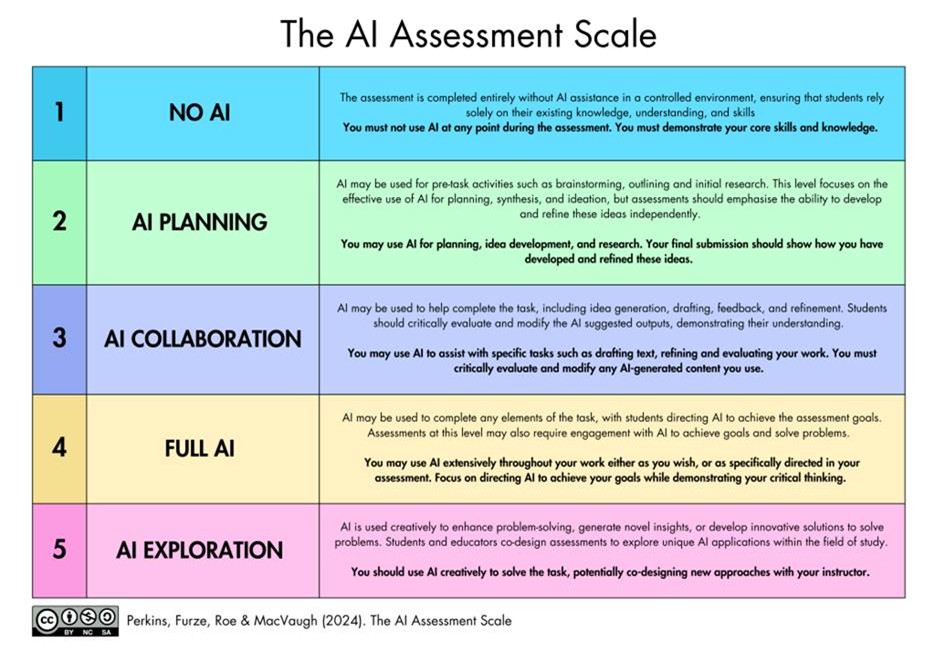
Two frameworks that can support thoughtful decision-making here are the AI Assessment Scale and Complementary vs Competitive Cognitive Artifacts.
1. The AI Assessment Scale helps instructors with looking at ways to redesign assessments, integrating GenAI when appropriate, and communicating expectations clearly. The scale moves from “No AI” to “AI Exploration,” encouraging reflection on what we truly want to assess and how Gen AI aligns, or conflicts, with those goals.
2. Dr. Rahul Kumar builds on David Krakauer’s work on cognitive artifacts and asks whether a GenAI tool amplifies human cognition (complementary) or replaces it (competitive). Put another way, a complementary cognitive artifact supports learning, while a competitive one erodes skills and reduces capability. Identifying and discussing with students what fits in each category in the context of your course can also help students develop a more nuanced approach to GenAI tools.
These frameworks can ground our decisions, but embracing constant change takes courage. A lot of what is being asked of us provokes fear, fatigue, and uncertainty. Courage allows us to stay open, question long-held assumptions, and lead with integrity.
- For instructors, courage might mean rethinking assessments and engaging in honest conversations with students, even when it’s uncomfortable. In my other life as a piano teacher, I’ve learned that what worked for me as a student may not work for my students today. Meeting learners where they are, rather than where I was, has helped me to be more learner-centered, curious, and courageous in the way that I teach.
- For staff and administrators, courage may mean finding different ways to support students with limited resources and breaking down departmental silos for better collaboration. It might also mean taking risks on creative and novel solutions.
- For students, courage is often about resisting shortcuts amid immense pressure and mixed messaging. Ads for products like Grammarly (which now has GenAI components) permeate YouTube and often blur the line between support and substitution. Open conversations with our students can help clarify what’s acceptable and why.
GenAI also follows on the heels of another major disruption. The pandemic led to a sense of isolation and a loss of human connection and that kind of connection is essential to maintaining integrity in the age of AI. When an integrity concern arises, holding space to clarify assumptions and opening up dialogue is important. This is especially relevant in cases of unauthorized GenAI use as the evidence can be less concrete than with traditional plagiarism. A conversation helps us to gain a better understanding of what the student’s process was in completing the assignment and helps in assessing whether the student has learned, moving away from focusing only on whether they cheated. This proactive communication can strengthen relationships and reduce student stress and anxiety from receiving an unexpected email notifying them they have been reported for a breach. We know that students learn best when they feel safe and are in learning brain instead of survival brain. Employing a fear-based approach often isn’t the most effective as capacity for listening and absorbing information decreases when in a state of alarm. Instead, creating environments that build psychological safety can help students feel more ready and able to engage, while still allowing for appropriate sanctions.
In their latest book, Dr. Tricia Bertram Gallant and Dr. David Rettinger also highlight the role of self-efficacy: students who believe they are capable are less likely to cheat. Supporting our students in increasing their self-efficacy, such as through scaffolding and chunking assessments, can help them tackle the obstacles and stressors they face. Encouraging the development of growth mindsets and reframing failure as an opportunity for learning can help address one of the reasons that students turn to shortcuts. Giving examples, sharing personal stories, and acknowledging challenges lets students know that they aren’t alone and can reach out for support.
As I reflect on academic integrity today, I feel cautious optimism. The human brain is hardwired to focus on negativity, and I’d like to challenge us to override our default settings to also see the good. We have innovative instructors and resilient students. A balanced perspective doesn’t mean ignoring problems but rather facing change and uncertainty with hope and accountability. GenAI tools will continue to evolve, and in an age defined by algorithms, it is our humanity – our courage, curiosity, and care for one another, that will keep us headed in the right direction.
If you are looking for support around GenAI and academic integrity, take a look at our new infographic resource that has compiled KPU’s resources on this. Also check out our remaining Academic Integrity Month events!
For academic integrity questions or concerns, please contact academic.integrity@kpu.ca.
References
Bertram Gallant, T., & Rettinger, D. A. (2025). The Opposite of Cheating: Teaching for Integrity in the Age of AI. University of Oklahoma Press.
Kumar, R. (2025, October 1). Smart or shallow? Postplagiarism, trust, and the future of learning with GenAI. Postplagiarism Speaker Series. CAIELI, University of Calgary[Hybrid]. https://hdl.handle.net/10464/19682
Perkins, M., Roe, J., & Furze, L. (2024). The AI Assessment Scale revisited: A framework for educational assessment (Version 1). arXiv. https://doi.org/10.48550/ARXIV.2412.09029