UDL & Decolonization and Indigenization
Decolonialization and Indigenization
Listen to an audio version of the text instead:
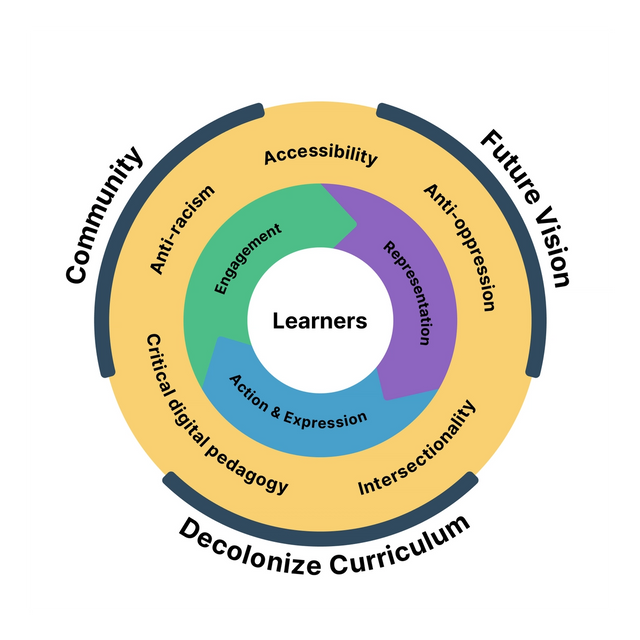
Universal Design for Learning is well positioned to support decolonization and Indigenization practices as, once again, the goal is to design learning environments that are welcoming and supportive of all learners. One of the goals of decolonization is arguably to actively and intentionally work towards dismantling barriers that have prevented substantive and effective education for learners under the yoke of colonization and oppression. In Canada, decolonization is most often discussed in the context of Indigenous, Métis, and Inuit peoples because they are the original stewards of the land and have endured centuries of colonial policies that disrupted their governance systems, cultural practices, languages, and relationships to land and community. However, decolonization truly extends beyond one group of people and impacts all those who have suffered under oppressive colonial practices and rule. With Universal Design for Learning (UDL), this includes designing positive learning environments where a plurality of experiences and backgrounds is more than just recognized—it is actively welcomed, valued, and embedded into the fabric of educational practice.
On the other hand, Indigenization in Canada is most specific to Indigenous, Metis, and Inuit peoples who have historically been oppressed, subjugated, and marginalized. A part of decolonization and Indigenization requires us as individuals to reflect on our role and part in continuing practices that further malign Indigenous peoples and UDL is one such opportunity to help break this vicious cycle.
Simple, yet genuine and impactful, ways instructors can engage in decolonization and Indigenization practices is through the way in which they design their syllabus, course, instruction, and assessments from a UDL perspective. Collaborate with Indigenous communities to create education materials that reflect their perspectives and knowledge, respecting intellectual property rights and cultural contexts. Diversify resources to include works by Indigenous scholars, artists, and activists, ensuring a broad range of voices and experiences are represented.
Below are some of the ways that decolonization and Indigenization can be embraced and promoted through the three core principles of UDL. Clicking each will expand to reveal content, along with an option to listen to an audio version of the text:
Reflection Point
Consider your own understanding and practice of decolonization and Indigenization in your personal and professional life. What current practices are you engaging in? What actions do you want to lean more into? Less into?
References
Antoine, A., Mason, R., Mason, R., Palahicky, S. & Rodriguez de France, C. (2018). Pulling together: A guide for curriculum developers. BCcampus. Retrieved from https://opentextbc.ca/indigenizationcurriculumdevelopers
Battiste, M. (2013). Decolonizing education: Nourishing the learning spirit. Purich Publishing Ltd.
Debassige, C. B., Wakeham, P., Smithers-Graeme, C., Haque, A., & Chitty, S. M. (2022). Mapping approaches to decolonizing and indigenizing the curriculum at Canadian universities. The International Indigenous Policy Journal, 13(3), 1-27. https://doi.org/10.18584/iipj.2022.13.3.14109
George Brown College (n.d.). Welcome to the UDL certificate. Universal Design for Learning: Inspiring Equity and Inclusion in Higher Education. UDL Integration George Brown College. Retrieved from https://udlontario.georgebrown.ca/
Kearney, D.B. (2022). Universal design for learning (UDL) for inclusion, diversity, equity, and accessibility (IDEA). eCampus Ontario. Retrieved from https://opentextbooks.uregina.ca/universaldesign/
Kimmerer, R. W. (2013). Braiding sweetgrass: Indigenous wisdom, scientific knowledge and the teachings of plants. Milkweed Editions.
Kirkness, V. J., R. Barnhardt (2001). First Nations and higher education: The four R’s – respect, relevance, reciprocity, responsibility. Journal of American Indian Education, 30(3), 1-15. University of Minnesota Press.Simpson, L. B. (2014). Land as pedagogy: Nishnaabeg intelligence and rebellious transformation. Decolonization: Indigeneity, Education & Society, 3(3), 1-25. Retrieved from https://jps.library.utoronto.ca/index.php/des/article/view/22170