What is UDL?
What is Universal Design for Learning?
Universal Design for Learning (UDL) is an interdisciplinary instructional design framework that draws on research in neuroscience, Social Learning Theory, and fields such as Inclusion, Diversity, Equity, and Accessibility (IDEA), to support the design of inclusive and engaging learning environments.
To listen to a podcast-style audio overview of the section, please listen below (captioning available and transcript downloadable under the player):
The framework originates from efforts in Universal Design to make physical spaces more accessible, adaptable, easier to navigate, and functionally useful for all users. Universal Design for Learning extends these principles into a teaching approach to make the learning environment accessible and beneficial for all learners. In this regard, UDL is broken down into three core components: Engagement, Representation, and Action & Expression.
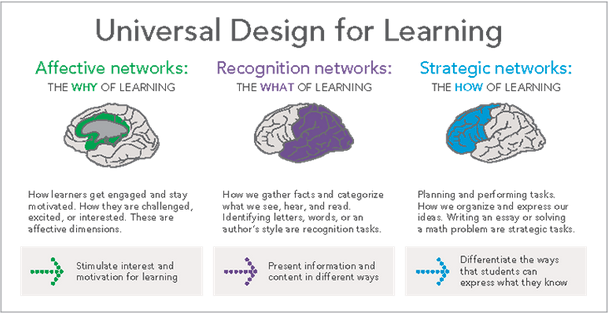
By implementing multiple means of Engagement, Representation, and Action & Expression into our design of courses, assessments, and instructional materials, students are better supported and more readily able to achieve their learning goals.
For an additional framing and context resource, read “A Taxonomy of Inclusive Design: On Disclosure, Accessibility, and Inclusion” (link) by Lorna Gonzalez and Kristi O’Neil-Gonzalez (2019, November 15).
For a video overview of UDL, please watch CAST’s “UDL at a Glance”
Universal Design for Learning Elements
Core Components of the UDL Framework
- Treating Variation in Learner Needs as the norm.
- The three (3) UDL principles of providing Multiple Means of:
- Engagement
- Representation
- Action & Expression
- The nine (9) UDL Guidelines and the thirty-one (31) checkpoints within the UDL principles
- The UDL goal of Developing Expert Learners
In this resource guide, we introduce each of these components of the UDL framework, along with information and resources to further aid implementation efforts in the areas of course design, assessment design, and instructional design.
Definitions of UDL
Prior to exploring the components and guidance of the UDL framework, it can be helpful to define what Universal Design for Learning (UDL) is, its applicability to post-secondary environments (particularly for instructors and faculty), and the core components of the framework.
Developed by CAST (Center for Applied Special Technologies), Universal Design for Learning (UDL) is “a framework to improve and optimize teaching and learning for all people based on scientific insights into how humans learn” (CAST, 2024) that is “grounded in neuroscience research addressing learner variability in the forefront of instructional design” (Gronseth, Stefaniak, & Dalton, 2022).
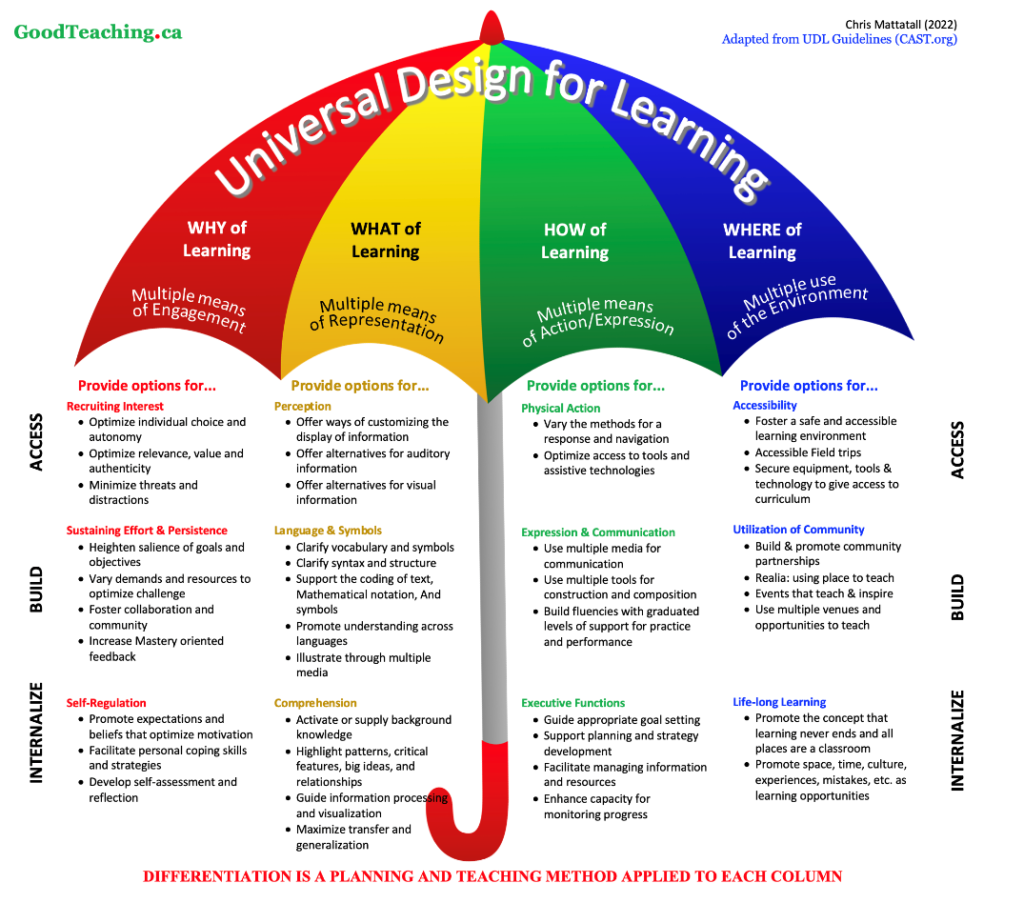
Since its first iteration in the 1990s, UDL has been extensively studied and applied in the post-secondary environment as a mechanism for improving accessibility, student engagement, and student success. This rich history of implementation and research has led to the UDL framework maturing from a set of principles into “a set of guidelines that can be used to design instructional experiences that reduce barriers in the curriculum and integrate flexible and engaging pedagogical supports from the outset” (Smith, Rao, Lowrey, Gardner, Moore, Coy, Marino, & Wojcik, 2019).
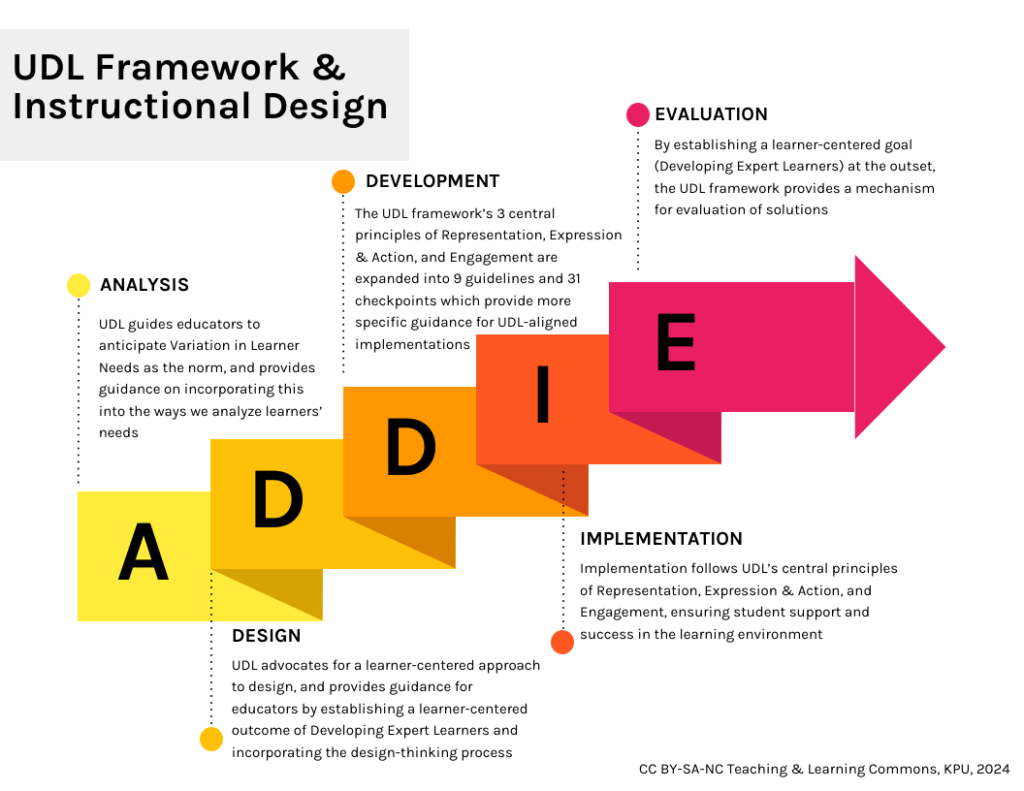
Universal Design for Learning (UDL) is now considered a comprehensive instructional design framework that provides guidance for both the design and delivery of learning experiences. An effective instructional design framework needs to provide guidance for all major phases of the process, from analysis to design, implementation and evaluation.
What’s next?
Why Universal Design for Learning in Higher Education?
According to the Canadian Disability Inclusion Plan (2022), more than 22% of Canadians identify as having a disability. However, it is important to note that disabilities are not exclusively physical, and many students experience impacts to their learning as a result of less apparent or invisible challenges such as learning exceptionalities, mental health needs, language, and cultural differences, and even gaps in their elementary and secondary education. In post-secondary education, students may experience one or a combination of different challenges that impact their ability to learn and even engage within learning environments.
For faculty, supporting all students is an important responsibility, though can often be seen as a challenging one due to increasingly diverse student populations. Instructors often need to respond to a wide range of student needs and accommodations that can require revising or adapting lessons, assessments, and materials to be more accessible.
You may have heard of efforts in this area being referred to as “JEDI,” or Justice, Equity, Diversity, and Inclusion. These four principles go hand-in-hand with UDL and support the idea that all learners should be able to engage, learn, and succeed – and that this is something that must be done authentically and intentionally.
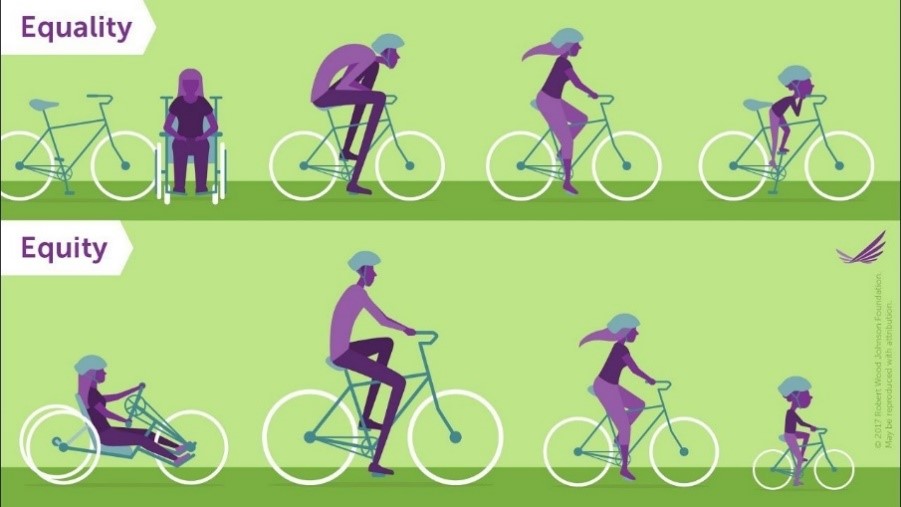
Take, for instance, the above graphic: equality states that everyone receives the same and equal treatment, regardless of if it is helpful/ useful for them. With equity, everyone receives support if they need it, and the support is specific to them so that they can participate and be included.
For a video overview of this concept, please watch Robert Wood Johnson Foundation’s “Equity vs. Equality”
Universal Design for Learning (UDL) offers a solution to this challenge of supporting the diverse needs of all students. UDL provides a framework for user-centered course design and delivery with the goal of inclusion of all learners. By focusing on breaking down barriers to learning through the design and delivery of inclusive educational and instructional activities and materials, learners are supported to meet their goals and, on their way, to becoming expert learners.
What’s next?
Why UDL? The Values and Value Proposition of UDL
The topics in this section are each accompanied by short reflection activities. These activities are optional, but we invite you to take a few moments after each topic to engage in reflective practice and learning.
Jaggedness in Learner Needs
Universal Design for Learning (UDL) traces its origins to the Universal Design movement, which focuses on making physical spaces accessible and usable for all people, regardless of their abilities or disabilities. In physical spaces, barriers to access are generally tangible and physical, making them easier to observe.
But in the learning environment, many barriers to access can arise from limitations in areas that are difficult to observe but can significantly impact a student’s ability to engage and succeed in educational settings (see list below).
Information Processing
Variability in how students process and understand information
Language Processing
Challenges related to understanding and using language
Introversion & Extroversion
Different social interaction needs and preferences
Financial Resources
Economic constraints affecting access to learning resources
Post-Secondary Readiness
Challenges related to understanding and using language
Self-Advocacy
Differences in ability to communicate needs and seek support
Spatial Ability
Variability in understanding and interpreting spatial information
Reading Speed
Diverse rates at which students can effectively read and comprehend texts
Mathematical Calculations
Differences in mathematical understanding and skills
Figure 4 Takacs, S., Zhang, J., Lee, H., Truong, L., & Smulders, D. (2022). A comprehensive guide to applying universal design for learning. Justice Institute of British Columbia. https://pressbooks.bccampus.ca/jibcudl/
Understanding and addressing these invisible challenges is a fundamental value of UDL. Which is where the concept of “Jaggedness” comes into play. Jaggedness (Rose, 2016) refers to the variation in knowledge, learning, skills, interests, and abilities in all learners. It is an acknowledgment that no two learners are the same; that each student’s abilities, strengths, and stretches are unique and may vary significantly across different dimensions. For instance, a student might excel in verbal communication but struggle with written tasks. Another might have strong analytical skills but find social interactions in group settings challenging.
This variability can become even more complex when students face deficits in multiple dimensions. A student might simultaneously deal with slow information processing, language barriers, and limited financial resources, each compounding the impact on their learning experience. Such students might appear disengaged or unprepared, not because they lack interest or effort, but because of the compounded effect of these invisible barriers. For example, a student with both language processing issues and introversion might find it doubly hard to participate in class discussions. A student grappling with financial constraints may also be managing time-intensive responsibilities outside of school, affecting their ability to engage in synchronous learning sessions or group projects. Similarly, a student with a slower reading speed due to a learning disability might also experience anxiety in timed assessments, further impacting their performance.
As educators, acknowledging Jaggedness is a crucial first step in UDL for moving towards a nuanced and empathetic understanding of student diversity, designing inclusive learning experiences, and becoming more responsive to student needs.
Here is a video by Todd Rose from CAST on “Variability Matters” that further explores Jaggedness in learning and the variability of learners (what is an “average” learner):
Reflection Point
Take a moment to reflect on the Jaggedness in your context. Which domains might your students have existing limitations in? Are there elements of your learning experiences that could disadvantage students with limitations in one or more domains?
What’s next?
Teaching to The Margins

A common phenomenon when designing and delivering learning experiences is that we draw on our own experiences as educators and learners to anticipate the challenges and barriers our students might be facing. This can lead us to focus on students who are vocal about their needs, whose challenges are easily observable to us, or whose challenges mirror ones we’ve faced before; the proverb, “the squeaky wheel gets the grease” comes to mind. Unfortunately, and [hopefully] inadvertently, we can fail to account for student needs that are unvoiced, unobserved, or not experienced by us directly. Which is why a central tenet of Universal Design for Learning (UDL) is “Teaching to the Margins.”
Here is a short video from Dr. Shelley Moore on “Transforming Inclusive Education” which may help you to better conceptualize “Teaching to the Margins”:
Teaching to the Margins prompts us, as educators, to look beyond our direct experiences and intentionally cater to the broadest possible spectrum of student needs, particularly those that are less obvious or easily overlooked. This helps shift the focus towards students who would typically fall in the periphery and can ensure that the learning experiences we design can accommodate a greater range of learner variability and be more inclusive.
As an approach, Teaching to the Margins is not only beneficial for students facing greater barriers to learning, but also enhances the overall learning experience for the entire class. For example, offering options to submit an assessment in multiple formats (for e.g., as a presentation, a written report, or a video) creates options that cater to varying levels of information processing, reading speed, and introversion/extraversion, but also gives students an opportunity to demonstrate creativity and engagement in how they prepare their submissions.
For Faculty, Teaching to the Margins, in the context of UDL, offers the dual benefit of making it easier to design inclusive learning experiences while making those same learning experiences more engaging and effective for all learners.
Here is a short video from CAST, “UDL on Campus: At the Margins”
Reflection Point
After reviewing this first section of the resource, reflect on what UDL means to you as an individual, an instructor, an educator, etc. Consider how you might currently engage in UDL practices and what areas you might want to further develop. Develop a short positionality statement (about 1-3 sentences) on your current understanding and practice of UDL.
What’s next?
UDL Interactions & Considerations
Universal Design for Learning (UDL) is, as the name suggests, is about designing learning for all. It encourages us to provide various ways for students to get involved, understand, and show what they know. In understanding the diverse backgrounds and learning needs of students, we’ve put together a UDL guide to help instructors design and develop their course and instructional materials.
As such, this guide not only provides support and resources on UDL but includes other areas that intersect with and contribute towards designing for inclusive learning environments. For example, the following section discusses UDL and accessibility. However, we are also aware and committed to the importance of decolonization and Indigenization in education. This guide incorporates decolonizing and Indigenization practices throughout the various sections, exploring how UDL can help break down old colonial barriers and value Indigenous ways of knowing.
Intentionally and authentically weaving Indigenous perspective and ways of knowing supports Indigenization and is a decolonial practice. That being said, we have also included a specific section on UDL & Decolonization and Indigenization to provide instructors a chance to explore these crucial areas more closely, helping them to better understand and engage in making education fairer and more responsive to all students.
UDL and Accessibility
In considering how we can design accessible, inclusive learning environments, it’s essential to understand the complementary roles and approaches of Universal Design for Learning (UDL) and Accessibility services. Together, the two approaches amplify each other’s impact, but they operate distinctively and serve different purposes in the learning environment.
Here is a brief video addressing the overlap of “Accessibility and UDL” by CAST’s UDL on Campus:
Accessibility services generally responds reactively to individual needs, especially when accommodations need to be provided for multiple, possible overlapping, physical and/or sensory disabilities. For example, wheelchair-accessible desks are crucial for students with mobility challenges, while screen readers and Braille signs aid those with visual impairments. Such accommodations often involve physical tools and resources that need to be procured and provided on a case-by-case basis.
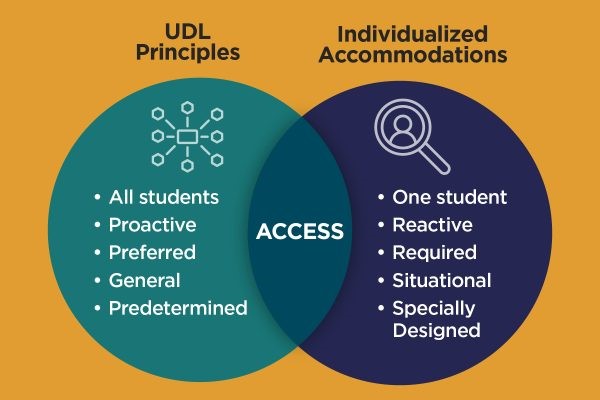
In contrast, UDL tends to adopt a more proactive approach, designing educational experiences to be inclusive from the outset. In acknowledging jaggedness, UDL aims to address more the more invisible, harder to observe barriers before they can impact learning. For example, strategies like providing course materials as videos and text to have the information available in multiple formats and providing explicit learning outcomes in plain, accessible language for courses and assessments assists learners with linguistic and cultural barriers as well as learners with difficulties in information and language processing.
To illustrate the differences in solutions between these two approaches, consider the following table, which contains a non-exhaustive list of solutions in Accessibility and Universal Design for Learning (UDL).
| Accessibility (Reactive) | Universal Design in Learning (Proactive) |
| Wheelchair Accessible Desks | Explicit Learning Outcomes |
| Accessible Documents | Student and Instructor feedback |
| Door Opening Buttons | Building Relationships |
| Ramps | Assessing Engagement |
| Closed Captioning | Self and Peer Assessment |
| Screen Readers | Guiding Goal Setting |
| Text to Speech Software | Providing Choice |
| Braille on Signs | Student-Designed Rubrics |
| Represent Information in Multiple Ways |
While UDL and Accessibility take diverging approaches in how they support students, it’s important to consider how this divergence enables the approaches to complement and support one another in creating inclusive learning environments. Consider the pyramid below, which situates UDL and Accessibility based on the levels and types of support they provide for students.
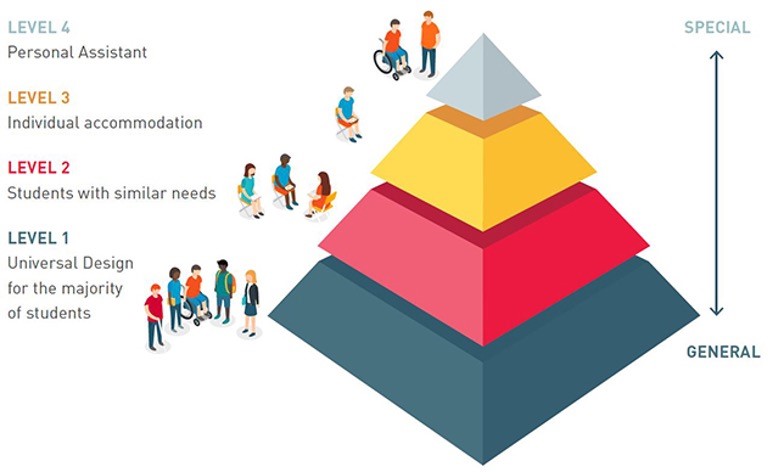
Within this paradigm, UDL and Accessibility both play an important role in creating inclusive learning experiences and environments, and the differing approaches complement one another in achieving a shared goal. Within the pyramid, UDL provides a foundational level of support (Level 1) by designing educational experiences that can address a broad spectrum of learning needs, including some situations where larger groups of students have similar needs (Level 2). But as student needs become more individualized, severe, or involve complex, co-occurring physical and sensory disabilities (Levels 2-4), Accessibility services are better placed to provide the support and accommodations needed.
For instructors, the interplay of UDL and Accessibility creates important opportunities for creating inclusive learning environments. By embedding UDL principles, instructors can create learning environments that are accessible to all, but also one that normalizes seeking accessibility services when an accommodation is required – enabling students to access accommodations independently with minimal assistance. It also lets instructors’ model professional and respectful workplace norms through the learning environment, which can be an invaluable way to help students learn and model these practices.
Reflection Point
What are some ways you could make it easier for students to independently access support services like Accessibility and Accommodations?
Universal Design (UD) Frameworks and Instructional Design
Within the overarching framework of Universal Design (UD), there are “four separate UD conceptual frameworks that have been applied in education” (Liu, Thurlow, Quanbeck, Bowman, & Riegelman, 2024). This guide primarily focuses on Universal Design for Learning (UDL), but two of the other conceptual frameworks that apply are: Universal Instructional Design (UID) and Universal Design for Instruction (UDI). Universal Instructional Design focuses on the design of course instructional materials and learning activities to meet the diverse needs of all learners, though in particular those with disabilities (Higbee & Goff, 2008). On the other hand, Universal Design for Instruction is more encompassing and focuses on applying the principles of UD to all of instruction, including accessibility for all with course modality and materials as well as considerations for the variability of learner’s experiences and personal demographics like sexual orientation, culture, and age (Scott, McGuire, & Shaw, 2003). To learn more about each of these two UD frameworks, click on the buttons below:
Universal Instructional Design (UID) Principles
There are eight principles for Universal Instructional Design (UID). Though these principles may perhaps seen as more common sense, these are foundational tenets of effective education that supports inclusive student-learning.
| 1. Create a welcoming classroom | 5. Explore the use of natural supports for learning, including technology, to enhance opportunities for all learners |
| 2. Determine the essential components of a course | 6. Design teaching methods that consider diverse learning styles, abilities, ways of knowing, and previous experience and background knowledge |
| 3. Communicate clear expectations | 7. Create multiple ways for students to demonstrate their knowledge |
| 4. Provide constructive feedback | 8. Promote interaction among and between faculty and students |
These eight principles are well-aligned with UDL as the focus and emphasis is on creating a supportive and inclusive learning environment through varied design in instructional style and methods and course materials and activities.
Universal Design for Instruction (UDI) Principles
There are nine principles of Universal Design for Instruction (UDI). These were developed after a review of the principles of Universal Design (UD), guidelines for inclusive K-12 education and college-level instruction.
| 1. Equitable use | 6. Low physical effort |
| 2. Flexibility in use | 7. Size and space for approach and use |
| 3. Simple and intuitive | 8. A community of learners |
| 4. Perceptive information | 9. Instructional climate |
| 5. Tolerance for error |
These nine principles are well-aligned with UDL as the focus and emphasis is on implementing inclusive and accessible instructional strategies and methods to supports the needs of diverse learners in higher education.
ADDIE Instructional Design Model
The instructional design model ADDIE, paired with Universal Design for Learning (UDL) principles, gives instructors a practical way to design and develop their course and instructional materials to meet the varied needs of all learners. It’s a step-by-step approach that helps ensure every part of the learning experience—from lectures to labs and tests—is created with every student in mind. By weaving UDL’s focus on accessibility and inclusion into each stage of ADDIE, instructors can build a learning environment where everyone can learn in their own way and feel a sense of belonging. This approach isn’t just about checking boxes; it’s about recognizing and embracing the richness that each student brings to the table, making education more effective and meaningful for all.
Here is an example of where the core components of the UDL framework are aligned with instructional design (using the ADDIE model):
Reflection Point
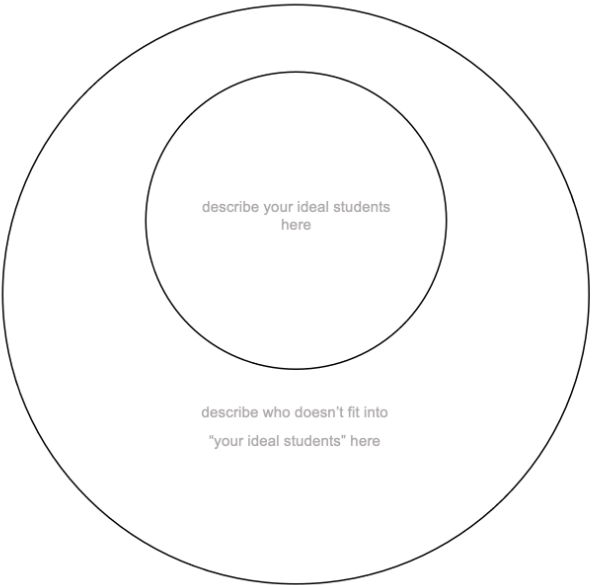
Based on Section 1.4: Your Ideal Students, from BCcampus’ “A Comprehensive Guide to Applying Universal Design for Learning,” take a moment to reflect on and describe the characteristics of the learners in your context. Do these characteristics fully reflect the diversity of students in your context? What are some ways you might begin to identify and learn about the student needs at the margins in your context? Please use the below graphic, adopted from, A Comprehensive Guide to Applying Universal Design for Learning by Dr. Seanna Takacs; Junsong Zhang; Helen Lee; Lynn Truong; and David Smulders