
Plastics are the workhorse material of the modern economy – with unbeaten properties. However they are also the ultimate single-use material. Growing volumes of end-of-use plastics are generating costs and destroying value to the industry. After-use plastics could – with circular economy thinking – be turned into valuable feedstock. Our research confirms that applying those circular principles could spark a major wave of innovation with benefits for the entire supply chain.
Ellen MacArthur Foundation
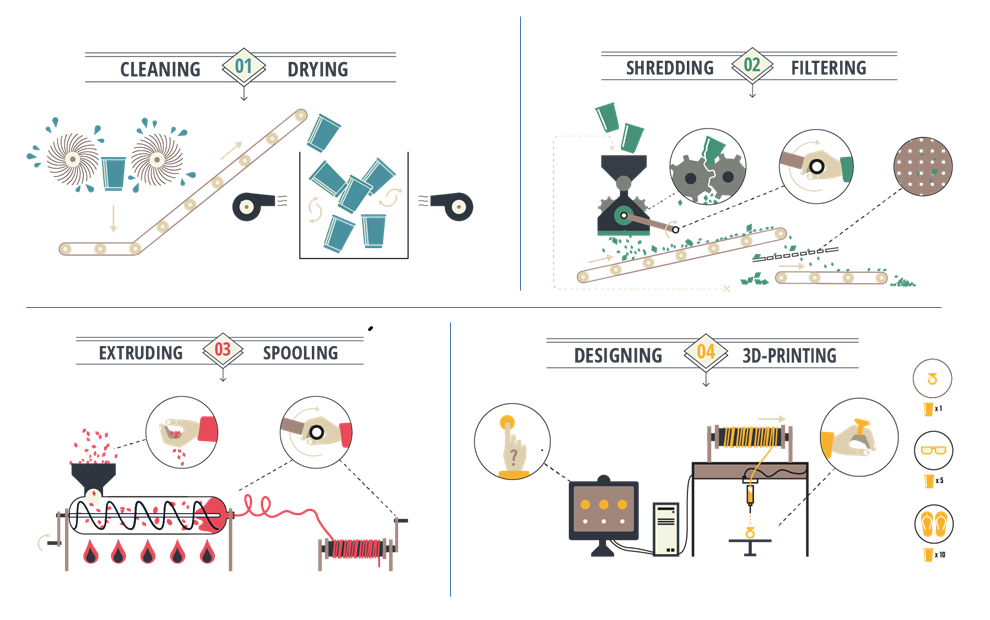
This Action Plan includes connecting with local 3D printer owners, collecting their scrap 3D printing filament, cleaning and sorting it, shredding it, re-melting it to produce more filament to 3D print with, and getting the new spool of filament back to someone who can use it. These steps are shown below in an early storyboard.

Zukowsky, 2020
Canada recycles less than 10 percent of its disposable plastics, and is on track to throw away $11 billion worth of disposable plastic by 2030 unless things change.
Justin Trudeau
bramhallo, 2015
Attempting to recycle different types of plastic to 3D print with will be a challenge, although the most impactful plan in its full potential. A plethora of variables exist such as where the plastic came from, how old it is, the purity of it, what contaminants it has come in contact with, just name a few.
Benefits:
– A small step in trying to reduce the amount of plastic in the world
– Experimenting with different types of plastic extrusion
– Filabot’s machine is capable of achieving this (more information on Filabot on my blog post here)
– More possible options of plastics that can be recycled and reused
Downsides:
– Unknown plastic origin, type, age, and degree of degradation
– Potentially unknown substance (i.e. food) contaminating the plastic
– Very complicated process as each plastic is different
– Potentially damaging the extruding machine due to improperly cleaned plastic
– Not enough output of a certain type of plastic to be able to 3D print with
– Increased chance of COVID-19 transmission compared to strictly collection PLA (preventable)
– Some plastics release harmful off-gasses
– Unidentifiable plastic
In summary, this path is significantly more complicated than recycling strictly PLA as there are a number of variables that may result in hiccups along the way, although still feasible. The options are more extensive compared to Plan #1, which only involves recycling PLA from 3D printing, leading to more potential impact. To fit the project scope, it may have to be limited to two or three plastic types in order to ensure the project’s success within the resources/time frame available. There could be potential for exploration after this project to look into accepting multiple types of plastic to convert it into 3D printable material.
My Two Sent.’s: One individual that participated and mentioned that PLA may be the most widely used and cheapest 3D printing material on the market currently, but that it may not be in the future, also stating that they would use whatever material best suited their 3D printing needs. This was a very insightful comment that made me reconsider the impact of basing the system from just PLA to multiple materials.
MacArthur, (Dame) E., Waughray, D., & Stuchtey, M. R. (n.d.). The New Plastics Economy: Rethinking the future of plastics. World Economic Forum. Retrieved from https://www.ellenmacarthurfoundation.org/publications/the-new-plastics-economy-rethinking-the-future-of-plastics
Parker, L. (June, 2019). Canada aims to ban single-use plastics by 2021. National Geographic. Retrieved from https://www.nationalgeographic.com/environment/2019/06/canada-single-use-plastics-ban-2021/
Bramhallo. (July, 2015). Recycling Process PPP [PNG]. https://www.3dhubs.com/talk/t/which-shredding-and-extruding-machines-are-available-part-3/2008
Zukowsky, B. (September, 2020). Re-PLAy Vancouver Storyboard [JPG]. Richmond, BC. https://wordpress.kpu.ca/birkzukowsky/project-scope/