Article Review: Ventilation control for airborne transmission of human exhaled bio-aerosols in buildings – Journal of Thoracic Diseases
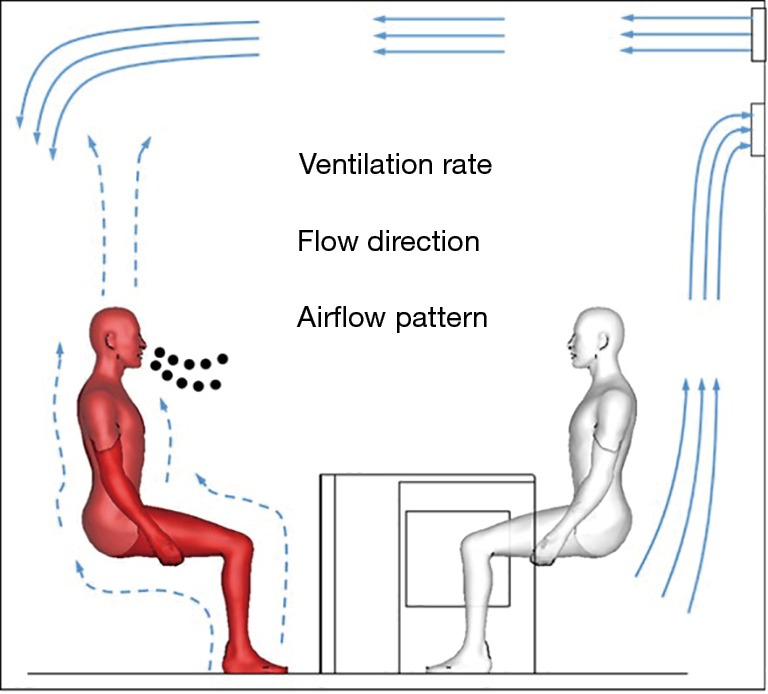
Introduction
- Airborne transmission mostly in indoor environments, where ppl spend 90% of time
- Growing urbanization, overcrowding in large cities, growing transportation networks spread faster
- SARS outbreak 2003, hong kong hospital hit hard most likely due to insufficient ventilation system in ward 8A
- Increasing ventilation rates in classrooms, offices, homes effective strategy in controlling airborne diseases
- “Ventilation is defined as the supply/distribution or removal of air from space by mechanical or natural means”
- Supply outdoor air, remove excess heat, humidity and contaminants
- Goal: pathogen-free fresh air
- Air flow controlled from ‘clean zones’ to ‘dirty zones’
The mechanism of airborne infection
- Path of airborne transmission via droplet nuclei
- Sneezing, coughing, speaking, singing, breathing
- 40k – 2mil droplets from a sneeze
- ~100000 from cough
- ~3000 loud speaking
- “Droplet spread refers to the passage of pathogens from a source to a susceptible through large droplets.”
- “Airborne transmission refers to the passage of pathogens from a source to susceptible through airborne aerosols”
- Droplet nuclei (residues of dried out droplets)
- Risk of short-range airborne infections > risk of long-range airborne infections
The impact of ventilation rate
- Higher ventilation rates also increases energy costs, NEED FOR balance between decreasing cross infection risk and energy consumption
- Minimum ventilation rate in isolation rooms is 12 air change per hour (ACH)
- 6 ACH in CDC guidelines, doubled after SARS, only 1 ACH in commercial buildings
- Wells-Riley equation to predict risk of airborne infection
- Natural ventilation large ventilation rates w/low energy consumption, larger ventilation rates than mechanical ventilation
- Proven that increasing ventilation rate reduces risk of cross infection for long-range airborne infections
- Effect of ventilation for droplet-borne transmitted diseases less known
The impact of flow direction
- Directional flow achieved through pressure differences
- Isolation rooms use positive pressure to keep the surrounding contaminated air out
- AII rooms use negative pressure to prevent droplet nuclei from infected patients from exiting the room (negative pressure only maintained by keeping windows and doors closed)
- Field studies: 50% of tested isolation rooms failed to provide negative pressure
- Caused by “inadequate reliability of pressure monitoring and controlling devices, strong diffuser flow directed at door, interaction with other exhaust ventilation systems and poor airtightness of the suspended false ceiling”
The impact of airflow pattern
- 3 types of common ventilation; mixing ventilation, downward ventilation, displacement ventilation
Source: Qian, H., & Zheng, X. (2018). Ventilation control for airborne transmission of human exhaled bio-aerosols in buildings. Journal of thoracic disease, 10(Suppl 19), S2295–S2304. https://doi.org/10.21037/jtd.2018.01.24
morganmunro September 19, 2020
Hi Camille, this is a very informative article and your notes are clear. I did not previously understand negative pressure ventilation, so thank you for that. It looks like the Well-Riley Equation will help you in your process as well as scenario simulations. There is airflow simulation software called Ansys Fluent that I have seen videos of. I hope this is helpful. Can’t wait to see what you learn next!