
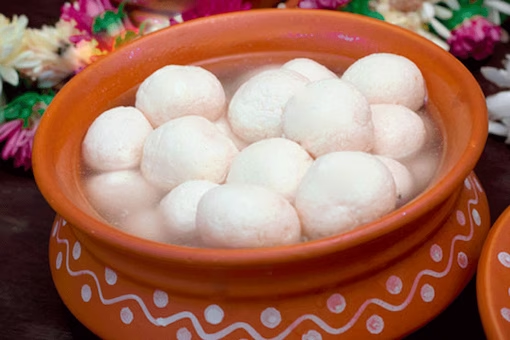
Tell me you have a sweet tooth without eating a Rasgulla. Well, at least in West Bengal, India there is nobody stopping you from eating this wonderful dish of sweet balls due to its availability across every other sweetshop.
The dish was started in 1868 by Nobin Chandra Das by processing a mixture of chena and semolina in boiling concoction of sugar syrup. It was claimed to be an original piece of recipe that was both delicious and easy to make. There is historical evidence that shows the reign of the dish in Puri as a 700 old sweet dish ritual. The goddess Lakshmi at Puri’s Jagannath Temple was offered the rasgulla as a primary offering to appease the lord. The dish has come to the limelight in recent years and has provided Odisha with a geographical indication tag showing its origin. There are different variants of rasgullas, in the form of chenna gaja, rajbhog, rasmalai, chenna poda and kamala bhog that are considered widely by desert lovers (Dairy, 2022). It has made the dish to be considered a dynamic one considering its minimal ingredients requirement and easy to make process to satisfy sweet cravings among the individuals.
The dish is considered to be associated with the Bengali food culture of India based on the claims made by the people of West Bengal regarding its invention. It is famous for the soft and luscious texture of the sweet balls that are served dipped in sugar syrup. According to folklore, it is said that the dish was invented by a priest by teaching the people to curdle the milk as the main process of making rasgulla. It was done because the individuals were throwing away excessive milk that made it necessary to come up with a dish to reduce its wastage. The state of West Bengal in India is quintessentially associated with the dish considering the recognition gained from Nobin Chandra Das (Pal, 2017). It has become a popular dish of the region considering its wide range of variants that has helped in serving the sweet needs of the consumers.
The dish is prepared by making small balls of curdled milk which are boiled in sugar syrup for some time. Usage of lemon or vinegar is done to curdle the milk and drain its excess water and moisture content to make them into small balls. It is then boiled into sugar syrup that may or may not be flavored using rosewater or saffron. Despite its origin to the Eastern region of India, the dish is widely sold across various parts of the nation. There are both sugar and jaggery variants of the dish that are available across various sweetshops of India to provide a wholesome food experience to food lovers. Usually, the dish is served as a dessert after eating the main course providing a sweet ending to the dining experience of consumers. It has made it a household name for any happy occasion and is consumed by millions of individuals across India.
Dairy, A. (2022). Origin of Rasgulla: Best Sweet of India. https://www.abisdairy.in/origin-of-rasgulla-best-sweet-of-india/ Pal, S. (2017). TBI Food Secrets: The Fascinating History of Rasgulla and the ‘Sweet’ Battle Over its Origin. https://www.thebetterindia.com/82618/history-rasgulla-origin-odisha-west-bengal/

