What Drives Timber Prices?
Before we can determine how much an acre of timber is worth, we first need to understand the law of supply and demand ultimately drives the price of timber. Demand is heavily influenced by location, surrounding mill types, proximity to those mills, and the volume and type of timber products consumed in a given area. The volume and types of products available on a tract of timber will therefore determine the value per acre.
pine logs fall into one of the following categories:
- Logs 5”-7” diameter at breast height (DBH) are considered “pulpwood”
- Logs 8”-11” DBH are considered “chip-n-saw” (CNS)
- Logs 12”+ DBH in diameter are considered “saw timber”
How Much Money is an Acre of Timber Worth?
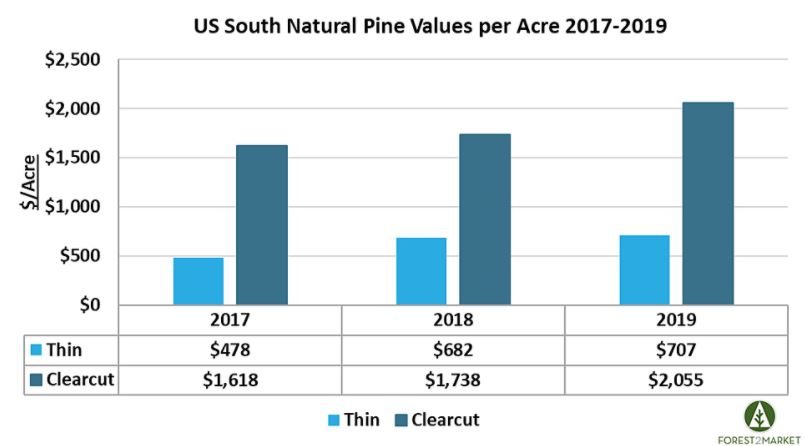
First thinnings of young timber brought lower prices from 2017-2019 due to the smaller trees that were removed; only pulpwood and smaller logs that fall into the chip-n-saw category are harvested at this time. However, second thinnings in the 21-25 age class typically remove more than just pulpwood, including larger chip-n-saw logs and smaller-diameter, saw timber.
Clearcuts, on the other hand, typically carry a higher price per acre due to the average size of the trees and the volumes of material removed. Most landowners prefer to clearcut their timberland when it is in the 26+ age class since a majority of the trees have reached the higher-value saw timber category.

"It is important to note a clearcut will remove all standing timber on a tract of land, which, even in the case of a managed forest in the 26+ age class, will include both pulpwood and chip-n-saw logs. This mixture of harvested timber products will ultimately affect the price per acre".
A couple of notable trends as well:
- Thinnings of CNS and small saw timber in the 16-25 age classes command a higher price per ton than pulpwood, but the price differential between the age classes is minimal. This is typically governed by the fact that thinnings in higher age class stands are less common and usually yield less volume per acre, which results in a lower price per acre.
- Thinning values per acre for CNS and small saw timber in the 16-25 age classes were up in 2018 but dropped markedly in 2019—a sign that the supply of these products outpaced demand in that year.
- Like thinnings, clearcut values per acre for timber in the higher-value age classes all decreased in 2019, also a sign that supply outstripped demand.
There are a couple of considerations to keep in mind when analyzing the natural pine data:
- Naturally regenerated stands of pine timber often have a higher density of trees than doing plantations. During thinnings on natural stands, more material is therefore typically removed, resulting in an increase in volume and price per acre.
- The clearcut price per acre on natural pine stands is slightly higher due to the presence of some hardwood saw timber that is harvested along with the pine during a clearcut, which carries a higher price than pine in the current market. Older timber stands also typically allow for larger trees, which can affect the total stand volume or the price per tree. The increased timber volumes combined with a mix of hardwood saw timber will result in a higher price per acre.
Demand for Pulpwood: Historical and Future
Historically, the pulp and paper industry has been the single largest consumer of both pine and hardwood pulpwood. The second-largest consumer of these forest products is the oriented strand board (OSB) industry.
Pine pulp wood demands
The pulp and paper industry consumes roughly 100 million tons of pine pulpwood every year. In the 1990s, OSB was introduced to the construction industry, and the pulp and paper industry had its first real competition for wood supply. Since then, OSB mills have been consuming approximately 20 million tons of pine pulpwood a year.

In the following figure, it shows very little demand from pellet manufacturers existed in pine pulpwood markets in 2008. In 2013, we expect that demand totaled 3.7 million tons, with the potential to approach the consumption levels of OSB mills—20 million tons—by 2020. This demand for pine pulpwood in the South will increase by 11 percent in the next five year period (2014-2018), driven by higher demand for packaging, containerboard, fluff pulp, OSB, and wood pellets.
Hardwood Pulpwood demand
Hardwood pulpwood consumption is significantly lower than pine pulpwood consumption, with the pulp and paper industry consuming 40 million tons, and the OSB and pellet industries combined consuming an additional 2 million tons. (Forest2Market cannot report these figures individually as a result of anti-trust guidelines.)
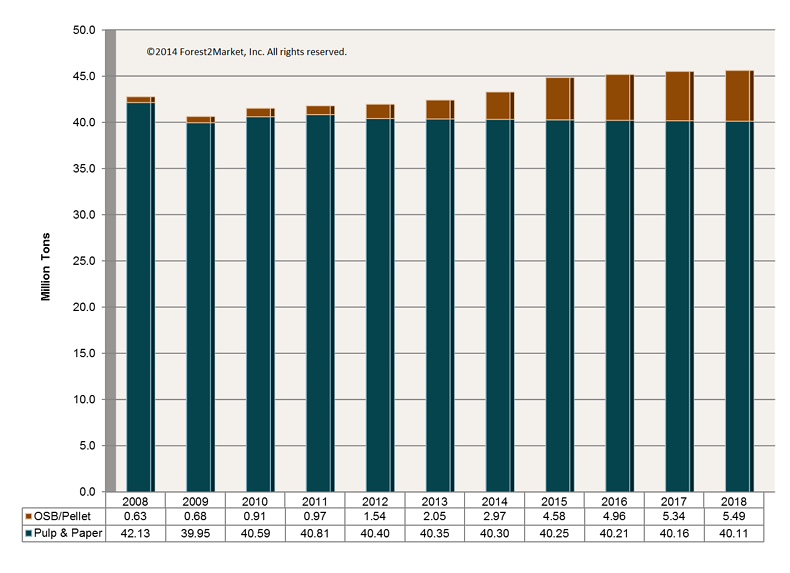
The following figure demonstrates that the demand for hardwood pulpwood will increase 5 percent in between (2014-2018).
Chip & Pulpwood prices trends (The US South and Pacific Northwest)
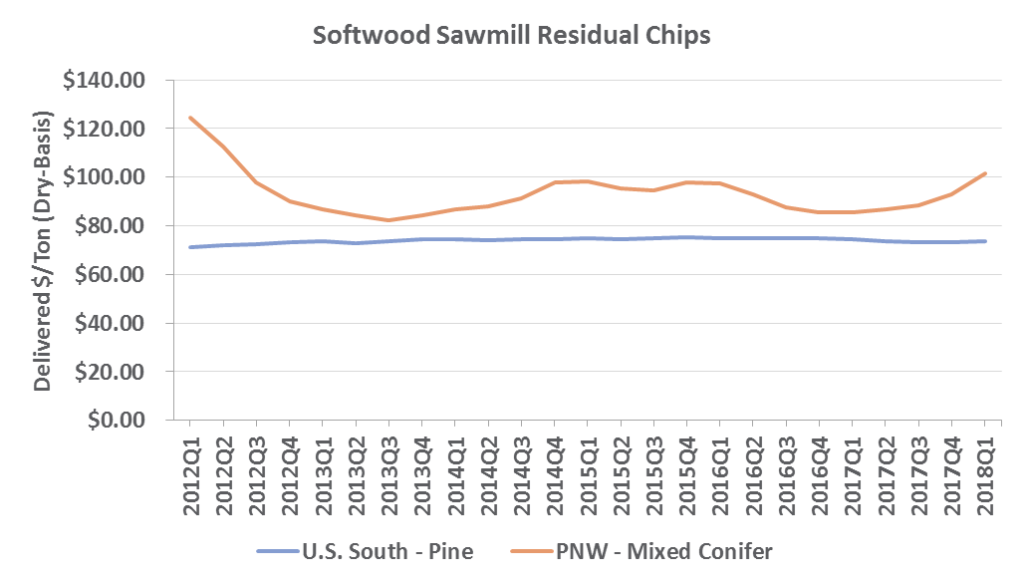
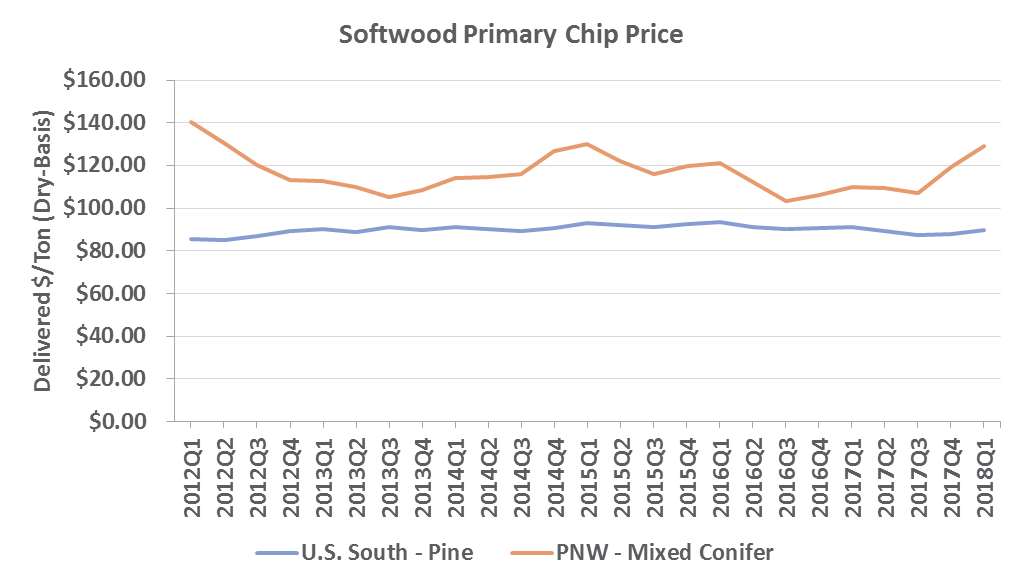
Softwood primary and sawmill residual chip costs remain markedly higher in the PNW than in the US South. Timber supplies are stressed in the region due to lack of management and harvesting on federal lands, increased domestic and export demand, and damaged/dying stands of timber caused by fire and pest destruction.
Actions for increasing residual chip prices
- The strong market for sawlogs and improvements in sawmill recovery has resulted in robust demand for smaller-diameter sawlogs (chip-n-saw) that would typically be delivered as pulpwood to chip mills. Some chip mills have struggled to maintain adequate pulpwood inventory to meet consuming mills’ needs, resulting in more demand for residual chips. Primary chip prices have increased as a result, as chip mills compete with sawmills for chip&saw logs.
- Recent increases in chip exports to overseas markets have put more pressure on domestic markets.
- Fiber shortages in BC have led to southern BC pulp mills increasing activity in the PNW market for chips and pulp logs.
- Recent chip consumption capacity announcements in the region will create additional competition for the existing chip supply.
Global Pulpwood and Pulp Markets
Wood raw-material costs fell for most pulp manufacturers throughout the world in Q2 2020, which reduced WRI’s two fiber price indices for the fifth consecutive quarter. The Hardwood Fiber Price Index (HFPI) dropped to its lowest level since 2004. The world’s two largest purchasers of wood chips, China and Japan, drastically reduced their chip importation in Q2 2020, as the COVID-19 epidemic took its toll on pulp and paper consumption in the two countries.
Prices for hardwood market pulp (HBSK) have remained practically unchanged during the COVID-19 epidemic, despite short-term increases in demand for tissue and other paper hygiene products. Prices for softwood pulp (NBSK) have inched up slightly this year from a three-year low in early 2020.
Sources
Kinney, S. ( January 7th, 2014). Demand for Pulpwood: Historical and Future. Forest2market. Retrieved from: https://www.forest2market.com/blog/demand-for-pulpwood-historical-and-future
Green, J. (July 5th, 2018). Chip & Pulpwood Price Trends in the US South & PNW. Forest to market. Retrieved from: https://www.forest2market.com/blog/chip-pulpwood-price-trends-in-the-us-south-pnw
Engle, J. (July 14th, 2020). How Much Money is an Acre of Timber Worth?. Forest2market. Retrieved from: https://www.forest2market.com/blog/how-much-money-is-an-acre-of-timber-worth
Wood Resources International LLC. (September 9th, 2020). Global pulp markets relatively stable in Q2 2020. Pulp and Paper Canada. Retrieved from: https://www.pulpandpapercanada.com/wrq-global-pulp-markets-relatively-stable-in-q2-2020/