
Described as a poet writing with a botanist’s knowledge, Robin Wall Kimmerer is an enrolled member of the Citizen Potawatomi Nation. She is an ecologist, distinguished professor, and award-winning author.
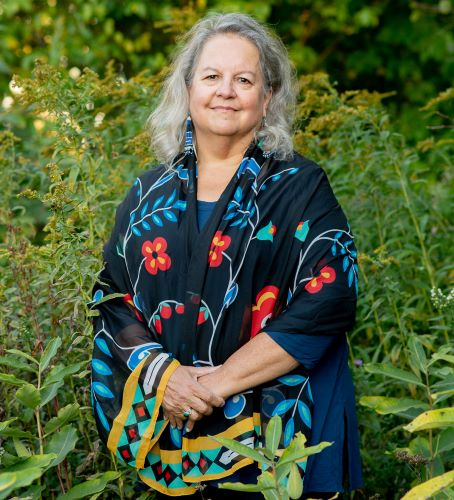
“Transformation is not accomplished by tentative wading at the edge.”
Kimmerer’s work holds deep resonance with Wild Spaces. She advocates for Indigenous science, place-based learning, and a re-wilding of language. In Braiding Sweetgrass she offers an invitation for reciprocity, for giving back to the land, and asks us “to imagine ourselves differently.” We have incorporated readings/videos from Kimmerer as course materials, and recited her guidelines for the Honourable Harvest during Wild Spaces events.
On this page you will find a webinar recording that Kimmerer did for Kwantlen Polytechnic University, a blog post on using her book Braiding Sweetgrass to teach in higher education, and a complete bibliography of her publications related to education, Indigenous science, plant medicine, and more.
Below is a blog post on teaching with Braiding Sweetgrass in university, with specific examples for biology, creative writing, geography, history, and sustainable agriculture.
“What would it be like, I wondered, to live with that heightened sensitivity to the lives given for ours? To consider the tree in the Kleenex, the algae in the toothpaste, the oaks in the floor, the grapes in the wine; to follow back the thread of everything and pay it respect?”
Bibliography
Books
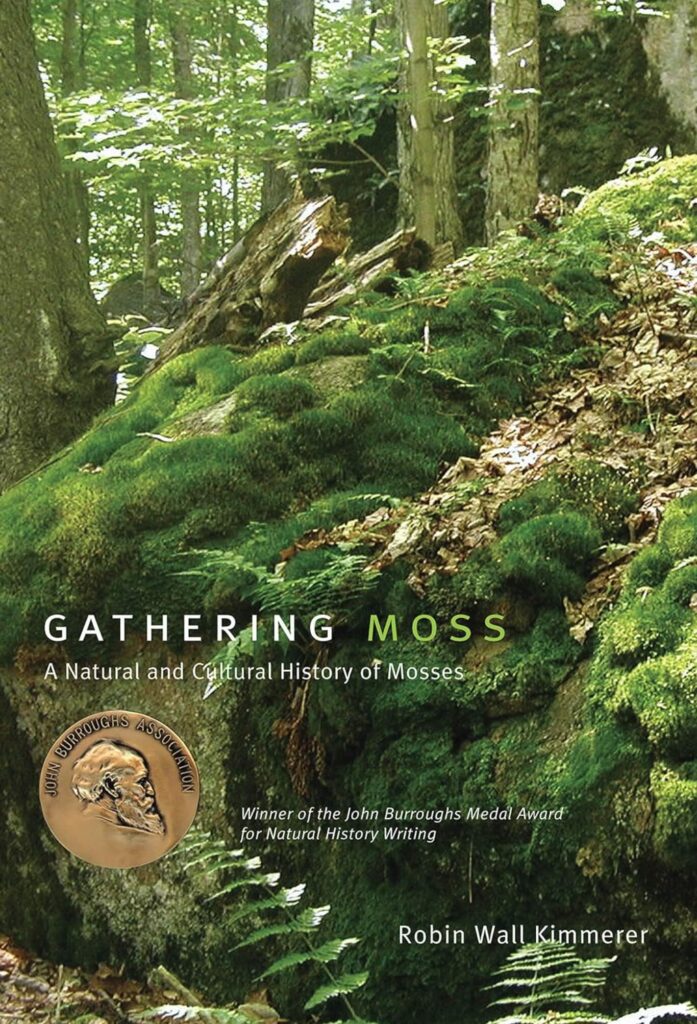
Kimmerer, R. W. (2003). Gathering moss: A natural and cultural history of mosses. Oregon State University Press.
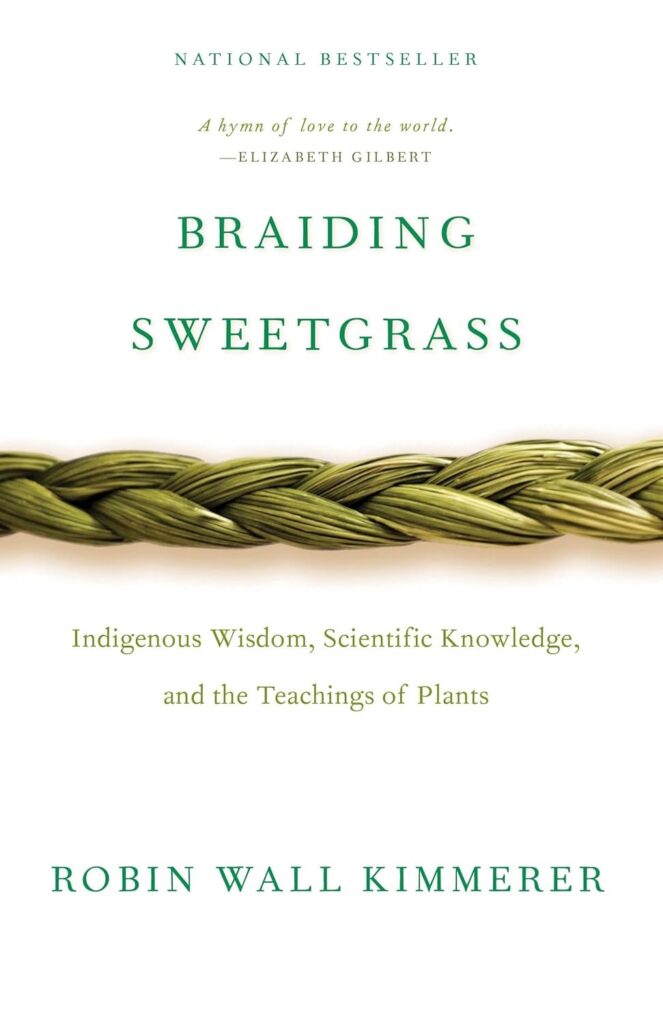
Kimmerer, R. W. (2013). Braiding sweetgrass: Indigenous wisdom, scientific knowledge, and the teachings of plants. Milkweed Editions.
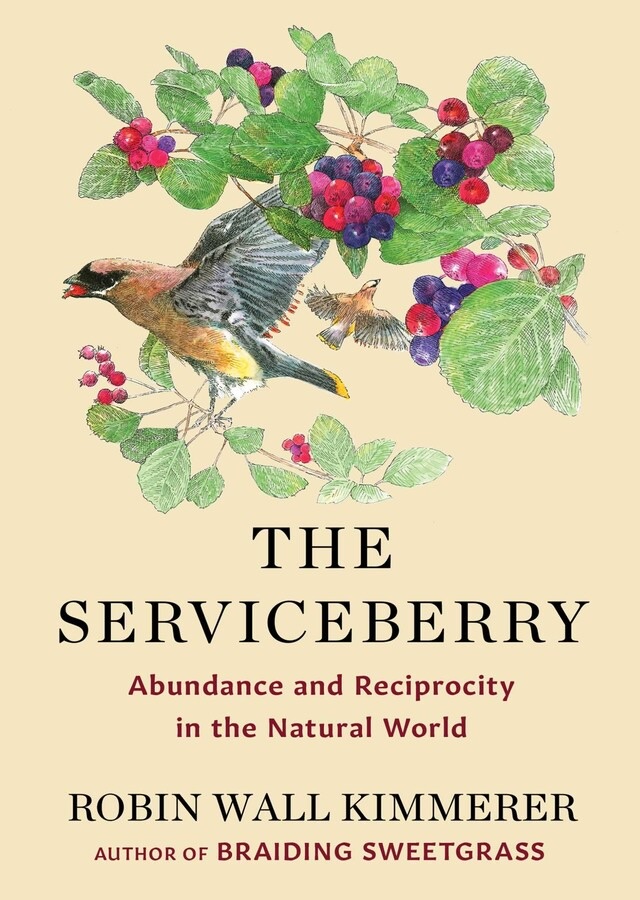
Kimmerer, R. W. (2024). The serviceberry: Abundance and reciprocity in the natural world. Scribner.
Articles
Fleischner, T., Espinoza, R., Gerrish, G., Greene, H., Kimmerer, R., Lacey, E., Pace, S., Parrish, J., Swain, H., Trombulak, S., Weisberg, S., Winkler, D., & Zander, L. (2017). Teaching biology in the field: Importance, challenges, and solutions. BioScience, 67(6), 558–567. https://doi.org/10.1093/biosci/bix036
Kimmerer, R. W., & Artelle, K. A. (2024). Time to support Indigenous science. Science, 383(6680), 243. https://doi-org.ezproxy.kpu.ca:2443/10.1126/science.ado0684
Kimmerer, R. W., & Lake, F. K. (2001). The role of Indigenous burning in land management. Journal of Forestry, 99(11), 36–41.
Kimmerer, R. W. (2000). Native knowledge for native ecosystems. Journal of Forestry, 98(8), 4–9. Available at KPU library here
Kimmerer, R. W. (2002). Weaving traditional ecological knowledge into biological education: A Call to action. Bioscene, 52(5), 432–438.
Kimmerer, R. W. (2012). Searching for synergy: Integrating traditional and scientific knowledge in environmental science education. Journal of Environmental Science, 2, 317–323. https://doi.org/10.1007/s13412-012-0091-y
Kimmerer, R. W. (2013). The fortress, the river and the garden. In A. Kulnieks, D. R. Longboat, & K. Young (Eds.), Contemporary studies in environmental and Indigenous pedagogies: A curricula of stories and place (pp. 49–76). SensePublishers. https://doi.org/10.1007/978-94-6209-293-8_4
Kimmerer, R. W. (2014). Returning the gift. Minding Nature, 7(2), 18–24. https://www.humansandnature.org/filebin/pdf/minding_nature/May2014_Returning_the_Gift.pdf
Kimmerer, R. W. (2015, March 30). Nature needs a new pronoun: To stop the age of extinction, let’s start by ditching “it”. YES! Magazine. https://www.yesmagazine.org/issue/together-earth/2015/03/30/alternative-grammar-a-new-language-of-kinship
Kimmerer, R. W. (2017, June 12). Speaking of nature: Finding language that affirms our kinship with the natural world. Orion. https://orionmagazine.org/article/speaking-of-nature
Van Horn, G., Kimmerer, R. W., & Hausdoerffer, J. (2021). Kinship is a verb. Orion: People and Nature. https://orionmagazine.org/article/kinship-is-a-verb/
Book Chapters
Grignon, J., & Kimmerer, R. W. (2017). Listening to the forest. In G. Van Horn and J. Hausdoerffer (Eds.), Wildness: Relations of people and place (pp. 67–74). The University of Chicago Press.
Kimmerer, R. W. (2016). Listening to water. In N. Brodie, C. Goodrich, & F. J. Swanson (Eds.), Forest under story: Creative inquiry in an old-growth forest (pp. 187–196). University of Washington Press.
Kimmerer, R. W. (2016). Interview with a watershed. In N. Brodie, C. Goodrich, & F. J. Swanson (Eds.), Forest under story: Creative inquiry in an old-growth forest (pp. 41–51). University of Washington Press.
Kimmerer, R. W. (2017). Heal-all. In T. L. Fleischner (Ed.), Nature love medicine: Essays on wildness and wellness (pp. 231–244). Torrey House Press.
Kimmerer, R. W. (2021). A family reunion near the end of the world. In G. V. Horn, R. W. Kimmerer & J. Hausdoerffer (Eds.), Kinship: Belonging in a world of relations, Vol. 1 – Planet (pp. 111–124). Center for Humans and Nature.
Kimmerer, R. W. (2021). White pine. In J. C. Ryan, P. Vieira, M. Gagliano, and Dennis McKenna (Eds.), The mind of plants: Narratives of vegetal intelligence (pp. 400–413). Synergetic Press.
Kimmerer, R. W. (2022). Chapter on earth justice. In R. Shetterly (Ed.), Portraits of Earth justice: Americans who tell the truth. New Village.
Kimmerer, R. W. (2023). Speaking of nature. In K. Holten (Ed.), The language of trees: A rewilding of literature and landscape (pp. 211–221). Tin House.
Kimmerer, R. W. (2024). Becoming earth: Experimental theology. In H. E. Burnett, K. L. Gansworth, N. Brown, & C. S. Perez (Eds.), Elements: Vol 1. earth (pp. 144–152). Humans and Nature. https://emergencemagazine.org/essay/becoming-earth
Note: Kimmerer has also published many scientific papers in her work in botany, which are not included in this list.
“Isn’t this the purpose of education, to learn the nature of your own gifts and how to use them for good in the world?”