

In this path, the collection of PLA for composting would still connect the local 3D printing community and dispose of scrap PLA responsibly. One of the downsides is that there is no reusable output product, as it would result in biomatter that can be used as fertilizer, which can easily be achieved from food waste with much less energy consumption. Below is a flowchart of the PLA composting process.

Cosate De Andrade, M. F., Souza, P. M. S., Cavalett, O., & Morales, A. R., 2016
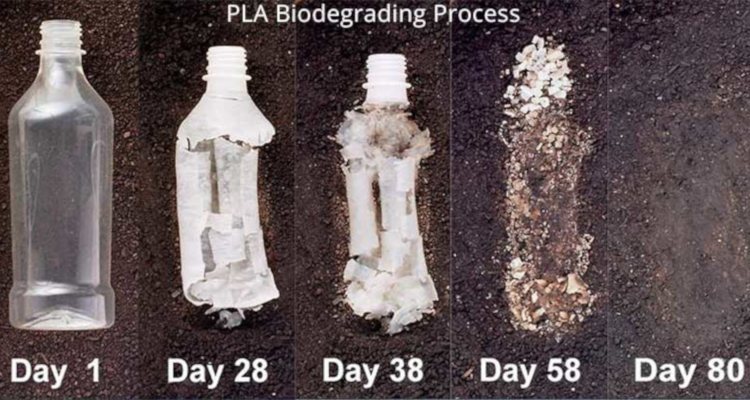
3dsourced, 2020
Above is a picture of the biodegradation of PLA over 80 days. The process of PLA biodegradation requires the material to be constantly heated and exposed to oxygen to break down, which not only results in massive amounts of energy consumption, but is also unachievable by a large majority of individuals in their personal compost bin/piles. In a study conducted on the Life Cycle Assessment of different PLA recycling methods, it was discovered that the total energy depletion in the composting process of 1kg took 42.20MJ (megajoules), as opposed to 3.29MJ from mechanical and 8.03MJ from chemical recycling (Cosate De Andrade, M. F., Souza, P. M. S., Cavalett, O., & Morales, A. R., 2016). To conceptualize, 42.20MJ is the amount of energy it takes to brew approximately 140 cups of coffee, while the total energy used to create and recycle PLA mechanically, 3.29MJ, is equivalent to brewing less than 12 cups of coffee (12 cups = 1 kilowatt-hour = 3.6MJ) (Arcadia).

Lauriello, 2019
If the individual recycling the PLA does not have the resources to commit to this, they will find it very difficult to find a facility that recycles PLA as “the material requires an industrial composting facility, of which there are only 113 in the U.S. Only about 25 percent of those facilities accept residential waste,” usually because of the oxygen required to execute it (Molitch-Hou, 2019).
Benefits:
– PLA doesn’t end up in the landfill or ocean
– Biomatter feeds microorganisms and created fertilizer
– Carbon neutral (releases the carbon that the plant used to grow)
– PLA does not release any harmful off-gasses
Downsides:
– Extremely limited options to recycle PLA in most cities, even then most of them only take industrial-sized amounts
– No second life for 3D printing the PLA
– The most energy dependant and exhausting method of dealing with PLA (more information on energy consumption of the different methods here)
To sum up, composting PLA is a good alternative to it ending up in the landfill or the world’s oceans, although there are many logistical issues including heavy energy consumption and a lack of proper recycling facilities, making it more difficult to execute. It may be a good alternative to any PLA that cannot be recycled into new filament for whatever reason.
My Two Sent.’s: After further research and insights from interviews, composting PLA is not the best route for this project to go, feasibility wise, for reasons due to the inability to access industrial composting facilities, to recreate the facility in a home environment, as well as the lack of breadth of materials that composting strictly PLA would involve. Compositing may be an option in the future, including the small amount of scraps that cannot be mechanically recycled, but for the current situation, it falls into the “infeasible” category.
Arcadia. (n.d.). How to visualize one kWh. Retrieved from https://www.arcadia.com/energy-101/energy-bills/how-to-visualize-one-kwh/
Cosate De Andrade, M. F., Souza, P. M. S., Cavalett, O., & Morales, A. R. (July, 2016). Life Cycle Assessment of Poly(Lactic Acid) (PLA): Comparison Between Chemical Recycling, Mechanical Recycling and Composting. Journal of Polymers and the Environment, 24(4), 372-384. https://doi.org/10.1007/s10924-016-0787-2
Molitch-Hou, M. (April, 2019). What They Don’t Tell You About 3D Printing PLA. Engineering.com. Retrieved from https://www.engineering.com/3DPrinting/3DPrintingArticles/ArticleID/18956/What-They-Dont-Tell-You-About-3D-Printing-PLA.aspx
3DSourced. (June, 2020). PLA Biodegrading Process [JPG]. https://3dsourced.com/guides/pla-vs-abs-filament/
Cosate De Andrade, M. F., Souza, P. M. S., Cavalett, O., & Morales, A. R. (July, 2016). PLA Composting Phases [JPG]. Journal of Polymers and the Environment. https://doi.org/10.1007/s10924-016-0787-2
Lauriello, S. (May, 2019). Continuous cups of coffee [JPG]. Health. https://www.health.com/syndication/conchata-ferrell-dies