Article Review: Design status of the advanced closed loop system ACLS for accommodation on the ISS – American Institute of Aeronautics and Astronautics
Intro:
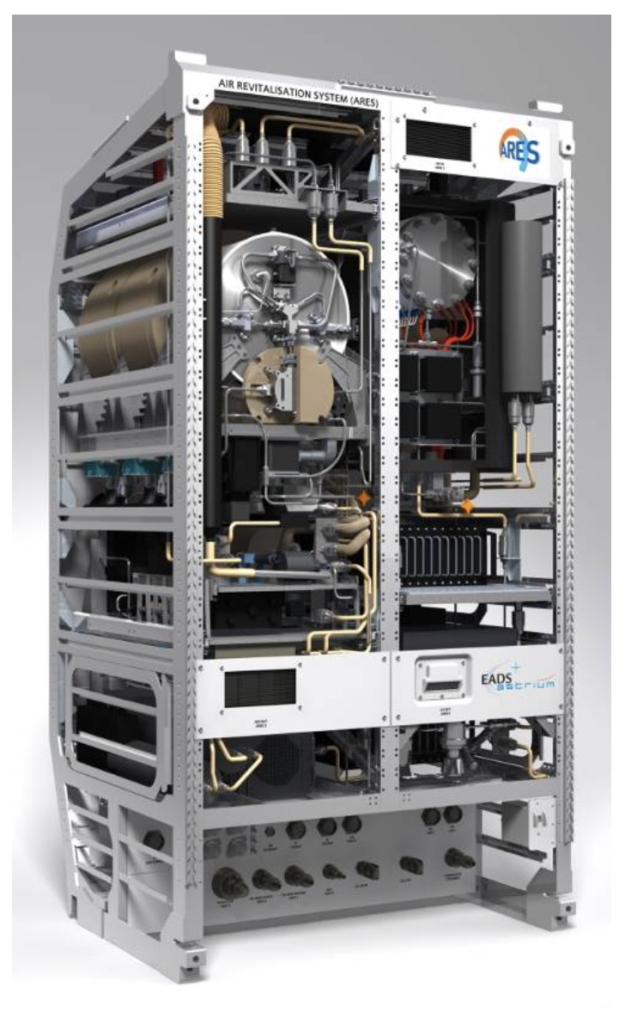
The Advanced Closed Loop System, or ACLS, is a regenerative life support system for use in closed environments which recycles CO2 into oxygen. This system significantly reduces the re-supply of oxygen necessary to the ISS. Closed-loop regenerative systems will be vital to the success of any future long-duration missions or manned missions to Mars.
ACLS has the ability to remove carbon dioxide from the spacecraft through adsorption and desorption processes, supply breathable oxygen through electrolysis of water, and carry out catalytic conversion of CO2 with hydrogen into water and methane.
Three main functions of ACLS:
- CO2 concentration subsystem (CCA) concentrates CO2 from the cabin, essentially controlling the amounts of CO2 to be acceptable
- CO2 reprocessing subsystem (CRA) converts carbon dioxide with hydrogen over a catalyst to produce water and methane
- oxygen generation subsystem (OGA) is an electrolysed that splits water into its elements, oxygen and hydrogen
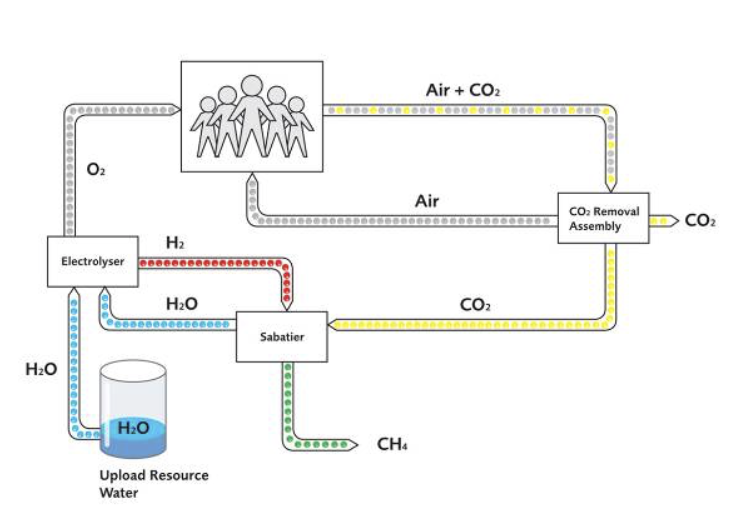
- Methane (CH4) is vented overboard
- 50% or water needed for oxygen production can be produced from exhaled CO2 from astronauts, remaining water supply from the ground
- ISS crew of 6 would need 2+ tons of water per year to produce enough oxygen
ACLS requirements:
- should remove minimum of 3kg/day of CO2 from cabin
- should generate minimum of 2.52 kg/day of O2 by electrolysis of water
- should generate minimum of 1.2 kg/day of liquid water from reaction of hydrogen and CO2
Notes:
- rest of article includes diagrams of different subsystems
- technical information and detailed design developments
Source: Bockstahler, K., Lucas, J., & Witt, J. (2012). Design Status of the Advanced Closed Loop System ACLS for Accommodation on the ISS. 42nd International Conference on Environmental Systems. doi:10.2514/6.2012-3403