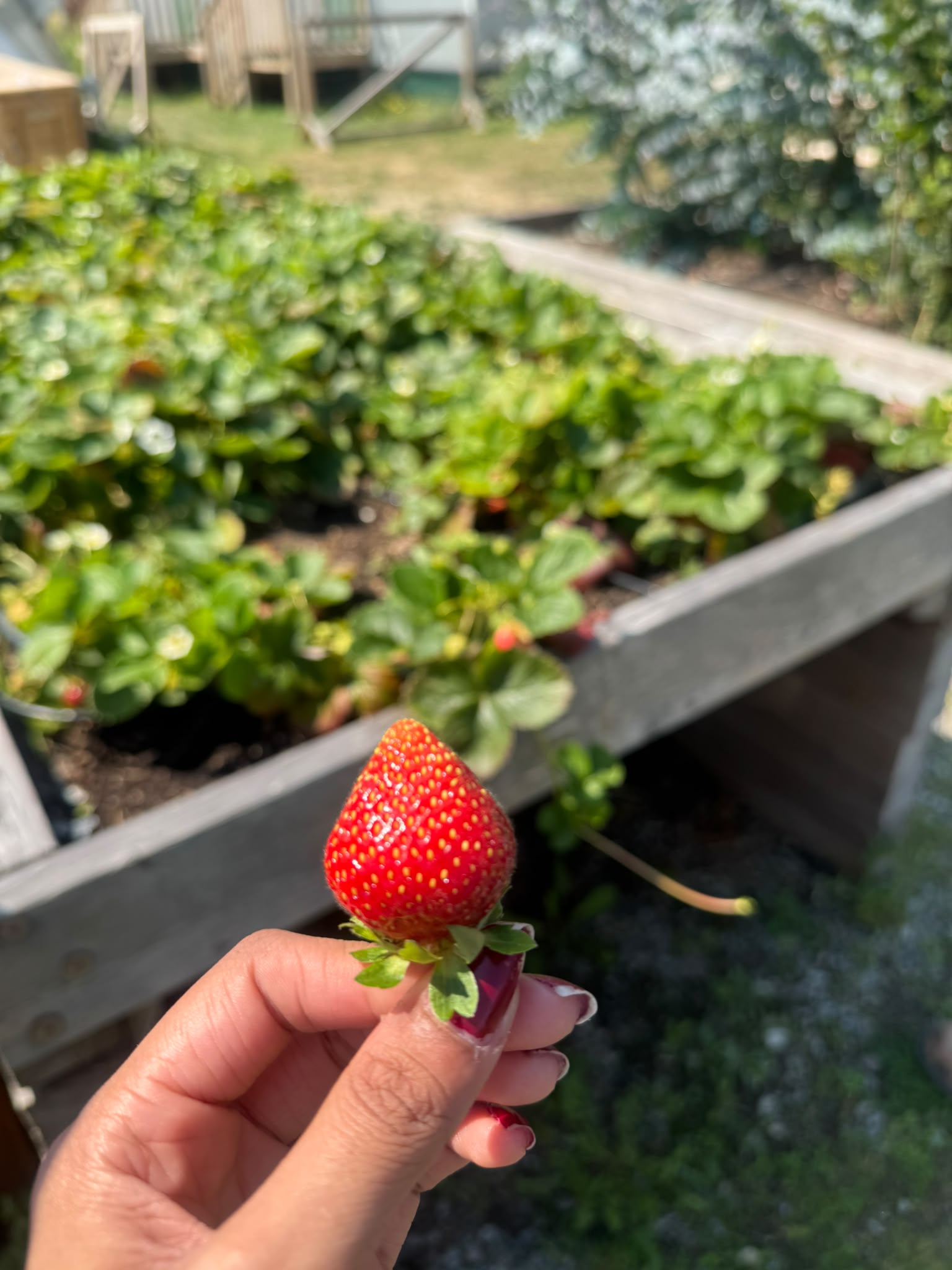
Before our Green Criminology field trip to the KPU Richmond Farm, I honestly didn’t know what to expect. I thought we would just walk around the farm and learn a little about how vegetables are grown. Instead, I left with a completely different perspective on farming, sustainability, and how they connect to Green Criminology.
My classmate and I were paired with Nathan, a Sustainable Agriculture student, who gave us a tour of the farm. We started in the market garden, where produce is grown to be sold. Nathan showed us different tools, like the half moon for removing weeds while standing up and the wire weeder used inside the high tunnels. It was interesting to see how much planning and care goes into growing food in a sustainable way.
One area that really stood out to me was the compost area behind the greenhouse. Nathan explained that weeds and produce affected by bugs aren’t simply thrown away, but they’re composted and returned to the soil. We also learned about the irrigation system, which slowly drips water directly into the soil to reduce waste. Seeing these small but thoughtful practices made me realize that sustainability is often built through everyday choices.
We also visited the learning garden, where volunteers and children come to learn about gardening. I liked seeing this part of the farm because it showed that it’s not just a place to grow food, but it’s also a place to teach people about sustainable agriculture and caring for the environment.
Before taking this course, I never would have connected a farm visit to criminology. However, this experience helped me understand that Green Criminology is about more than just environmental crimes. As Rob White explains in Critical Green Criminology, we should think about environmental harm and its effects on people, animals, and ecosystems, not just whether something is illegal. Walking around the farm, I could actually see these ideas in practice through composting, water conservation, and responsible farming methods.
I also thought about Food Crime and Green Criminology by Tourangeau and Fitzgerald, which explains that green criminology encourages us to look at food systems in terms of environmental and social harms, not only legal ones. The KPU farm showed me what a more responsible and sustainable food system can look like.
The trip also reminded me of a website I created for another KPU course called Restoring Food Sovereignty. While the website focuses on Indigenous food sovereignty, I found myself making connections between those ideas and what I saw at the farm. Both emphasize respecting the land and building sustainable food systems.
One thing I didn’t expect this class to do was make me think differently about my own life. My parents actually own a farm here, but I’ve always thought of it as somewhere we go during vacations. After visiting the KPU Richmond Farm, I realized there’s probably a lot I could learn by spending more time there. This field trip didn’t just change how I think about farming, it also made me appreciate it in a whole new way.
Sources
White, R. Critical Green Criminology. Course reading.
Tourangeau, W., & Fitzgerald, A. Food Crime and Green Criminology. Course reading.
Website referenced: Restoring Food Sovereignty. https://restoringfoodsovereignty.weebly.com/
Generative AI acknowledgment: I used ChatGPT to help organize and edit this blog post based on my own notes, reflections, and experiences from the KPU Richmond Farm field trip.

Hey! I really enjoyed reading about your learning while we were on the farm, it was a super educational experience. Though on the farm, my group member and I also learnt a lot from our sustainable agriculture student we didn’t learn about the composting aspect. I never realized or thought about how beneficial these weeds and other composted material can be. This is just one great example of how we as students and ordinary community members can benefit our garden and the environment at home, growing a compost pile has many great benefits within gardening and food production. This field trip also to me connected a lot with critical green criminology, as it strays away from idea that aspects of green criminololgy only fit within the definition of crime when they are illegal. Critical green criminology encourages us to expand our thinking of green criminology, to environmental harm, habitat destruction, and the abuse of environmental resources. Learning about Sustainable agriculture and the production of food, we learn a lot of important facts and practices to help or benefit and protect the environment at home. One thing I also find really great about gardening and sustainable agriculture, is how much it can help pollinator insects and birds. Our field trip to the farm also made me think about how many things feed into and rely on our ecosystem, and how human consumption has worked to damage the the foundations of ecological livelihood.
Resources
Montini, M. (2021). The environmental transformation of environmental law into ecological law. The law of the future series (pp.11-22) Routledge
White, R. (2017). Critical green criminology. Routledge international handbook of green criminology (pp. 120-131) Routledge
Hi JJ,
I really enjoyed reading your blog because it showed how a simple field trip can completely change the way we think about the environment. I liked how you reflected on the composting system and irrigation practices instead of describing what you saw. it reminded me that sustainability is often built through small, everyday actions that can have a meaningful impact over time.
Your point about Green Criminology being more than just illegal environment acts also stood out to me. It made me think about Goyes (2023) discussion of Southern Green Criminology, where he explains that environmental harm is often tied to unequal access to resources and the exploitation of ecosystems. While the KPU farm demonstrates sustainable practices on a local level, it also encourages us to think about how food systems can either protect or harm both people and the environment.
I also thought it was interesting that the visit changed how you see your own family’s farm. It shows learning doesn’t always happen in a class, sometimes it changes how we view places that always have been apart of our lives.
Source
Goyes, D. R. (2023). Southern green criminology: Fundamental concepts. In D. R. Goyes (Ed.), Green crime in the Global South. Springer.
*edited using grammerly