
When I began studying green criminology, I did not know there was such a thing as standing for the rights of nature, trees, or the environment. Since then, my vocabulary has expanded greatly, and the field trip to Cougar Creek Park, along with Deb Jones’s insights, helped me reflect on how we have failed as a society to protect our creeks and the nature that existed before human intervention.
Before we even began our walk with Deb, who is a volunteer with the Cougar Creek Streamkeepers, her presentation on the 3-3-300 rule was fascinating and highlighted the importance of being able to see at least 3 trees from our window, live in a neighbourhood with 30% canopy cover, and be within 300 meters of high-quality green space, which is extremely important for physical and mental health. As we kept walking towards the park, Deb showed how the landscape near our university has changed over the years and how nature’s ‘sponge’ has been reduced because the area is now covered with pathways and sidewalks, preventing water from soaking in. She also stopped multiple times to point to different people’s houses and show how they all had drain spouts emptying water from the houses roofs onto their lawns. This means rainwater from the roof can soak back into the Earth instead of being piped directly to the stream. This is important because as Deb said in her presentation, “the more we develop, the more rainwater we pipe away.” Think about all the rainwater we get living here in the Fraser Valley that we could use for activities at our homes, but it gets treated as “run off” from roofs and roads and parking lots, piped away to be dumped into streams without recharging groundwater aquifers or slowly seeping through the soil to recharge streams at nature’s pace. There is even one place right here at our KPU campus where we let the rainwater wash away, which we should be using to fill our rainwater barrels and ultimately watering cans rather than turning on a hose to water them. Honestly, after the field trip, if there was one thing that I learned, it was that we as a society have failed at maintaining clean drain areas and preserving our rainwater, and our government and system have undoubtedly failed us too, in the construction of an adequate system to help preserve and conserve stream banks. I remember Deb mentioning that almost every stormwater grate on the road connects to a stream, but not every stormwater grate is marked with a fish. That does not mean the particular creek does not have salmon and can be dumped with oil, grease, or garbage; it just means the city did not deploy enough people to get the job done.
This does not end here. Green criminology addresses environmental justice and protection, but the main question that comes to mind is: why is this protection of rights gendered, then? Why is it that we always see men taking control and thinking it is okay to cut trees, let animals suffer, and women are the ones speaking for their rights? Well, I do not know why, but what I most certainly know and what is also stated in Angeline Marie Letourneau’s article, “To Preserve and Promote: Gendering Harm in Green Cultural Criminology,” is that it’s because women do not have enough representation in positions or roles that allow us to make or amend laws for species or environmental justice. Moreover, most of the things that are causing harm to the environment are male-dominated, especially those big pickup trucks that contribute to rubber particle buildup, air pollution, and noise pollution, which you will always see men driving.
Lastly, I want to end this blog by noting that people like Deb are doing something great and meaningful, which has definitely left an impact on me and made me think: am I doing anything to harm the environment, or even to protect it? I was walking right next to her on the excursion when she stopped at one point and pulled out her camera to click a picture of what was once the creek, which was going to be the focal point of the walk but dried, dried completely.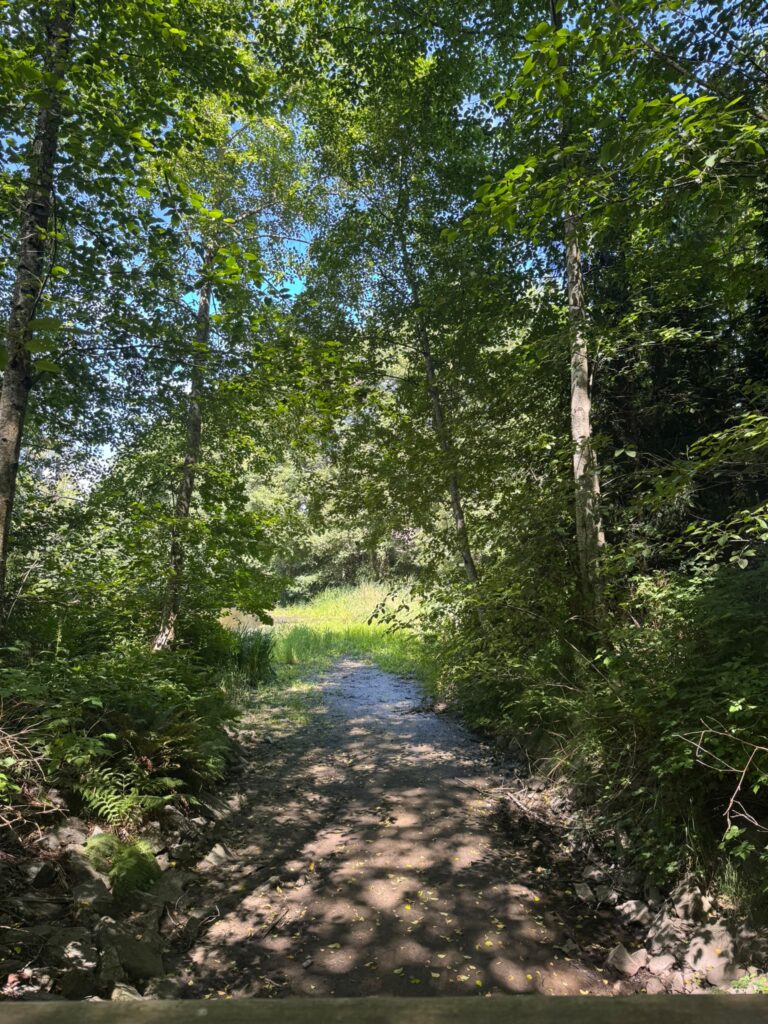
Green criminology talks a lot about protecting the environment but uses a very gender neutral lens. But ecofeminism says that harms against animals and the environment are not something basic- it should actually be seen as a way (outlet)of men’s violence. So ecofeminism suggests ways for men to care for the environment, making it difficult for them to inflict any form of violence on it and changing their perspective that caring for the environment is unmanly (Letourneau, 2023).
References
Letourneau, A.M. (2023). ‘To preserve and Promote’: Gendering Harm in Green Cultural Criminology. In Gendering green criminology (pp 267-288). Bristol University Press.

Hi Taylor, I really enjoyed reading your blog. I also had no idea that just because something is legal does not necessarily mean it is morally right. Before reading your post, I always assumed environmental laws existed to prevent environmental harm, but your discussion helped me realize that legality does not always equal justice. It made me think about how industries such as agriculture, farming, and large production factories can legally comply with environmental regulations while still harming ecosystems. As well, your blog also reminded me that every part of an ecosystem is interconnected because if one part is harmed, it can affect plants, animals, and even humans. For example, according to Burrell and Pedersen’s discussion, an ethic of care encourages people to move away from dominating nature and instead recognize our responsibility to care for the environment. As you mentioned, protecting nature should not only be about following laws but also about considering whether our actions are fair and beneficial to the ecosystem as a whole.
Burrell, S. R., & Pedersen, C. (2025). From men’s violence to an ethic of care: Ecofeminist contributions to green criminology. Journal of Criminology, 58(3), 372–388. https://doi.org/10.1177/26338076241293145
Hello Ganimat! I enjoyed your reflection on the impact of development on the natural “sponge” at Cougar Creek. Prior to reading your comment, I would have considered storm drains, sidewalks, and downspouts to be regular components of a city. Through your post, it became clear to me that these elements are not necessarily neutral; their presence will determine the fate of rainwater.
Brisman and South’s (2018) explanation on the issue of green cultural criminology was also enlightening in regard to this idea. First of all, it is said that society’s attitude towards nature will affect its behavior regarding it. In this case, treating rain as “runoff” means that we believe nature should be managed by society for its own convenience. Second of all, the authors note that society trusts technology more than it acknowledges the harm caused by our lifestyle.
Deb taking photos of the creek, which was completely dried out, made this topic even more realistic. Your post made me understand that destruction of the environment is sometimes included in normal infrastructure and becomes a part of everyday life. I would like to thank you for your ecofeminist reflection, which asks an important question.
Sources-
Brisman, A., & South, N. (2018). Green cultural criminology. In W. S. DeKeseredy and M. Dragiewicz (Eds.), Routledge handbook of critical criminology (2nd ed., pp. 132–142). Routledge.
Hi Ganimat! I enjoyed your reading. Your blog actually brought back a lot of memories from the Cougar Creek Walk. I was there too, and honestly, the dried Creek at the end really stuck with me. I remember standing there thinking how something that is supposed to be full of life just looked completely empty. It was a quiet but powerful moment.
The 3-3-300 rule also blew my mind. I had never thought about access to green space as something that affects health, but it makes so much sense. And the point about drain spouts was something I had never paid attention to before Deb pointed it out. Now I notice them everywhere.
Your point about green criminology being gendered really resonated with me. I had been thinking about the environment mostly in terms of what is being harmed and by whom, but not really about who gets to speak up and who has the power to make decisions. As Letourneau (2023) argues, ecofeminism pushes us to see that violence against nature and violence against women actually come from the same place and a mindset that treats both as things to be dominated and used. That connection had not clicked for me before this week’s reading, and your blog helped it land even more clearly.