Designing for Equity: Launching KPU’s New Universal Design for Learning (UDL) Resource
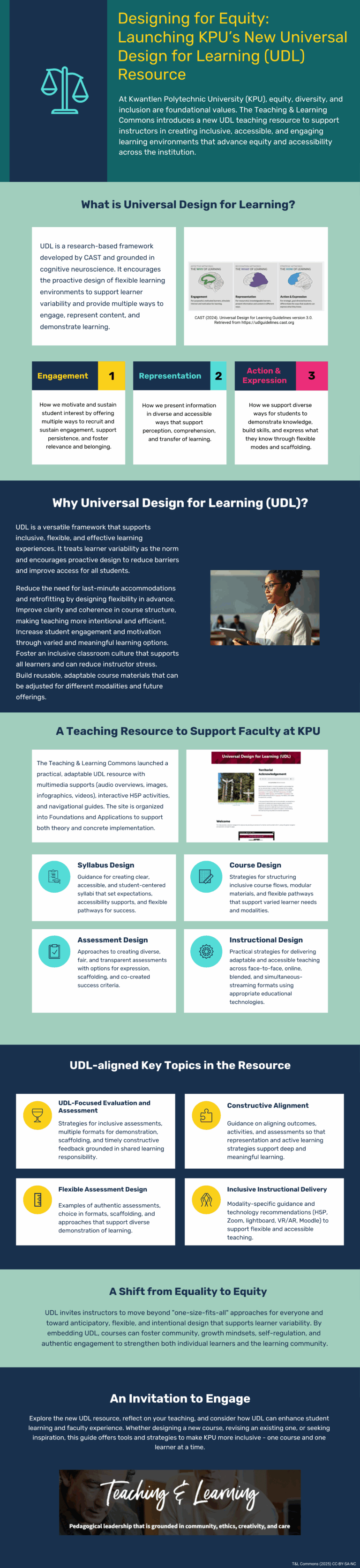
As an example of Universal Design for Learning (UDL) in practice, this blog promotes and supports multiple means of accessing content including, text, audio, and graphics. An infographic version of the entire blog is available at the end of the blog, and an audio version of this blog is available by clicking the play button below:
At Kwantlen Polytechnic University (KPU), the commitment to equity, diversity, and inclusion (EDI) is more than a strategic goal – it’s a foundational value that shapes how we teach, learn, and build community. As part of this commitment, the KPU EDI Action Plan (link will open the PDF version) emphasizes the adoption and promotion of UDL principles across the institution.
What is Universal Design for Learning?
UDL draws its inspiration from the field of architecture, where Universal Design (UD) was developed to create environments accessible to all people – regardless of age, ability, or circumstance. The goal was to design spaces that didn’t require retrofitting or special accommodations and instead worked for everyone from the outset. A classic example is the curb cut; originally intended for wheelchair users, it also benefits parents with strollers, travelers with luggage, and delivery workers. In other words, a change in design may directly support some, but it can also support everyone.
UDL applies this same philosophy to education. Developed by the Center for Applied Special Technology (CAST) (link will open CAST’s website) and grounded in cognitive neuroscience, UDL is a research-based framework that guides the design of flexible learning environments. It recognizes that students bring varied backgrounds, strengths, and needs to the classroom and that effective teaching must reflect this diversity.
At its core, UDL is about removing barriers to learning by offering multiple ways for students to engage with content, process information, and demonstrate what they know. UDL is structured around three core principles:
- Engagement: How we motivate and sustain student interest
- Representation: How we present information in diverse and accessible ways
- Action & Expression: How we support students in demonstrating their learning
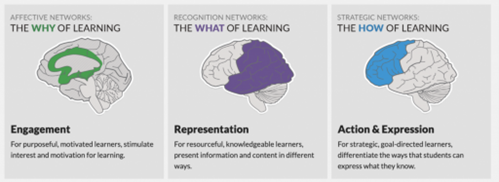
Each principle is explored through nine guidelines and thirty-one checkpoints, offering both theoretical grounding and practical strategies. UDL can be connected to broader concepts such as Universal Design, Accessibility Services, and inclusive instructional design models, providing a rich foundation for educators seeking to deepen their practice.
By applying these principles, educators can create learning experiences that are inclusive by designing proactively. Just as curb cuts transformed public spaces, UDL has the potential to transform classrooms – making learning more equitable, accessible, and effective for all.
Why Universal Design for Learning?
Universal Design for Learning is a versatile instructional design framework that can be applied across a wide range of educational contexts and disciplines. Rooted in neuroscience and social learning theory, UDL supports inclusive, flexible, and effective learning experiences for all learners. It recognizes that learner variability is the norm, not the exception, and encourages educators to design learning experiences that proactively reduce barriers to access and success. While UDL is often associated with accessibility, its primary strength lies in its ability to enhance learning for all students by anticipating diverse needs from the outset.
Rather than replacing academic accommodations, UDL complements them by reducing the need for reactive measures. It also supports students who may not qualify for formal accommodations but still face barriers, such as language differences, financial pressures, or challenges with executive functioning. In this way, UDL can help also help bridge the gap between effective instruction and inclusive access, offering a proactive approach that benefits everyone in the learning environment.
Importantly, UDL also benefits instructors. By designing courses with flexibility and inclusivity in mind from the beginning, instructors can:
- Reduce the need for last-minute accommodations and retrofitting
- Improve clarity and coherence in course structure, making teaching more efficient and intentional
- Increase student engagement and motivation, leading to more meaningful learning interactions
- Foster a more inclusive classroom culture that supports all learners, which can enhance instructor satisfaction and reduce teaching-related stress
- Build reusable, adaptable course materials that can be easily modified for different modalities or future offerings
In short, applying UDL principles can support instructors in creating courses that are more sustainable, responsive, and impactful; aligning with institutional goals around equity, accessibility, and inclusive excellence.
A Teaching Resource to Support Faculty at KPU
In alignment with this vision, the Teaching & Learning Commons (T&L) has launched a new UDL teaching resource site: a comprehensive guide designed to support instructors in creating inclusive, accessible, and engaging learning environments for all students.
This resource is not just a collection of teaching tips – it’s a genuine commitment to inclusive education and a proactive response to the evolving needs of our diverse student population. It positions UDL not only as a pedagogical framework but also as a tool for advancing equity, accessibility, and antiracism in higher education. The new teaching resource was developed to support faculty in applying Universal Design for Learning (UDL) as a pedagogical framework: one that encourages intentional, flexible design across syllabus, course, assessment, and instruction. Below is a screenshot of the homepage:
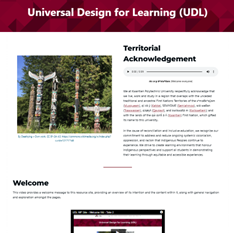
Visit the site by clicking: Universal Design for Learning (UDL)
The UDL teaching resource is designed to be practical, adaptable, and relevant across disciplines and modalities. It supports instructors in embedding UDL principles into every phase of course design and delivery. The format and layout of the resource has been designed to support UDL – each section includes an audio overview along with images, infographics, and even video clips to assist in presenting the information in multiple means to support all learners. To help get you started, there is also a navigational video, an H5P activity (“choose your own adventure” style), and a content outline (table format).
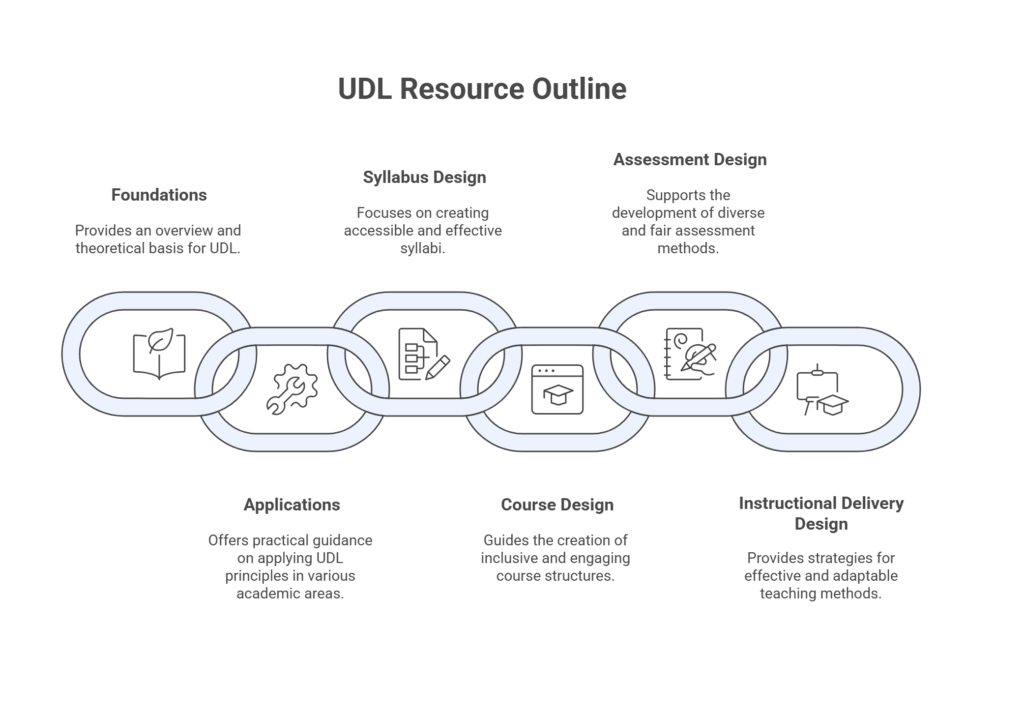
The resource is primarily divided between Foundations and Applications of UDL, with the former including the theory and principles and other foundational content of UDL, and the latter more specific towards applying UDL into different aspects of instruction. Specifically,
- Syllabus Design – focuses on creating accessible and effective syllabi
- Course Design – guides the creation of inclusive and engaging course structures and flow
- Assessment Design – supports the development of diverse and fair assessment methods
- Instructional Design – provides strategies for effective and adaptable teaching methods
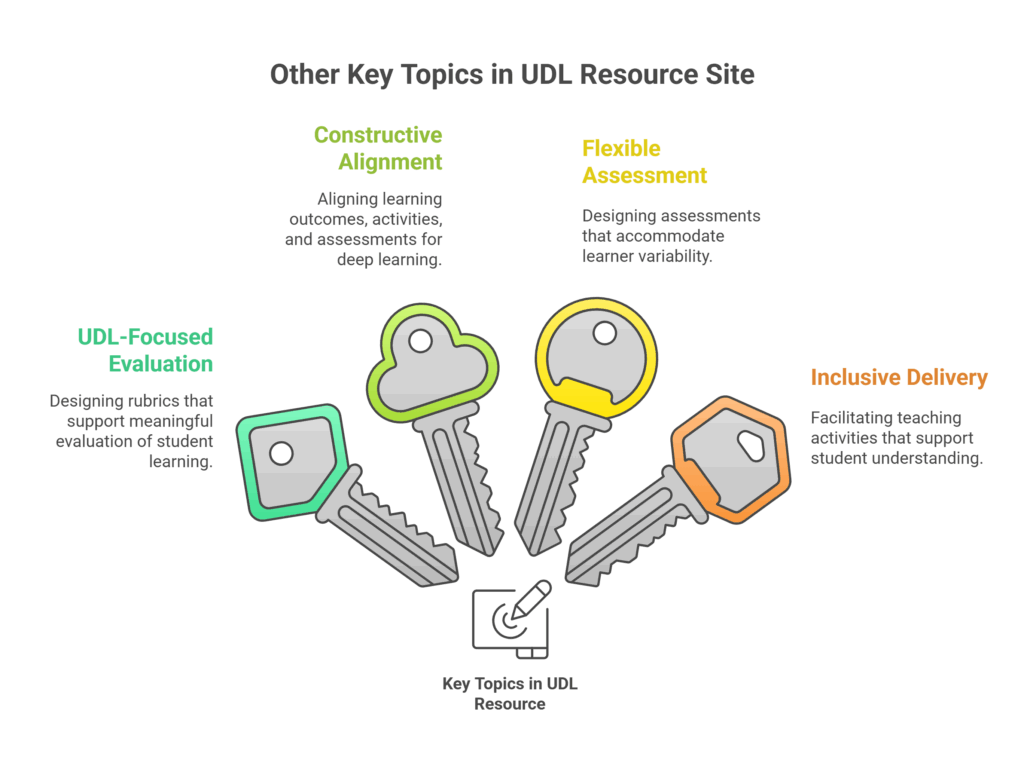
Other UDL-aligned key topics within the resource include:
UDL-Focused Evaluation and Assessment
Explore strategies for designing inclusive and transparent assessments that align with learning outcomes while supporting learner agency. This section explores flexible formats, like multimedia projects, presentations, and reflection, and emphasizes co-creating success criteria with students. It also offers guidance on delivering feedback that is timely, compassionate, and grounded in shared responsibility for learning.
Constructive Alignment
Design courses in which learning outcomes, learning activities, and assessments are intentionally connected to support deep and meaningful learning. As how information is represented is a core strength of the UDL framework, the resource provides examples of how to ensure clarity and coherence across course components, such as aligning active learning strategies with outcome-based assessments or using backward design to plan instructional sequences. It also includes tips for identifying and addressing misalignment that can lead to confusion or surface-level engagement, helping instructors create more inclusive and effective learning environments.
Flexible Assessment Design
Discover approaches to designing diagnostic, formative, and summative assessments that support learner variability. The resource highlights authentic assessment formats like ePortfolios, case studies, and collaborative projects, and provides strategies for integrating multiple means of expression. Supportive methods such as chunking complex tasks, scaffolding skill development, and offering choice in assessment formats are emphasized to support diverse learners and promote equitable success in their demonstrations of learning.
Inclusive Instructional Delivery
Strategies for designing and facilitating teaching and learning activities that support student understanding and provide opportunities to demonstrate learning. The guide also includes modality-specific strategies for enhancing accessibility and engagement across face-to-face, online, blended, and Simultaneous Streaming formats, and highlights educational technologies such as H5P, Zoom, lightboard studio, VR/AR, and Moodle features to support flexible content delivery and diverse learning activities.
A Shift from Equality to Equity
UDL invites a shift from equality, where all learners receive the same support, to equity, where learning environments are designed to anticipate and respond to diverse needs. This means moving beyond one-size-fits-all approaches and embracing flexible, intentional design that supports learner variability.
UDL emphasizes fostering learner development through community and collaboration. This approach not only benefits individual learners but also strengthens the learning community as a whole. It fosters a growth mindset, encourages self-regulation, and promotes authentic engagement with learning. By embedding UDL principles into syllabus, course, assessment, and instructional design, instructors can help students build resilience, embrace challenges, and engage meaningfully in their learning.
An Invitation to Engage
The launch of this UDL teaching resource marks an important step in KPU’s journey toward inclusive education. It reflects our collective commitment to creating learning environments that honor the diversity of our students and empower them to thrive.
We invite all instructors to explore the resource, reflect on their teaching practices, and consider how UDL can enhance both student learning and faculty experience. Whether you’re designing a new course, revising an existing one, or simply seeking inspiration, this guide offers a wealth of tools, insights, and strategies.
Together, we can build a more inclusive KPU – one course, one classroom, and one learner at a time.
To visit the site, please click: Universal Design for Learning (UDL) (will open the site in your browser). For further support, please reach out to the Teaching & Learning Commons at tlcommons@kpu.ca (will open your email application).

Daniel Benzimra
Daniel is a life-long learner who has a wide variety of educational experience primarily in the K-12 sector, but in higher education with andragogy as well. Daniel enjoys collaboratively problem-solving educational challenges from a student-centered approach. In his role as a Teaching and Learning Strategist, Daniel works directly with faculty to help support the learning needs of their students through pedagogically-sound and evidence-based best practices.
Daniel strongly believes in the value of ongoing education and enjoys furthering his own learning and professional development. Daniel is passionate about meeting the needs of learners, special education, and intentional design for learning.