Mission Information – Apollo 14 – Launch date 01/31/1971 – Landing date 02/09/1971 – Duration 9 days – Apollo 15 – Launch date 07/26/1971 – Landing date 08/07/1971 – Duration 12 days – Apollo 16 – Launch date 04/16/1972 – Landing date 04/27/1972 – Duration 11 days – Apollo 17 – Launch date 12/07/1972 – Landing date 12/19/1972 – Duration 12 days
Occurrence of infectious disease could pose serious threats to crew and missions. One or more crew members could be exposed to an infectious disease before launch and not recover resulting in a delay of the mission. If a crew member is exposed only a few days before launch they may not show any symptoms until mid-flight where extensive medical equipment is not available and other crew members would be exposed. Loss in capabilities of sick crew member would hinder mission.
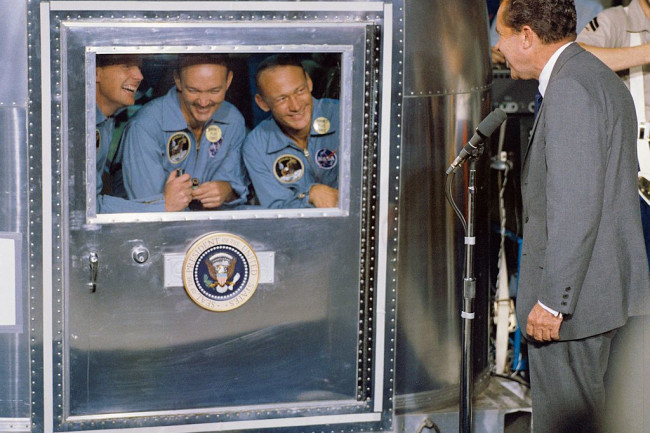
Gemini and Mercury missions suspected to have low risks because of shorter duration missions, precautions were still taken with restricted access to crew living quarters. Risk increased for Apollo missions due to increased length of missions. Health Stabilization Program not implemented until after Apollo 14, following the exposure of an Apollo 13 member to rubella.
Objective of Health Stabilization program to minimize or eliminate possibility of compromised health before, during and after flight.
Approach:
Exposure prevention –
- minimizing or eliminating exposure to infectious disease
- disease are transmittable by fomites (contaminated objects), contaminated consumables (food, water, air), and personal contacts
- Fomites – of least concern, precautions still took place with use of separate headsets and microphones for astronauts
- Contaminated consumables – greater risk, closely controlled living environment provided pre-launch
- highly-efficiency bacterial filters in all supply air ducts
- higher atmospheric pressure in areas inhabited by crew members, directed air leakage away from crew members
- procurement of food handled by cooks in crew quarters, monitored for medical team
- portions of food purchased subjected to microbiological evaluation
- food prep areas inspected daily for cleanliness and maintenance of sanitary conditions
- drinking water subjected to daily microbiological evaluations
- drinking water sources limited to fountains provided in crew quarters and working areas
- Contacts – highest risk, minimized contact with other individuals during preflight period
- crew members limited to areas they could visit and people they would come in contact with
- crew members isolated from potential carriers (transient groups, high incident groups – children, uncontrolled contacts – maintenance personnel)
- children most common carriers of upper respiratory and gastrointestinal infections, astronauts isolated from children for 21 days prior to flight
Clinical medicine –
- clinical medicine program provided for all Apollo crew members and their families
- included routine and emergency physical examinations
- complete virological, bacteriological, immunological, serological and biochemical studies conducted at Johnson Space Center for quick diagnosis and treatment of any disease occurrence
Immunology –
- serological tests conducted on Apollo crew members to determine immunity levels
- tetanus, syphilis, typhoid, mumps, poliomyelitis, rubella, rubeola, yellow fever
- immunizations for diphtheria, tetanus, typhoid, influenza, poliomyelitis, smallpox and yellow fever given to astronauts
- immunizations for mumps, rubella and rubeola given if no serological response
- astronauts’ families immunized for diphtheria, pertussis, tetanus, mumps, poliomyelitis, rubella, rubeola, and smallpox
- immunizations for viral and bacterial infections of respiratory and gastrointestinal tracts not available, which are most likely to occur
Epidemiological surveillance –
- build housing facilities for flight crew and primary contacts
- modify existing housing for flight crew and primary contacts
- provide strict isolation of prime crew and backup crew in crew quarters and limit personal contacts to medically approved individuals
- option 3 chosen, options 1 and 2 were determined cost prohibitive
- medical surveillance program initiated 3 months prior to launch
- records of medical histories and critical info of primary contacts
- primary contacts subjected to extensive physical examination 60 days before launch
- microbiological samples obtained to determine carriers
- only healthy individuals allowed access to crew members during 21 day prelaunch isolation period
- primary contacts subjected to medical surveillance during 21 day preflight period
- primary contacts required to report if any of them or family members became ill or were exposed to an infectious disease
- daily reports were obtained from schools of crew members children regarding total absences
- daily reports from local public health authorities about current trends or incidences of disease in the areas or primary contacts
Results:
- flight crew health stabilization program was successful; no preflight, inflight or post flight illnesses during Apollo 14-17 missions
- prior to Apollo 14 mission, 57% of prime crew members experienced some illness during 21-day prelaunch period and inflight
- monitoring health of primary contact children was key as most common illness was upper respiratory tract infections, children are common carriers
Source: McCollum, G. W., & Wooly, B. C. (2004, July 15). Apollo Flight Crew Health Stabilization Program (APHSP). NASA Life Sciences Data Archive . https://lsda.jsc.nasa.gov/Experiment/exper/863.