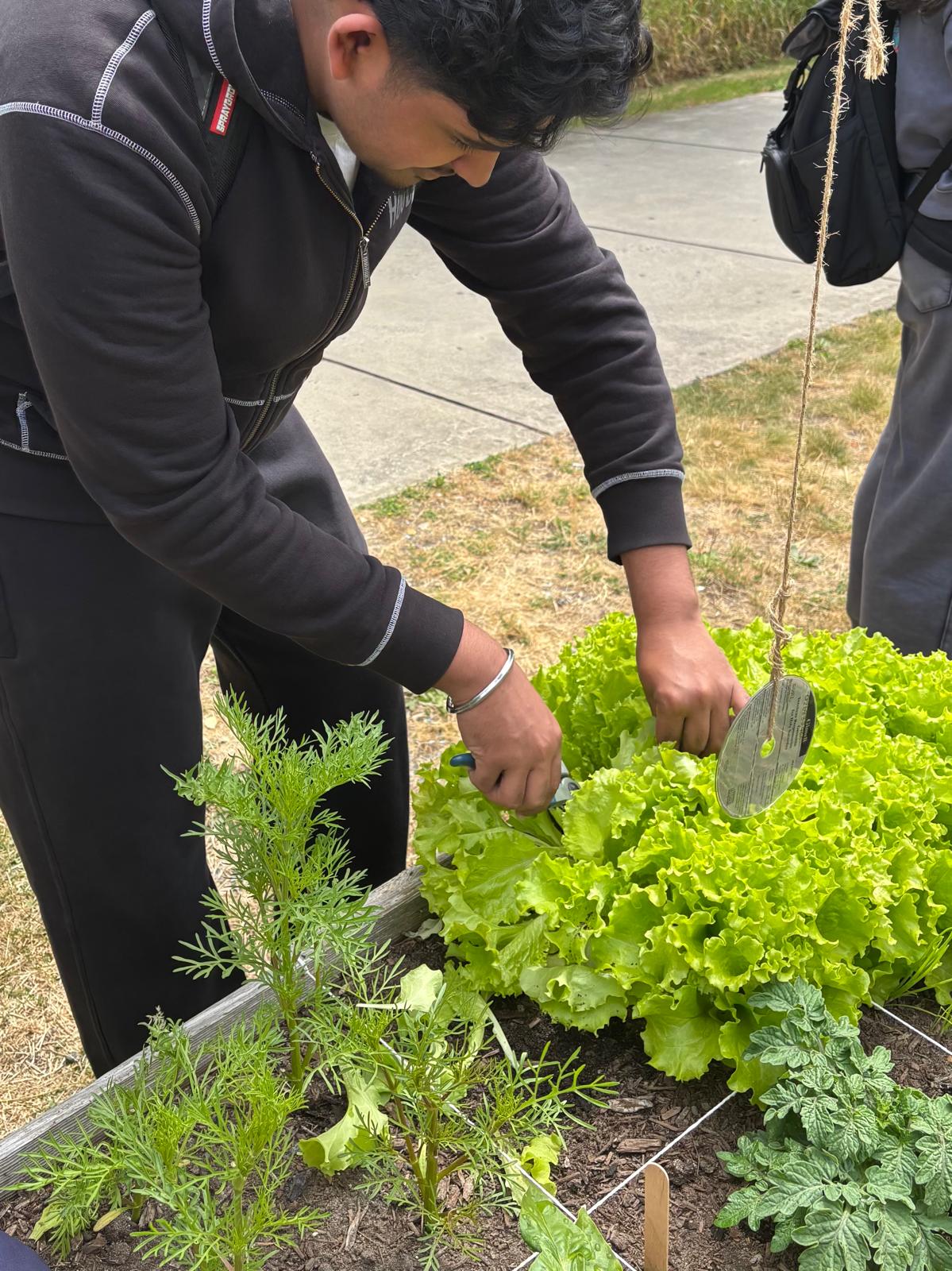
One of the things I appreciate most about my Green Criminology class is that it gives us the opportunity to learn through hands-on experiences rather than only through lectures. This week, our group harvested lettuce from the campus garden and I learned a gardening technique that was completely new to me. Instead of pulling the entire lettuce plant from the ground, I learned how to thin the lettuce by harvesting only the larger outer leaves while leaving the centre, or growing point, untouched. This “cut-and-come-again” method allows the plant to continue producing new leaves, making it possible to harvest from the same lettuce multiple times (Johnson et al., 2017). It was rewarding to know that the lettuce we harvested could be eaten while the remaining plant would continue growing for future harvests.
Working in the garden also changed the way I think about sustainability. Before this class, I never considered how small harvesting techniques could have a meaningful impact on reducing waste and increasing food production. By harvesting responsibly instead of removing the entire plant, we are making better use of available resources while supporting long-term food production. Activities like this reinforce one of the central ideas of green criminology that is caring for the environment involves making thoughtful, sustainable choices in our everyday lives. Spending time in the garden reminded me that environmental stewardship is not always about large-scale actions; sometimes it begins with simple practices that respect and protect the natural world.
Another highlight of the week was our field trip to Cougar Creek. Overall, it was a great experience because it allowed us to see environmental conservation happening in our own community. During the visit, we learned about the wild berries that grow along the creek and their importance within the local ecosystem. We also learned about the life cycle of Pacific salmon and why healthy streams are essential for their survival. One of the most interesting parts of the trip was hearing from Deb and her fellow volunteers about the work they do to restore salmon habitat. They build small dam-like structures in the stream to slow the flow of water and create suitable areas where salmon can safely lay their eggs. Research has shown that restoring stream habitat through structures like these can improve spawning conditions and support healthier salmon populations over time (van Zyll de Jong et al., 2016). Seeing the dedication of the volunteers made me appreciate how much community members can contribute to protecting local ecosystems. The field trip was a great reminder that environmental conservation depends not only on government agencies but also on passionate individuals who are willing to dedicate their time to preserving nature for future generations
Johnson, G., Buzby, K., Semmens, K., & Waterland, N. L. (2017). Comparison of two harvest methods for lettuce production in an aquaponic system. Journal of Agricultural Science, 9(1), 64–74. https://doi.org/10.5539/jas.v9n1p64 van Zyll de Jong, M. C., Gibson, R. J., Cowx, I. G., & Scruton, D. A. (2016). Long-term response of salmonid populations to habitat restoration in a boreal forest stream. Ecological Engineering, 91, 148–157. https://doi.org/10.1016/j.ecoleng.2016.02.029

Provide Feedback