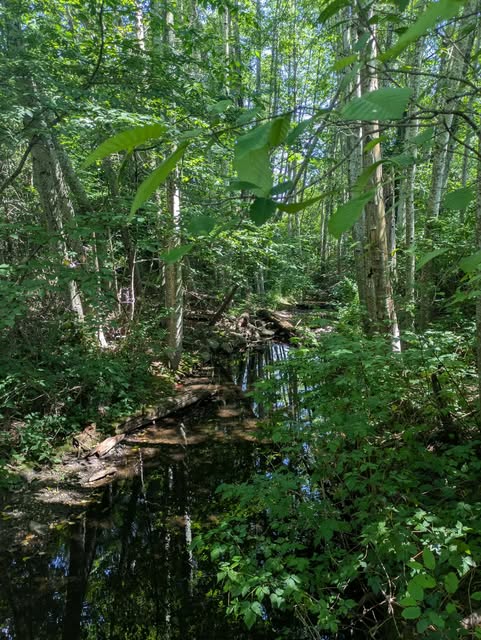
Rusty pipes, a toy car, pieces of plastic, electronics, and more. These seem like a random list of items, but they all have one thing in common: they are lying in the Cougar Creek waterways. Visiting Cougar Creek was an incredibly enlightening experience. We saw eagles, learned about invasive Himalayan blackberries, and walked along a lovely creek. Except while walking along the creek, we saw that many stretches of the water had dried up, and that there were excessive amounts of pollution within many areas of the water as well. This stuck with me and made me look more into the topic of this pollution.
What is Going Into the Creek?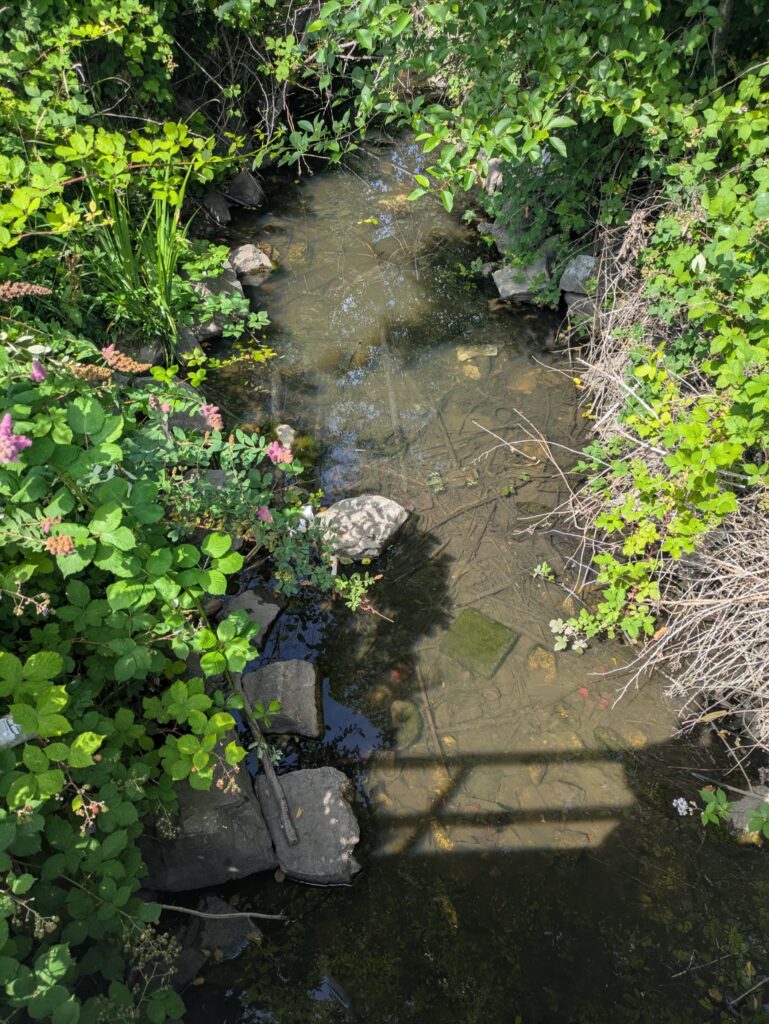
The Cougar Creek Streamkeepers are a group of volunteers that help maintain the creeks wellbeing and health. They have listed many things as sources of pollution for the water, but among the most damaging are tire and brake dust, especially for the Salmon population. Researchers have identified a chemical called 6PPD-quinone, which is a product of the preservatives in vehicle tires that breaks down once in contact with the environment. The chemical is so lethal to coho salmon that a single drop placed in an Olympic swimming pool would be enough to kill at least half of the fish inside it (OPB, 2026). This has become a massive problem as in some urban streams, more than 90% of returning coho salmon die before they can spawn (CBC News, 2024). Our cities are built around a traffic model that is very stop-and-go, which is essentially every intersection surrounding Cougar Creek, and that generates the highest amount of chemical output into the environment (Raincoast Conservation Foundation, 2026). Organizations have been pushing for bans on this preservative, but so far, none have been successful.
Is it Wrong?
Nobody is specifically breaking any laws here. You are allowed to have tires, you can drive on roads, and you can drain water out of streets, yet coho salmon also have the right to swim up 1,400 kilometres of waterways to spawn their offspring safely (City of Surrey, 2025). More than that, other fish use the waterways as spawning grounds as well. This is where ecocide has become a very important environmental topic. Ecocide is described as a very serious level of widespread destruction of the environment (White, 2025). We have ingrained something incredibly damaging to the environment into our daily lives. Unfortunately, no individual is responsible, no prosecution is possible as of now, and the only thing most affected is the animals that can do nothing about it.
Why the Law is Not Catching This
An article by Rachel Killean talks about many attempts to criminalize ecocide as an international crime, going all the way back as far as the usage of Agent Orange in the Vietnam war (Killean, n.d.). The challenge with all of this is that it has never been unlawful. Many aspects of blatant pollution are obviously criminal, though it is very rarely prosecuted, nor prosecuted harshly. Ecocide arguably has as much damage on the environment, yet it is seen as a product of our society functioning normally.
What the Field Trip Taught Me
I believe it is worth mentioning that I had no clue as to our proximity to Cougar Creek at KPU. I think much of the problem with any lack of support for getting these chemicals banned is that people are unaware. They are unaware of what goes into their products, into their waterways, and what ecosystems can be affected around them. Without large publicity to bring light to the ongoing problems, it is difficult, if not impossible, to actually gain support and backing for a large-scale campaign.
CBC News. (2024, February 7). B.C. environmental groups request review of tire chemical linked to salmon deaths. https://www.cbc.ca/news/canada/british-columbia/chemical-salmon-deaths-1.7108014 City of Surrey. (2025). https://www.surrey.ca/about-surrey/environment/wildlife-habitats/fish Cougar Creek Streamkeepers. (n.d.). Cougar Creek. https://cougarcreekstreamkeepers.ca/cougar-creek/ Killean, R. (n.d.). Ecocide law and policy. The Palgrave handbook of environmental policy and law. Palgrave Macmillan. https://doi.org/10.1007/978-3-031-55387-5_3 OPB. (2026, April 12). Every tire produces a chemical that kills coho salmon. Can Northwest scientists pump the brakes? https://www.opb.org/article/2026/04/12/every-tire-a-chemical-that-kills-coho-salmon-can-northwest-scientists-pump-the-brakes/ Raincoast Conservation Foundation. (2026). When will Ottawa act to remove salmon-killing chemical from vehicle tires? https://www.raincoast.org/2026/04/ottawa-salmon-killing-chemical-vehicle-tires/ White, R. (2025). Ecocidal tendencies of late capitalism. Routledge handbook of green criminology.. https://doi.org/10.4324/9781003401629-6

Hi Cameron,
I really enjoyed reading your blog because you talked about an environmental issue that I honestly knew very little about before. I had no idea that chemicals from vehicle tires could be so harmful to coho salmon, and it surprised me to learn that something we use every day can have such a big impact on local ecosystems. Your blog also made me think differently about our Cougar Creek field trip. Like you, I had no idea how close Cougar Creek was to KPU or how much pollution was affecting it until we actually walked through it.
I also liked how you connected this issue to ecocide. One of the biggest things I’ve learned in Green Criminology is that not all environmental harm is illegal. As White (2025) explains, serious environmental damage can still happen even when no laws are being broken. Your example of tire chemicals shows this perfectly because people are simply driving their cars, yet it still causes harm to wildlife and the environment. It also reminded me of Ferrell’s (2020) idea that many environmental harms become normalized because they are part of everyday life. I agree with your point about education too. I think the more people learn about issues like this, the more likely they are to support changes that help protect local ecosystems like Cougar Creek. Great post!
References:
Ferrell, J. (2020). Consumed by the crisis: Green criminology and cultural criminology. In A. Brisman & N. South (Eds.), Routledge international handbook of green criminology (2nd ed., pp. 638–657). Routledge. https://doi.org/10.4324/9781315207094-37
White, R. (2025). Ecocidal tendencies of late capitalism. In Routledge handbook of green criminology. Routledge. https://doi.org/10.4324/9781003401629-6
This is a really compelling post Cameron, the 6PPD-quinone stat actually shocked me and the fact that a single drop in an Olympic pool is enough to kill half the coho in it says a lot about how insidious this kind of pollution is, especially since it’s technically all “legal.” I think the “Is it Wrong?” section in your blog was actually quite interesting as it highlighted how everyone involved is basically just doing normal stuff like owning a car, driving to work, letting rain wash the street but the cumulative effect is this slow-motion ecological disaster that nobody’s actually responsible for.
The ecocide angle is what stuck with me most, though. It’s wild that something can cause this much damage and still fall completely outside what our legal systems consider “criminal.” The Agent Orange comparison helps show this isn’t some new debate either, just one that’s never gotten enough traction to actually change policy. Also, I really liked the personal reflection at the end- us not knowing that Cougar Creek was practically next door to KPU kind of proves your own point that we’re pretty disconnected from the ecosystems right around us. That feels like the real through line because it highlights that its not just a chemistry or policy problem, it’s an awareness problem.
Curious though; do tire manufacturers actually have a viable alternative preservative to switch to, or is part of the holdup that nothing else works as well yet? Feels like that could be a big piece of why bans keep stalling.
Anyways, this was a very insightful blogpost that gave some great information beyond classroom too!