Standard: NASA-STD-3001 Technical Brief – Health Stabilization Program V1 4.4.2.4 Overview
Summary:
Health Stabilization Program (HSP) necessary for all spaceflight missions to reduce risk of infection both pre-flight and in-flight. HSP has been implemented since Apollo 14 mission. The 2 main components of HSP are pre-flight immunizations and quarantine, which have been rudimentary in managing the risk of in-flight infection, especially upper respiratory and enteric infections. Current protocol mandates HSP starts 14 days before launch. HSP only successful if there is full participation.
After implementation of HSP, there was a noticeable reduction in illnesses and infections pre and in-flight. Before implementation of HSP, 57% of Apollo crew members experienced some extent of infectious illnesses before flight. Since implementation of HSP starting with Apollo 14, there has been a significant decrease in the risk of infectious diseases. See image below.
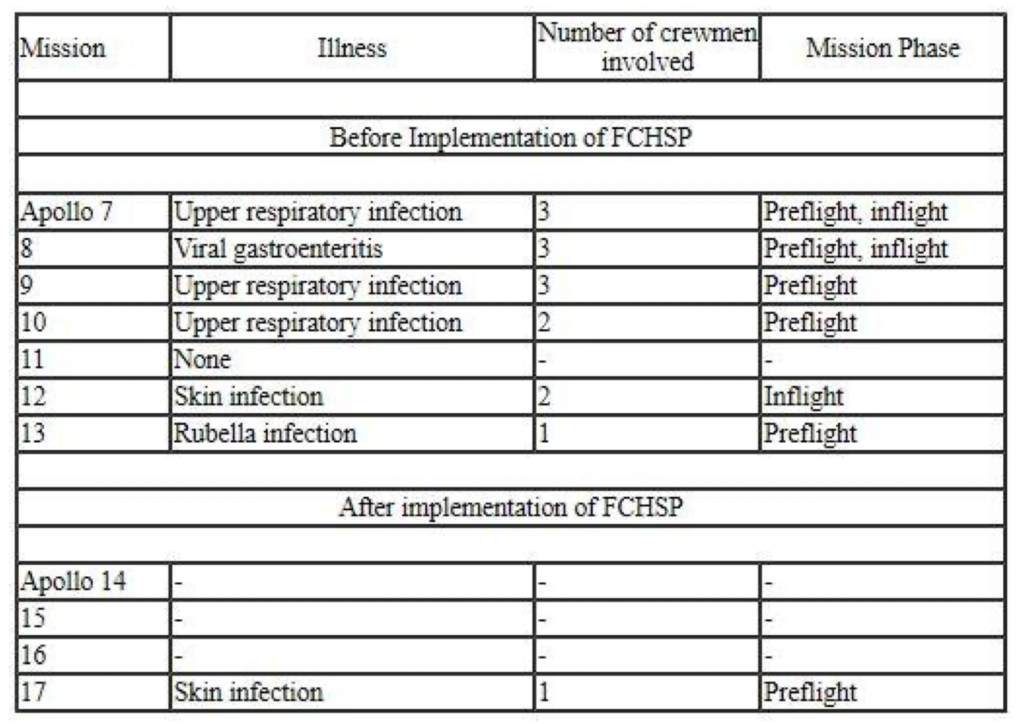
Apollo
- 21 day HSP for prime and backup crew
- Immunizations
- Extensive disease exposure via quarantine
- Limited exposure to fomites, contaminated consumables, and interpersonal contacts
- Crewmembers used different equipment
- Closed controlled living environment – ultra-high efficiency bacterial filters, positive air pressure (outward flow of air only), and controlled food and water intake (including microbiological testing of samples)
- No exposure to potential carries (eg. children, maintenance personnel); contacts restricted to medically approved individuals only (~100 people total)
Skylab
- 21-day pre-flight, 7-day post-flight HSP
- Immunizations similar to Apollo
- Quarantines to minimize crew exposure to infectious diseases
- Similar to Apollo – positive air pressure,
- Primary contacts were inspected by a nurse before interaction with crew; interactions with non-primary contacts were performed via CCTV
- Food was specially prepared for the crew
- Additional space for isolation of an ill crewmember
- Limitations were set on the number of primary contacts
- Cited as the change that impacted the incidence of disease most
ISS
- 14-day pre-flight HSP
- Countermeasures in place: crew and contact education; hand & respiratory hygiene; physical separation; PPE; immunizations (similar to Apollo); medical screening of contacts by a physician before crew interaction; and, avoiding tasks with a high risk of infectious disease acquisition
- Operating groups and personal contacts are allowed to have close crew contact, but special guests and VIPs must stay >1.5 meters away
- Personal contacts are limited to 2-3 people or family members (with exceptions)
- They may be isolated prior to crew contact, depending on when they arrive at the site
Source: NASA. (20, February 10). NASA-STD-3001 Technical Brief – Health Stabilization Program V1 4.4.2.4 Overview. Retrieved September 18, 2020, from https://www.nasa.gov/sites/default/files/atoms/files/health_stabilization_pro gram_technical_brief_ochmo_021020.pdf