Understanding the complexity of the soil
Gaining a new criminological perspective
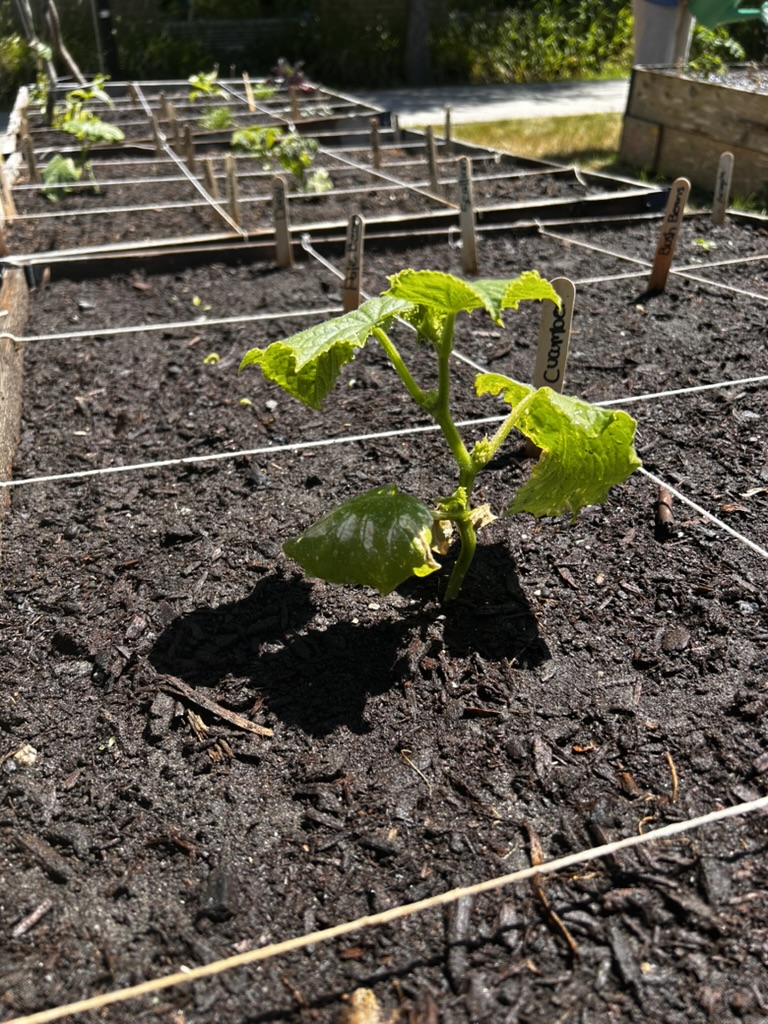
Taking green criminology, I had done gardening before, but never thought it would connect to criminology as well. Once my group and I started discussing which vegetables we wanted to grow, we considered many factors, such as growth time, sunlight requirements, water consumption, etc. Once we planted our seeds, I didn’t expect the number of techniques that came into play, for instance, seed depth and areas to plant for specific seeds that needed more sunlight.
Furthermore, taking responsibility for watering our crops and later reading our articles helped me understand the impact of environmental harm and the reduction of evasive harm as well. What I’m learning so far is that you have to nurture your crops to reach their full potential by watering them every day, checking on their progression, and making sure natural predators like snails and bunnies aren’t interfering with your garden. You need to have a plan, and I believe this applies to our lives as well. You need to have a plan to grow and blossom to your fullest potential.
Connection to Criminology
In one of our first classes together, I had a light idea of what environmental harm was. I was interested in learning through gardening what environmental crime can look like in the real world. One of the key discussions we had in class that painted a big picture was when our professor spoke about an incident that happened a while ago, where the Canadian government were dumping large amounts of mercury in the Indigenous reservoir. These communities relied on the affected waters for fishing and other food sources. As a result, many Indigenous people experienced serious health issues, including increased rates of illness and cancer due to mercury contamination in the fish they consumed. This conversation helped me understand how environmental crime leaves long-lasting effects on communities and their resources. One of the articles we’ve read in class, Critical Green Criminology by Rob White, talks about ecology and human interference that affects sustainability through global capitalism. This ideology helped me understand how capitalism and consumerism neglect environmental harm, such as global warming and the extinction of at-risk species, in favour of gaining wealth and profit.
Another reading, Green Cultural Criminology by Avi Brisman and Nigel South, introduces the term greenwashing, which refers to how corporate responsibility, technological efficiency and a false sense of social partnership are all invoked to present an impression of improved environmental behaviour that reassures consumers. However, in reality, it’s either not or is trying to achieve capitalism from consumers who believe in their message.
All Together
Altogether, I believe gardening has allowed me to see the importance of environmental stewardship firsthand, while the course readings have helped me critically examine the social, political, and economic factors that contribute to environmental harm. Overall, I am excited to learn more about green criminology and see how our gardening project turns out throughout the course
Edited using Grammarly Brisman, A., & South, N. (2018). Green cultural criminology. In Routledge handbook of critical criminology (pp. 132-142). Routledge. White, R. (2018). Critical green criminology. In Routledge handbook of critical criminology (pp. 120-131). Routledge.

I really enjoyed reading your blog because I liked how you connected gardening to the broader ideas of green criminology. Your reflection shows that gardening is more than just growing plants; it also demonstrates the responsibility and care needed to protect the environment. I especially liked your point about having a plan for both a garden and our own lives, as it highlights how small daily actions can make a meaningful difference over time. Your discussion of greenwashing also stood out to me. It reminded me of White’s (2018) argument that environmental harm is often driven by capitalism, where profit is prioritized over sustainability. This helps explain why some corporations present themselves as environmentally responsible while continuing practices that damage ecosystems. It also connects to the idea that many harmful environmental actions are not always treated as crimes, even though they have serious consequences for people and wildlife. Overall, your blog demonstrates how hands-on experiences like gardening can deepen our understanding of the concepts we discuss in class. It made me think more about how individual actions and larger economic systems both play important roles in protecting the environment.
Generative AI Acknowledgement: Quill Bot was used to fix the flow.