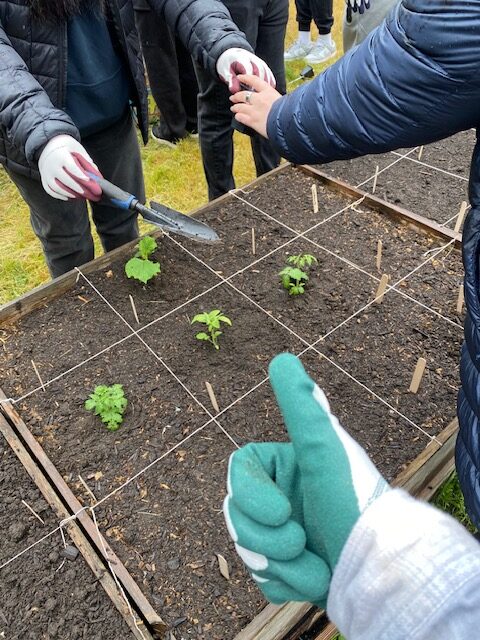
What Planting Reminds Me Of
So far in my course in Criminology 3911, my thinking, typically directed to the study of human crime, has shifted to crimes against the environment. This has reminded me of the environmental concerns that I was taught when I was growing up and forgot as I got carried away with other academic topics. I believe everyone has a deep care for greenery and the environments it supports, as we have had the privilege of playing in parks and witnessing firsthand the beauty of nature.
It is a wonderful opportunity that in this course I am reminded of almost a nostalgic care towards plants, as I myself get to plant various plants with my team. The little considerations we take to ensure that our plants survive and thrive can be likened to how we ensure our actions benefit our friends and family. Truly, it reminds me of caring for such people as I look at these plants and see something new each day, as if a friend had bought new clothes or seen a younger family member having grown taller. I believe it activates the same parts of our brains that control empathy and consideration as we provide further gardening methods to improve their current state
Morality in Green Criminology
I have learned that crime and harm can expand into environmental damage that can even affect the way we produce our own food. In the article Food Crime and Green Criminology by Tourangeau and Fitzgerald, there are generally systems of law and food policies that help regulate the safety of the environment; however, crimes can still occur that violate these regulations (Tourangeau & Fitzgerald, 2020, pp. 208-209). These crimes can also be directed towards animals that are protected by law, which puts into question the different moral standards understood by green criminology. Understanding the reason behind crimes against protective laws regarding the environment is truly essential to not only improve future policies but also to understand crime as a whole (Tourangeau & Fitzgerald, 2020, pp. 208-209).
Note: Grammarly was used to edit this blog post
References:
Tourangeau, W., & Fitzgerald, A. J. (2020). Food crime and green criminology. In A. Brisman & N. South (Eds.), The Routledge International Handbook of Green Criminology (pp. 208-209). Routledge.

I really liked how you connected gardening to empathy, it made me think about my own time in the garden differently. I had not really considered that checking on plants every week could activate the same kind of care we feel for people, but it makes sense. There is something about watching a small seedling change day to day that does pull at the same instinct as noticing a friend or family member grow or change. It is a nice reminder that empathy does not have to be reserved only for humans.
Your point about morality in green criminology also got me thinking. I had assumed that once there are food safety laws and environmental regulations in place, that is basically the end of the story, but you are right that crimes still happen within and around those systems. The Tourangeau and Fitzgerald (2020) point about regulations not always being enough to prevent harm to either the environment or animals really stuck with me. It makes me wonder how much harm is happening that we just do not see because it technically falls within legal limits. Your post gave me a lot to think about regarding how laws and morality do not always line up.
I really enjoyed reading your blog post because it highlights an emotional aspect of gardening that is often overlooked. Your discussion about developing empathy for plants made me think about how gardening changes our relationship with the environment. I agree that caring for plants can feel similar to caring for friends or family because we become responsible for their growth and well-being.
Your point about noticing small changes in plants each day also connects to green criminology. Environmental harm often occurs gradually, making it easy for people to ignore damage to ecosystems. Through gardening, we become more aware of these changes and begin to recognize the importance of protecting the natural world.
Your discussion of food crime was particularly interesting because it shows that environmental harm extends beyond pollution and includes the systems that produce and distribute food. Burrell and Pedersen (2025) argue that an “ethic of care” can strengthen relationships between humans and the environment. This idea connects well with your experience of caring for plants, as gardening encourages empathy, responsibility, and environmental stewardship. Overall, your post demonstrates how gardening can help people better understand the values of green criminology.
Reference (APA 7th edition)
Burrell, S. R., & Pedersen, C. (2025). From men’s violence to an ethic of care: Ecofeminist contributions to green criminology. Journal of Criminology, 58(3), 372–388. https://doi.org/10.1177/26338076241293145