
We recently went on a fieldtrip to Cougar Creek in Surrey, where we were guided by a member of the Cougar Creek Stream Keepers. Before the fieldtrip, I had only heard of Cougar Creek on the news because of the salmon spawning, so in my mind, I pictured a well-flowing creek surrounded by parkland, far away from any houses or buildings. But that wasn’t the case. Parts of the creek we saw flowed past residential houses and schools, and other parts were surrounded by parkland where empty beer bottles could be seen.
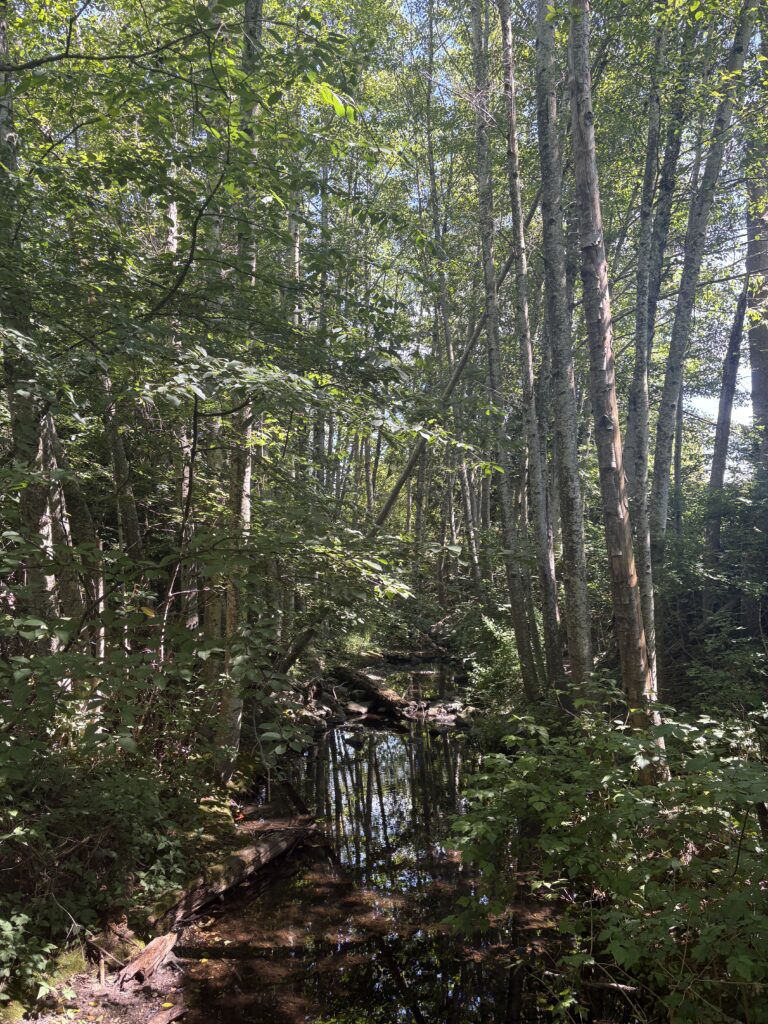
Photo of Cougar Creek
Our guide explained that Cougar Creek once looked very different: fast-flowing creeks, lakes and dense forests. However, urban development, pollution, and changes to the landscape had damaged the creek and made it difficult for salmon to survive. Listening to the guide describe the creek’s history made me realize that environmental harm is often gradual and easy to overlook. Green criminology encourages us to think beyond traditional crimes and instead focus on harms to ecosystems, even when those harms are legal. White (2021) argues that green criminology is concerned with environmental, ecological, and species justice, reminding us that rivers, wildlife, and ecosystems deserve protection, not just because humans benefit from them, but because they have value in themselves.
One idea from Burrell and Pedersen’s (20224) article that stood out to me was their discussion of an ethic of care. They argue that environmental problems are rooted in seeing humans as separate from nature rather than as part of it. Instead of treating ecosystems as resources to exploit, they suggest building caring, interconnected relationships with the natural world. Walking along Cougar Creek made this concept come to life. The restoration work from volunteers and conservation groups is not about controlling nature but about repairing relationships between people and the environment after decades of harm. The continued restoration work truly shows that environmental justice is not only about preventing future harm but also about taking responsibility for repairing damage that has already been done.
At the end of the fieldtrip and the days after, I reflected on what I had seen and learned, and I came to the realization that green criminology is not just about identifying environmental crimes. It is also about recognizing the value of restoration, community care, and our shared responsibility to protect ecosystems. It also gave me hope for environmental change by seeing how healing damaged environments is possible when people choose care over exploitation.
Little garden update! We have finally seen some produce production. As of July 5th the Indigo Rose Tomatoes have turned from flower to fruit. As of July 14th the beets have started to bulb, and the peppers have flowered.

Photo of Indigo Rose Tomatoes from our garden at KPU
*This post was edited using Grammarly
References
Burrell, S. R., & Pedersen, C. (2024b). From men’s violence to an ethic of care: Ecofeminist contributions to green criminology [Review of From men’s violence to an ethic of care: Ecofeminist contributions to green criminology]. Journal of Criminology, 58(3), 372-388. https://doi.org/10.1177/26338076241293145
White, R. (2021). Critical green criminology [Review of Critical green criminology]. Routledge eBooks, 28–38. https://doi.org/10.4324/9781003172093-3

Hi Kayla,
Your post was very descriptive and well organized. Noting that Salmon habituate the area, why do you think people litter? I agree that environmental damage is easy to overlook, considering even today people dispose of litter in the area. Environmental categories having intrinsic value is a strong point. People associate environmental protection as a superficial view, ignorant of the vast number of species that depend on these environmental systems. Burrell and Pederson’s stance is also agreeable to me. This stance is what I would argue enables people to cognitively exploit the environment to their own benefit. Economic systems also perpetuate this (White,2024). As you and Burell and Pederson mention, we should take a more respectful approach to the environment. It inspires me to think how much more advanced indigenous customs are. This inspires me to want to learn more about indigenous values of the environment and will be a hobby of mine in the future.
I very much agree that too often we focus on the harms of green criminology and not the restorative aspect. After all we expect our justice system to rehabilitate, and indigenous styles of justice seek restoration; So, why should we not seek the same approach to Criminological theories?
I’m glad to see the gardening going well. Experiencing this journey, will you also be gardening in the future?
References:
White, R. (2024). Ecocidal tendencies of late capitalism. In Criminological Connections,
Directions, Horizons (pp. 67-84). Routledge.