
Introduction to Astronomy
ASTR 1100 – Jennifer DeBenedictis
Summary:
Two outdoor astronomy experiments: measuring shadow length using a “gnomon” to determine their latitude on Earth, and a parallax experiment to measure distances using local landmarks.
True Noon and Our Latitude experiment
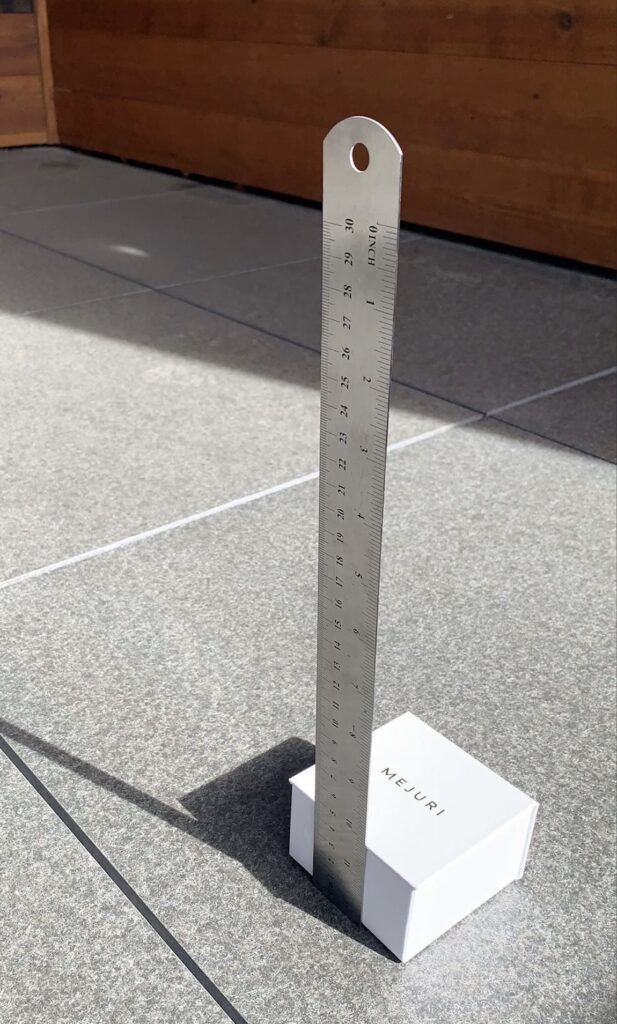
In this astronomy experiment, students learn first-hand about their literal place on planet Earth. They construct a “gnomon”, which is a vertical rod that casts a shadow, and then they measure the length of that shadow every five minutes during the time when the sun is highest in the sky. Based on their data, the students can then accurately calculate what latitude they are located at on planet Earth using a technique that Vikings once used to navigate at sea. This experiment was particularly interesting during the pandemic, when students were measuring their latitude not only across the Lower Mainland, but across Canada and also in South Korea and India.
Parallax experiment
In this astronomy experiment, our online students go out into their community to learn how to measure distances to landmarks using the phenomenon called “parallax”. By standing in two different locations, and seeing how much the position of a landmark appears to shift relative to the distant horizon, students can calculate how far away that landmark is from where they are standing. This is a technique astronomers use to calculate the distances to stars within our galaxy, where the two locations they use are two different positions on Earth’s orbit around the sun (in other words, they take measurements at two different times of the year).