Power resides with the theorists so long as they use language no one understands. In order to gain the right to theorize, one must attend their institutions for many years, learn the other language, and unlearn the feeling for the human and earth.
Lee Maracle of the Stó:lo nation
Unearthing Our Bias
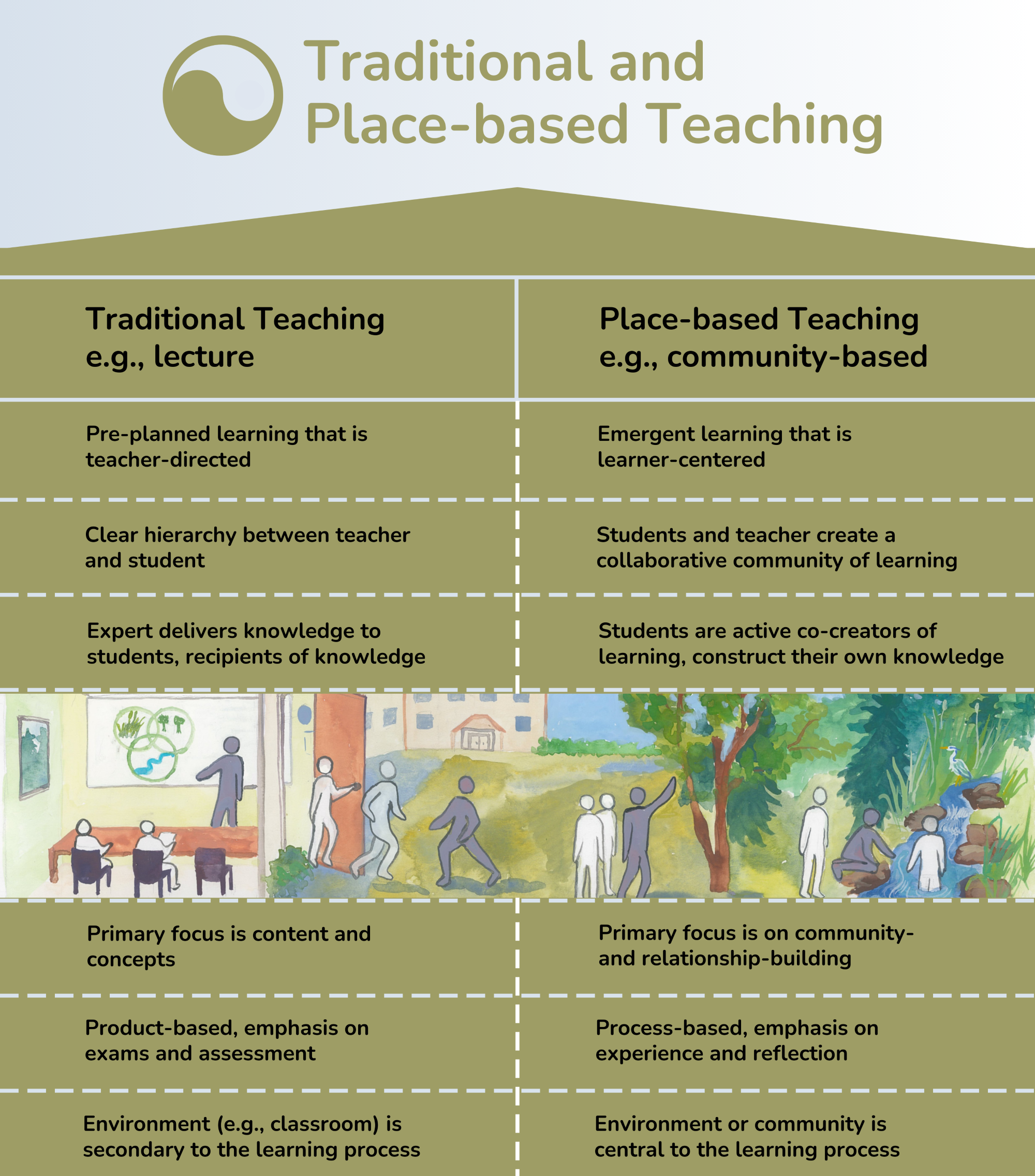
Want to implement placed-based learning? This section provides specific steps in taking this journey, including preparation, challenges, assessment, and community partnerships. But first an important consideration: place-based learning is not an add-on or technique to be implemented without first examining your own teaching philosophy and pedagogical biases. Place-based learning differs from traditional (read: conventional instruction via lectures and exams) in significant ways.
The above image outlines some key differences between more traditional teaching practices and place-based teaching. Both approaches have their respective benefits and potential drawbacks. Created by Lee Beavington. Colour illustration by Sofia Jain-Schlaepfer.
Assumptions and Intentions
Before we begin this work, we must consider two things about education: our assumptions and intentions. How were you taught in school or in university? In rows of desks or in a circle? With the teacher being the expert and dominant figure at the front of class, or the teacher being a supportive ally with which you co-created your learning experience? How often did learning happen outside the classroom? Did you have Indigenous instructors, and/or engage with Indigenous works such as stories, art, or writing? How (or was) your learning connected to the local community? How often did you worry about grades more than your learning experience? What elements were framed by a colonial mindset? (Hint: probably most/all of them.) Based on your answers to the above questions, you may need to unpack a lot in regards to what education can look like, the role teachers can take, and what a learner-centered approach offers.
Second, think about your intentions. Why do you want to implement place-based learning? To connect learning more with community? To deepen meaning and purpose in student learning? To connect with the land or local First Nations? Alternatively, if your goal is to deliver content to students, and have them repeat what you have taught on an exam, this is at odds with both Indigenous ways of learning and place-based education. This is an opportunity to re-examine your intentions. Teaching that can happen without context to place and community, perhaps with the goal of ‘learning to earn’, is part of the banking model of education (see below). Place-based education aims for something radically different.
In the institutions where I have taught, the prevailing pedagogical model is authoritarian, hierarchical in a coercive and often dominating way, and certainly one where the voice of the professor is the ‘privileged’ transmitter of knowledge.
bell hooks
Avoiding the Banking Model
Place-based learning challenges the idea of what Paulo Freire calls the banking model of education, with a placeless curriculum and standardized testing. Instead, PBE priorities relationship-building, critical thinking, Indigenous ways of understanding, connecting to the land, civic responsibility, eco-social justice, and cultivating change makers in the world.
All education is a political act. If you maintain the status quo (perhaps in an attempt to be ‘neutral’ or ‘apolitical’) this in itself makes a political statement. As Blenkinsop and Fettes (2023) write, “there is no neutral, non-implicated position in the act of teaching” (p. 58). We can see the great harm that happens when the status quo of toxic educational institutions and pedagogies, such as seen in residential schools, are followed without question.
Blenkinsop and Fettes provide further context:
“Transformation that works toward positive social change for everyone is a dynamic, imperfect, ongoing process. The critical educator needs to be not only actively critical toward actions, beliefs, structures, and processes that perpetuate oppression, but also reflexive, self-critical, and transparent about their own actions and implicatedness in larger systems. In any society, there is never a ‘neutral’ stance. The colonial Western form, however, is a society where one can benefit from oppression without being overtly oppressive oneself.” (2023, p. 103)
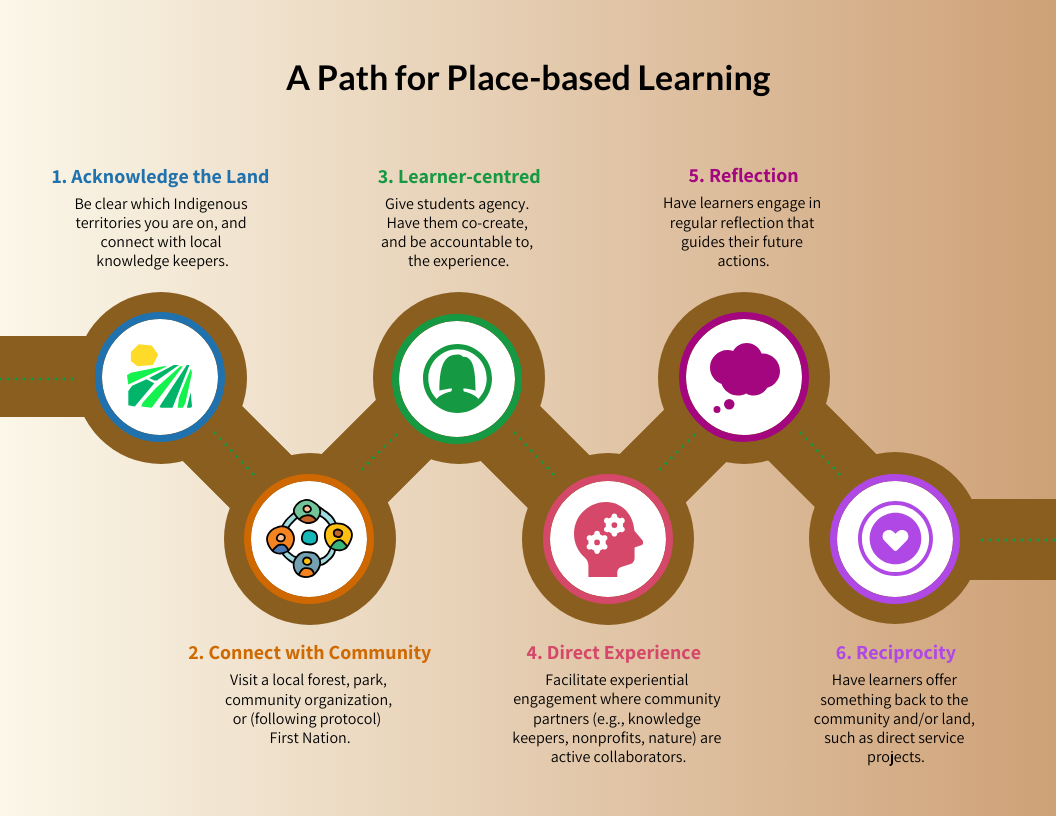
The path towards implementing place-based learning effectively requires careful intention and relationship-building. Created by Lee Beavington.
Preparing for Place-based Education
Now that you have explored your biases, brought in Indigenous ways of understanding, and got clear on your intentions for teaching, we can take the next steps.
1. Acknowledge the land Know the Indigenous territories you are on. Learn the correct pronunciations. Whenever possible connect with local knowledge keepers, Elders, or Indigenous community members. When working with Indigenous communities, move forward with respect and good intention. Learn the stories of this place, the colonial impacts, and the more-than-human members. Find out more about the First Nations local to KPU here.
2. Connect with your community Become familiar with the lands, territories, community organization, park, forest, campus grounds or other places where you plan to take students. This may involve going on a guided forest walk, connecting with a local charity or business, inviting a knowledge keeper to speak, or walking around your campus. The stronger your connection to this community—human or other-than-human—the stronger your place-based experience will be for students.
3. Learner-centered Lead with the idea that students are co-creators of their experience. Ask for their input. Follow their curiosities. Be less the ‘expert’ and more the supportive ally that fosters an inclusive learning environment. Learn with and from your students. Incorporate the inquiry-based learning model.
4. Direct experience Facilitate active learning such as discussion, exploration, hands-on activities, and other experiential modalities. Collaborate with community organizations, local First Nations, the forest, or the river. Have a community member, whether human, heron, or tree, be a co-teacher. Stretch the idea of how and when learning occurs.
5. Reflection Reflection is central to the experiential learning cycle. Allow students individual time to contemplate, invite them to discuss their experience in groups, and provide options for students to submit audio, video, written, or other creative responses. Reflecting on learning deepens understanding, builds relevance, and can prepare students to think about how they will act differently in the future.
6. Reciprocity Being mindful of the site of your place-based learning, build in reciprocity from the start. Can you plant a tree? Pick up garbage? Provide a gift to your host or community member? Advocate for the protection of a forest or river? Brainstorm with students different ways that they can offer something back, and have them act on their ideas.
What could I give these plants in return for their generosity? I could return the gift with a direct response, like weeding or bringing water or offering a song of thanks that sends appreciation out on the wind. I could make habitat for the solitary bees that fertilized those fruits. Or maybe I could take indirect action, like donating to my local land trust so that more habitat for the gift givers will be saved, speaking at a public hearing on land use, or making art that invites others into the web of reciprocity.
Robin Wall Kimmerer
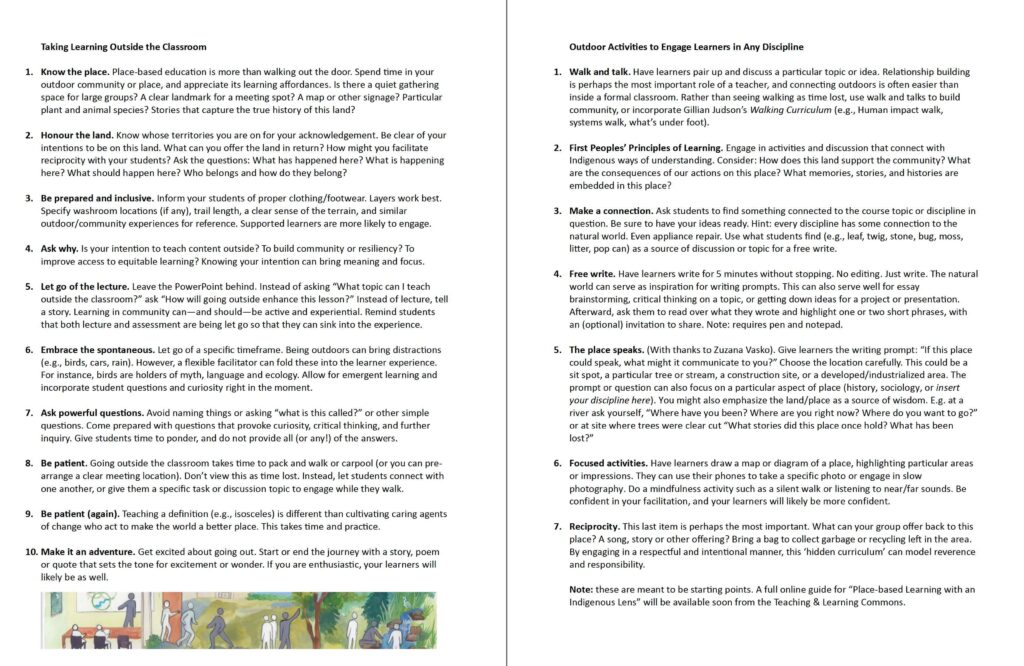
Printable Handout
View and download this 2-page PDF for some additional ideas to get started on two topics:
1. “Taking Learning Outside the Classroom”
2. “Outdoor Activities to Engage Learners in Any Discipline”
Place-based education requires planning, clear intentions, and connecting with community. This takes time and may require a shift in perspective for those new to PBE. Common teaching tools such as PowerPoint, lecture and exams may no longer be required.
The question we may need to ask: are our students and communities worth the effort?
Here are some common challenges, followed by the drawbacks of limiting learning to the conventional classroom. Click for details.
Place-based education is less understood than conventional lecture, especially in higher education. Most instructors will teach the way they were taught: through lecture and exams. PBE can be seen as controversial in challenging dominant norms around education, and disrupt the teacher-student hierarchy. If this excites you, you are in the right place. If this is alarming or intimidating, have a conversation with colleague that already implements place-based education. Visit the Examples section by clicking here.
Many educators do not have time to change their teaching practice or cultivate the facilitation skills required for place-based learning. This is a valid consideration. Yet if our primary role is to educate, should we not be giving our students what they best deserve: something meaningful, relevant, and connected to community? Connect with your school or university’s teaching support. If you’re at KPU, contact Wild Spaces. Start small, such as facilitating a single placed-based experience with students.
Place-based education invites community members, knowledge keepers, and the natural world to be co-teachers. This may be a foreign idea to those more familiar with the ‘lecturing expert’ model. To reexamine one’s teaching philosophy, and move toward a more learner-centered and community-based approach requires initiative and support. To confidently implement this kind of learning usually requires first-hand experience; attend experiential workshops or do professional development in place-based education.
Without support from colleagues or administration this can be a difficult journey. You may need to take the first step. The research is there, the examples are plenty, the supports are present at KPU: take the leap! Share place-based benefits with key administrators. In addition to this guide, the KPU Wild Spaces team is here to support you.
Going outside the classroom may present physical, mental, or other challenges for students. Some may find the classroom setting familiar and more comfortable. While this may be an exciting adventure for some, others may be stretched and have anxiety. Please review the “Turning Obstacles into Opportunities” section.
Drawbacks of Staying Indoors
Acknowledging the challenges for those unfamiliar with place-based education, let’s now consider the drawbacks of limiting learning to inside the classroom:
Can perpetuate teacher-student hierarchy/power dynamics
Can perpetuate human-nature hierarchy/power dynamics
Can promote or repeat settler-colonial narratives
Potential for students to be passive in the learning process
Less healthy environment (e.g., prolonged sitting, enclosed space, less autonomy, less sensory engagement)
Keeps the more-than-human world silent
For me, the way through this dilemma is to centre the land and land-based practice in my life and work. The land has a way of levelling things, of cutting through what we think we know, of forcing us to engage in the practices of our peoples, knowing that our peoples are the priority.
Considerations for how to assess place-based education. Created by Lee Beavington.
Assessment Guidelines
Assessing place-based learning typically does not mesh well with standardized tests or multiple-choice exams. Student reflection, group discussion, and creative responses may be more effective. Here are some guidelines:
Formative Formative assessment (low stakes and more frequent) aligns well with place-based education, compared to summative (high stakes, less frequent, such as exams) which may leave students feeling uncertain or anxious. To help you understand where learners are at, and any learning gaps or sources of confusion, have learners submit short reflections, one-minute papers, project outlines, or research proposals. Structured guidance can help students succeed, especially for those less familiar with this kind of learning.
Reflection This is a powerful way for students to deepen their learning, give the teacher feedback on what the experience was like for them, and to assess their engagement. Written reflections are common, though consider expanding options for students to include oral, video, or creative reflections such as drawings, infographics, or other visual art.
Group Discussion This is a great way to build rapport and community in your class. Some discussions should be no stakes, so students feel comfortable sharing, and less stressed about being judged or graded. Later group discussions can be assessed based on the share outs from each group, how much each student contributes, and/or individual reflections on their experience and contributions.
Creative Responses Place-based education can offer unique and memorable learning experiences. This is a great opportunity for students to express their learning uniquely. Consider having students create infographics, write poetry, draw their journey, write a letter to community, make a video, or other creative modalities. If your students are less familiar with creative expression, scaffold this by asking them to make something creative to share in class (no or low stakes). Provide examples of possible submission types without being overly prescriptive. Here are some KPU examples of creative student projects from different disciplines.
“Contemplaytion” by education student Jo Finnie, created as part of her creative response for her multi-semester inquiry-based project. Jo writes: “This connection shows the integration of the new and old; like the circular connection of life as believed by the Dakelth (Indigenous Peoples of the local area).”
Reflective Questions for Students
What did you learn about yourself, others, and/or your community during this process?
What unexpected obstacles did you face, and how did you overcome them?
What new plants/people/places did you discover in this community? How might you connect with them further in the future?
How might you carry this learning forward into the future? What can you offer back to the land or community?