Glossary
Accessibility is a dynamic process to help ensure that students of all abilities and disabilities can access learning opportunities. This can include equitable access to physical, digital, and curricular elements. Accessibility barriers can be experienced by everyone, and they are experienced uniquely. Traditional educational environments possess their own barriers; place-based experiential learning can mitigate these but can also introduce new obstacles related to mobility and unfamiliar terrain. This is an opportunity to uncover our own biases regarding where and how education occurs. We can also consider turning obstacles into opportunities such as embracing flexible and compassionate pedagogy.
Human-centered thinking and being, with the belief that humankind are the most important beings on the planet. Western thinking is often embedded with anthropocentrism, which can lead to the marginalization and oppression towards other-than-humans (e.g., ecosystems, animals, plants).
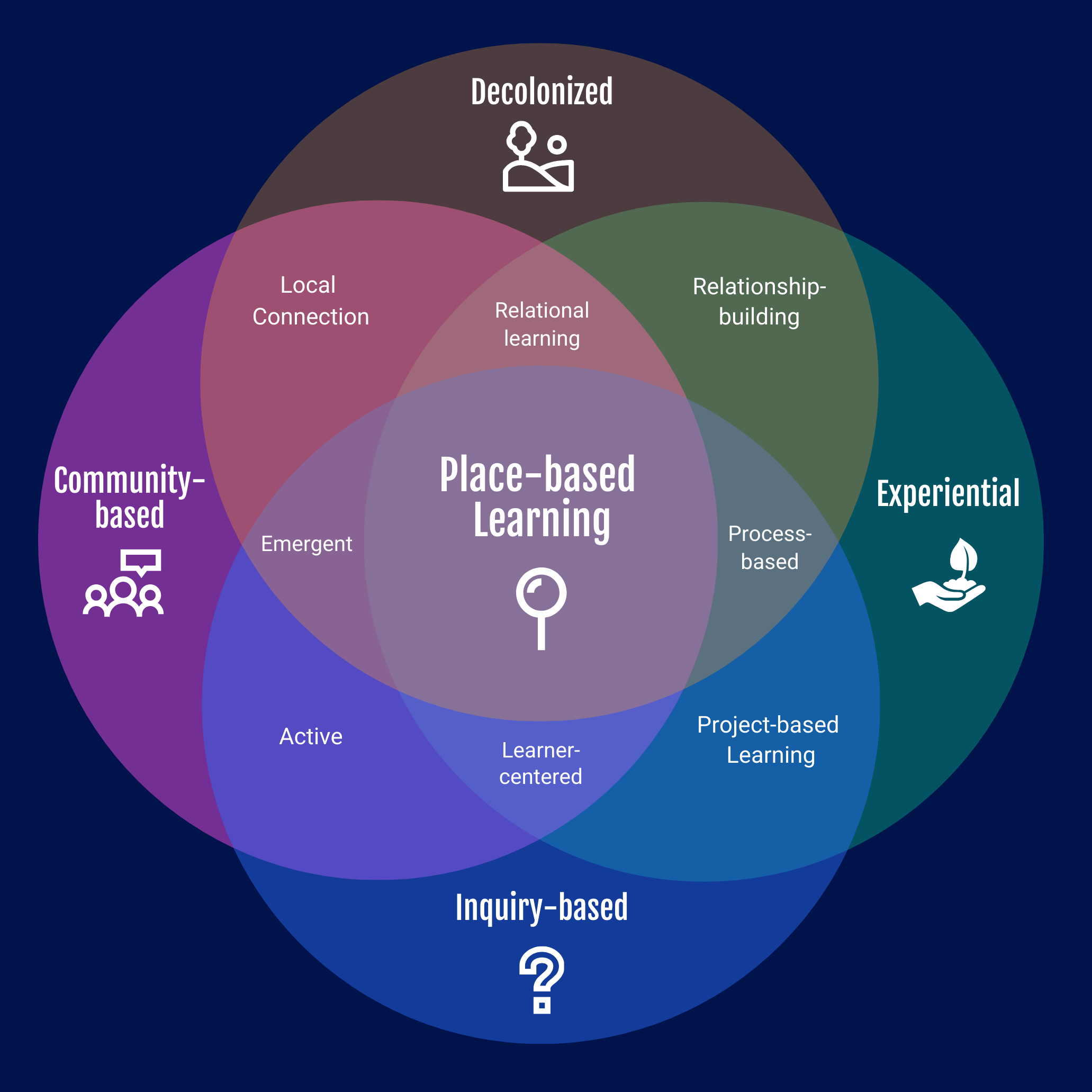
A pedagogical strategy where students engage with the local communities, institutions, or the natural environment. Through service learning or volunteering, students participate directly with their community (can also include online communities), addressing real-world scenarios, and reflect upon this experience. For example, students can work with Cougar Creek Streamkeepers for stream restoration, river biology, or a fine arts project—all have occurred at KPU. Community-based learning is often synonymous with place-based learning, since both encourage intentional experiential learning with the local community. David Greenwood offers a distinction in place-based learning being non-anthropocentric, with a commitment to including the more-than-human world.
The subjugation of Indigenous Peoples in Canada through cultural genocide, including severing their relationship to land and community. As a result of colonialism the dominance in economic, social, and political realms are maintained through exploitation.
Disrupting and deconstructing colonialism. Decolonization should not be taken as a metaphor. Decolonial work dismantles colonial structures and thinking, and returns Indigenous lands to Indigenous Peoples. Learn more.
Environmental education is a broad field that can focus on sustainability, natural ecosystems, and human behaviour in relation to these topics. William Stapp, who planned the first Earth Day in 1970, coined ‘environmental education’ in 1969 in regard to biophysical processes and increasing awareness to finding solutions to environmental issues. More recently, the North American Association for Environmental Education gives this definition: “a process that helps individuals, communities, and organizations learn more about the environment, and develop skills and understanding about how to address global challenges.” While environmental education and place-based education are both relevant across disciplines and can be learner-centred, place-based education is site-specific with a greater emphasis on local lands and communities.
Any learning where students apply their knowledge to real-world situations, and reflect upon this direct experience. Examples include art projects, community-based or place-based learning, internships, field trips, or hands-on laboratory work. The cycle of experiential learning is outlined by David Kolb as concrete experience (direct engagement), reflective observation (observe what occurred and draw connections), abstract conceptualization (develop ideas and theories), and active experimentation (try out new ideas in a practical and novel situation), which then cycles back to concrete experience.
Emphasizes Indigenous ways of understanding through holistic and experiential opportunities typically led by Indigenous teachers, and often occurring on Indigenous traditional territories. Experiences may include storytelling, medicine gathering, traditional harvesting, hunting and fishing, and other bushcraft and traditional activities. Land-based learning involves intentional time spent on the land through physical, mental, and spiritual connections. Dechinta is an example of an Indigenous land-based education initiative based in Yellowknife, Northwest Territories. Learn more.
An educational approach that puts students in the driver’s seat. The instructor’s role is to facilitate learning and guide the student through more personalized learning, accountable self-reflection, and formative assessment. Students become active collaborators in the learning process.
Coined by eco-philosopher David Abram, the more-than-human world includes the natural world, plants, animals, and other entities (inclusive of humans). The term more-than-human decenters the human and avoids the derogatory term ‘non-human’ (e.g., we do not refer to women as non-men).
Experiential learning that occurs outside the classroom. Although there is some overlap with place-based learning, outdoor learning typically focuses more on skills-based or adventure-based learning, while PBE ensures there is intentional collaboration with the community.
Connects learners to the local environment or community through direct engagement, and includes active collaboration with or by the local ecosystem or community member. Examples include site visits, field trips, service learning, campus as a living lab, or other experiential learning. Often used synonymously with community-based learning.
Developed by David Greenwood and others, place-conscious learning aims to expand place-based education with a critical understanding of the links among socio-cultural, historical, economic, and political aspects of community. Ecological justice and Indigeneity are also embedded. As Greenwood writes, “place-conscious education can provide environmental education research with a fluid conceptual framework that bridges cultural and ecological analysis, and that is responsive to diverse and changing cultural and ecological contexts.”
The process of building relationships, honouring treaties, learning about Indigenous history and current cultural practices, taking responsibility to respect Indigenous traditions and beliefs, and related actions that build relationships between Indigenous and non-Indigenous peoples in Canada as outlined by the 94 calls to action in the Truth and Reconciliation Report.
A process where students contemplate their learning journey and draw connections between their self, others, and the world. They may consider past and current experiences and relate these to the future. Reflective activities include journalling, self-assessment, ePortfolio, class discussion, and one-minute papers. Reflection is a key tenet of the experiential learning cycle, and also germane to place-based education in allowing students to examine, describe and express their experience.
Rooted in social constructivism, relational learning cultivates a collaborative educational experience that decenters the teacher and invites dialogue about the learning process. Students and instructors learn together within an inclusive, supportive, and co-constructed learning environment. Strategies to foster relational learning include remembering student names, building rapport and strong relationships across hierarchies, having students complete a pre-class survey about who they are and what they are bringing to this course, and providing regular opportunities for authentic connection and discussion within and outside of class.
Connects community service to class themes or learning outcomes. In partnership with a community organization, students apply knowledge or theory learned in the classroom to a direct practice. This type of experiential learning includes reciprocity between the student (active learning that is applied) and the community (student volunteering or contributing to the community). Examples of service learning at KPU.