Benefits

Why a Pedagogy of Place Matters

The benefits of outdoor place-based education are numerous and well documented. Increased learner agency, heightened focus and self-esteem, boosting social-emotional skills and academic achievement, fostering community connections, and enhancing spiritual, physical, emotional and psychological health and well-being. For first-year STEM students, PBE boosted academic performance, persistence, sense of belonging and also narrowed equity gaps (Johnson et al., 2020). University students taught through PBE better engaged with socio-scientific issues (Herman, 2021), while students whose studies connected with community found higher-paying jobs after graduation (Matthews et al., 2015). Well-designed learning that occurs outdoors also positively influences student wellness, focus, and motivation. In addition, PBE fosters community connections, enhances environmental and scientific literacy, and can address eco-social justice issues.

The numerous benefits of place-based education include academic, physical, emotional, and community-based enhancements.
Created by Lee Beavington.

10 Benefits Connected to Higher Education

Place-based learning can address specific issues and challenges found in higher education.

Student motivation. Going outdoors or to a local community is inherently active and experiential. Learners are more curious and involved.

Diverse student needs. Nature is the great leveler. Religion, power, wealth and other socio-economic status often hold less weight when in the forest or on the river.

Gen AI. Direct experience, and reflecting on this experience, is difficult to replicate through AI, especially when connected to the local, our senses, and/or personal reflections.

Community building. Being on the land and in community can be especially meaningful and engaging, and holds relevance for learners beyond the classroom.

Student wellness. Being outdoors provides a host of benefits to learners: calmness, lower cortisol, a sense of belonging, creative thinking, restoration and relaxation.

Decolonization. Learning that happens on the land or with community can help disrupt some of the institutional hierarchical and systemic barriers.

Can be done remotely. Everyone lives in a place, and in a community. Place-based education can be taught in online courses with the inclusion of sit spots, community connections, or Ecology in 1m2.

Helps with focus. Well-designed learning experiences outside the classroom grab learner attention and increases focus and retention. Students remember.

Mitigates anxiety and burnout. Many students can benefit from going outside due to movement, novelty, and increased autonomy. Enthusiasm is bolstered for student and instructor.

Student retention. Learning connected to community, which fosters a sense of belonging and meaning-making, increases student persistence and retention.

I said that in the land-based education I participate in, I was always advocating for curriculum and learning objectives to be left behind, and for educators to bring ingredients—Elders, learning, land and water—together, and then see what learning emerges from that alchemy.

Leanne Betasamosake Simpson

A Sense of Belonging
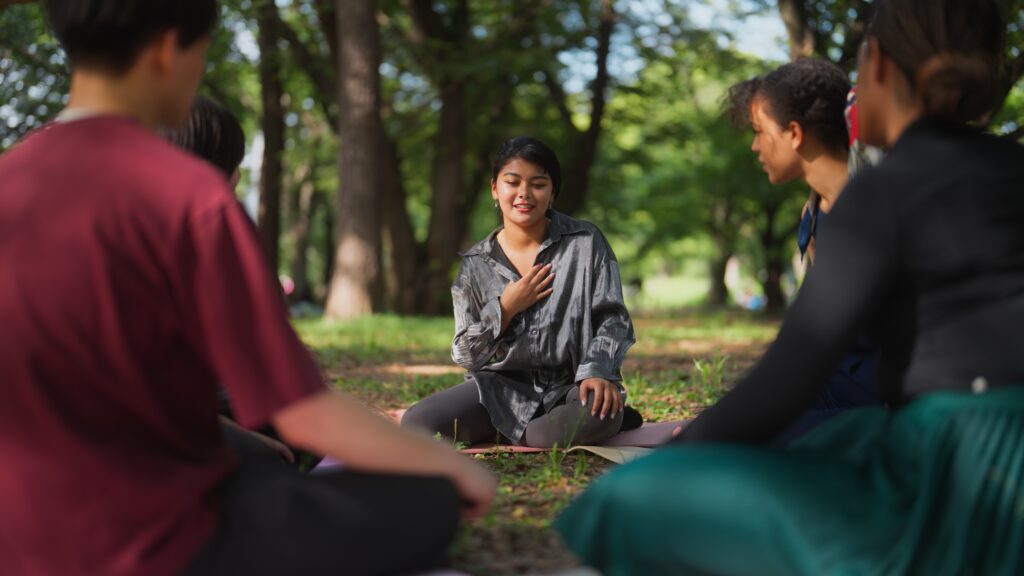
Students sitting outdoors with trees in background

Perhaps the most important benefit of learning in place—or with community—is cultivating a strong sense of belonging. Such a variable may be difficult to measure, yet studies have found that an intentional connection with nature leads to a sense of purpose and more meaning in life. What a gift to offer our learners, to feel more connected, to have a clearer sense of life purpose, and be part of a community. We can start building this circle of trust in the first class by having students share learning preferences, strengths and stretches, and what their excitements and expectations are for the course.

When we consider the four 4’s put forward by Kirkness and Barnhardt, Respect, Relevance, Reciprocity, and Responsibility, place-based education has the power to foster these in our learners, especially Indigenous students. In decolonizing educational practices, learning on and from the land is integral. When we gather with community, with clear intentions and connection to place, this can cultivate relevant learning, a sense of stewardship and communal responsibility, and inspire respect and a reciprocal exchange. 
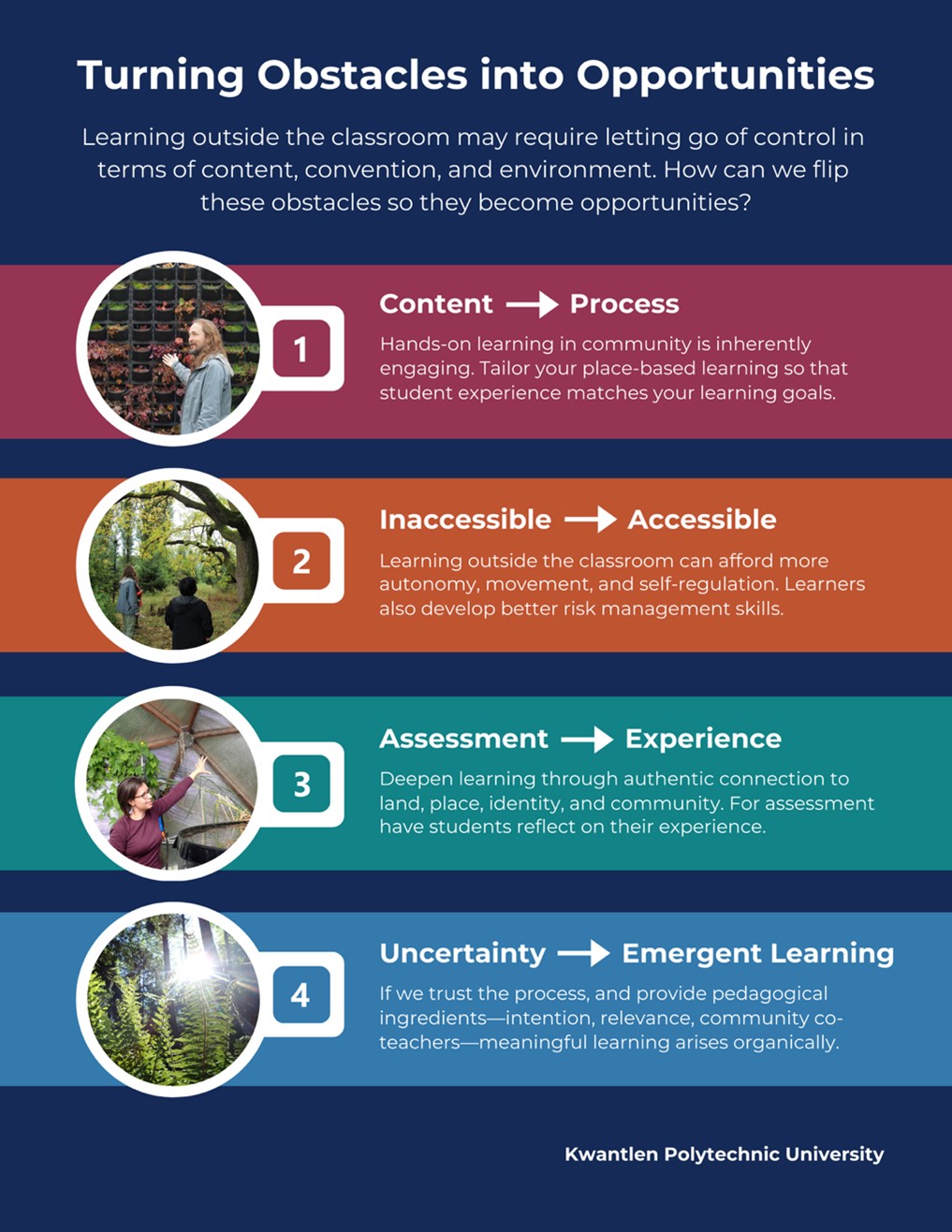
How the potential obstacles of place-based learning can be turned into opportunities. Created by Lee Beavington.

Turning Obstacles into Opportunities:
Decolonial Teaching Practices

Given the numerous benefits of PBE, why don’t more teachers, and other facilitators, take their learning outdoors? Doing so requires letting go of some control in terms of content, convention, and environment. What if we flipped some of these obstacles so that they became opportunities? What is the potential for emergent learning when we embrace a more fluid and decolonial teaching approach?

Click each item below to learn more.

Teachers of content-heavy courses or curricula may worry about lost class time. Going outsice the classroom and into community requires coordination and transition, and there is no place for a PowerPoint. Yet this could be an opportunity for Learning in Depth or inquiry-based learning. Instead of covering many topics briefly, learners can focus on a specific topic or question (chosen by them and connected to place). Less definitions and worksheets and more engagement that is experiential and ecologically-relevant.

Then don’t. Storytelling, mindfulness, and active learning are more suited to the outdoor or community environment. If you need some direct instruction, do this beforehand or limit how much directed instruction you do outside. Discourse that occurs outdoors is more open and authentic, since the teacher/student, expert/novice, authority/follower dichotomies are unsettled. As Mark Fettes and Sean Blenkinsop argue in their book, Education as the Practice of Eco-Social-Cultural Change, become a “time rebel.” Release the expectation of content quantity and instead tune into relationships and moments of wonder, “fiercely resisting the colonizing pressures and practices of scarcity driven education” (Fettes & Blenkinsop, 2023, p. 35).

This is an important consideration. There are mobility, financial, and other potential barriers to learning outdoors. How might we move beyond traditional barriers and learn in alternate settings? Part of the answer is awareness, and knowing the abilities and anxieties of our learners. Part of this is ensuring learners are aware of the terrain, literally: paths, roads, washroom proximity, weather forecast, distance to travel. If we flip the idea of the outdoors being less accessible, we might ponder on those students who feel anxious sitting at a desk all day. Many learners may prefer and benefit from going outside, as it can afford more autonomy, movement, self-regulation, and a sense of adventure.

When in the forest, following a stream, or even on the school or university grounds, there is always the possibility of the unexpected. Entering this with a flexible mindset can turn these presumed distractions (e.g., birds or other wildlife, community members, a flooded trail, another set of students) into a poignant encounter. Western and colonial thinking fixate on knowability and clear structure. As Fettes and Blenkinsop (2023) elaborate, “What teacher, for example, is not familiar with the experience of trying to cram ever increasing amounts of curricular ‘stuff’ into an ever-shrinking amount of classroom time, while at the same time having to turn away from rich learning moments or stop free exploration before it commences?” (p. 34). Dropping expectations for covering specific content opens opportunity for emergent learning that fosters collaboration, team building, and/or connection with the natural world.

This depends on how we define ‘nature’ or ‘wild.’ Most universities or schools lack access to vast tracts of wilderness or something akin to old growth. However, most will have access to a grassy field or a local park. Tiny but thriving ecosystems of life exist in grass and the soils underneath. The moss in the cracks between sidewalks, the birds that forage or nest at/near campus, or a single tree can all be a source of many stories, projects, or exercises in attunement. Planning less frequent but longer excursions can take learners to wilder places, where they can witness more-than-human life flourishing on its own terms.

While the outdoors is a fitting place to learn biology or geography, a case can be made that most disciplines can be taught effectively on the land. This requires a shift from viewing the natural world as a collection of objects about which we want to understand, to an ecosystem of human and other-than-human beings and landscapes that inform and inspire everything from creativity and language to sustainability and (insert your discipline here). Rather than a backdrop, the natural world becomes a co-teacher with countless threads of curricular and—more importantly—relational connection. See the Examples section to see how KPU instructors from different disciplines are applying place-based learning.

Good point. But only relevant if you teach botany or geology or a topic that necessitates identifying plants, animals, landforms and the dynamics that spiral them all together.

Let go of being an expert and embrace a more learner-centered approach by asking powerful questions, letting students follow their own inquiries, and giving space for the natural world to speak on its own terms. This is a chance for you to learn alongside your students, and compost the idea of ‘learning outcomes,’ as Fettes and Blenkinsop (2023) articulate, “to be radically rethought—for what if one valued learning outcome is to recognize one’s profound ignorance, or the inappropriateness of seeking further knowledge in the absence of a fundamental shift in relationship?” (p. 40).

This is a real barrier. How to chip away at this? You can gather evidence for the impact of ecological place-based education, offer workshops to colleagues where they can practice outdoor facilitation in a supportive environment, or invite a speaker/facilitator to help with this work. Creating a new culture for education takes time. Host a book club with Robin Wall Kimmerer’s Braiding Sweetgrass, which can act as a bridge from colonial/rigid/prescriptive learning to land-based/reciprocal/holistic education. Join a KPU Wild Spaces event.

Experiential, nature-based learning that is open to emergent possibilities can be difficult to assess. Some authentic learning options include reflection, discussion, and portfolios. However, compared to quizzes or essays, these can be challenging to measure. Perhaps we need to address the larger pedagogical question: Is it more important to have authentic learning connected to land, place, identity, and community? Or to be able to measure these through a number, grade or other rubric? Some student experiences cannot be measured, yet they may be our learners’ most poignant—and cherished—educational memories. Can we see this not as a loss in the lesson plan, but rather as a gift of connection and taking learning and personal connection deeper? Click here for assessment guidelines for PBE.

This should give you pause. By default we usually teach who we are and how we were taught. Reading about nature- or place-based teaching, or delving into the theory, might help inform your practice and justify this work to reluctant believers. But as educators, we need to see and experience effective and intentional outside-the-classroom facilitation. This is best done by having someone model this. Join a teacher that regularly takes their class outdoors. Attend an experiential conference where hands-on workshops have participants engage in place-based activities. Notice the possibilities that emerge and adapt them to your teaching practice. Connect with KPU Wild Spaces.

Learning outside the classroom requires preparation and transition. When walking to a location, instead of considering this ‘time lost’, another option is to incorporate the Walking Curriculum. In this way, learners engage through movement and active participation. A walk is a great time to connect (learners tend to open up in this less formal setting), to reflect on learning, well-being, and our roles (there are lots of research on how walking can explore anti-racist and anti-colonial ways of being, such as the WalkingLab), and to tune in to the natural world. Try incorporating a sound walk or other sensory focus.

Students are much more likely to die from driving to school than from climbing a tree. A palpable fear around tree climbing is not supported by the evidence: the number of kids that die from climbing trees is infinitesimally small, 0.00000156% according to one study (Tulley, 2010). Purposeful play in natural environments helps students navigate physical risk. This is not to say that risks do not exist: allergies, tripping hazards, changing weather. Yet outdoor learning is a fitting place to stretch comfort zones and explore unique risk tolerance on a physical, interpersonal, and emotional level. In reality, there is risk in any learning environment. The natural world can be a source of fears, but also a place to overcome them. Many potential risks can be mitigated by a sound safety plan, identifying hazards, setting boundaries, and a confident teacher. Taking learning outside the classroom can prepare students to better manage the same risks which we fear.

Final Thoughts on Obstacles and Opportunities

Letting go of conventional teaching is not a passive process. Active effort is required to challenge the status quo and be willing to teach differently. We must also acknowledge that a series of “tips and tricks” is unlikely to lead to transformational change. If we want to shift from conformity and efficiency and follow Fettes and Blenkinsop’s (2023) advice “to stretch individual and collective thinking into wilder, less linear, more systemic, creative possibilities” (p. 40) then some guiding questions may help. Therefore, the suggestions previously presented might be framed by questions such as:

  1. How am I repeating settler-colonial narratives and practices in my teaching?
  2. How can I shift from seeing the natural world as a backdrop, to the natural world being an active participant?
  3. In what ways can I co-create learning with my students?
  4. Is strict adherence to learning outcomes getting in the way of meaningful educational experiences?
  5. What powerful questions can I ask learners that leaves space for mystery and unknowability?
  6. How can can the more-than-human members of our community become part of my teaching (or other) practice?
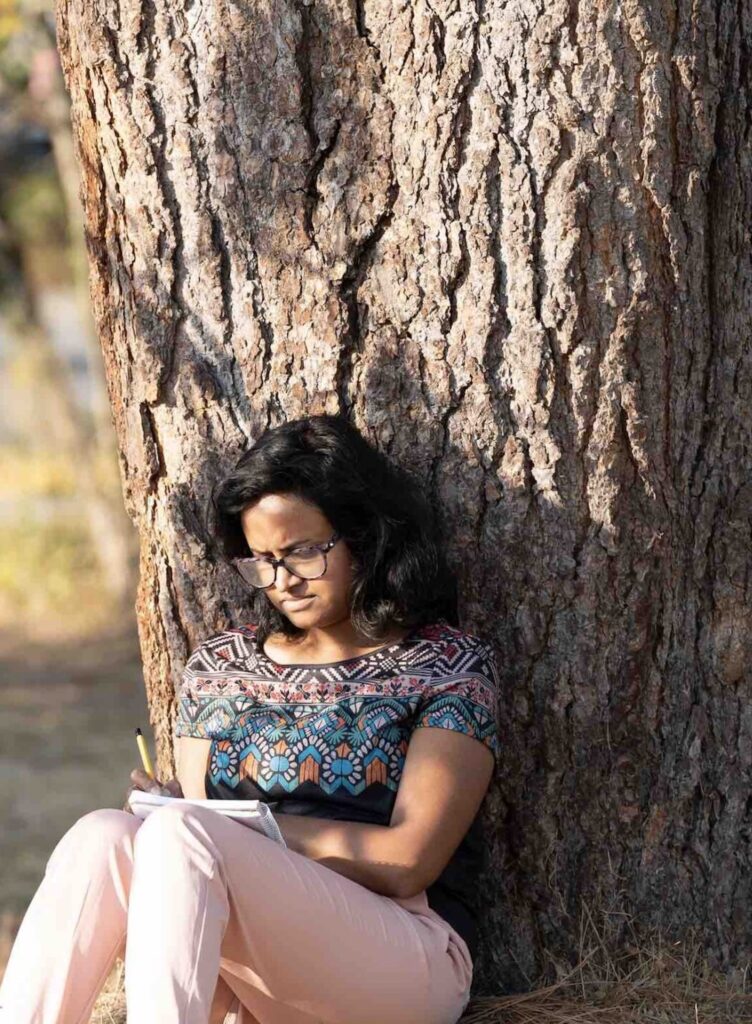
Authentic learning experiences often take place outside of the classroom…formal education can lose its meaning for many students when it does not allow them to imagine themselves in the worlds they inhabit outside of school.

Sara florence davidson & Robert Davidson

References

Fettes, M., & Blenkinsop, S. (2023). Education as the practice of eco-social-cultural change. Palgrave Macmillan. https://doi.org/10.1007/978-3-031-45834-7

Herman, B. C., Newton, M. H., & Zeidler, D. L. (2021). Impact of place‐based socioscientific issues instruction on students’ contextualization of socioscientific orientations. Science Education, 105, 585–627. https://doi.org/10.1002/sce.21618

Johnson, M. D., Sprowles, A. E., Goldenberg, K. R., Margell, S. T., & Castellino, L. (2020). Effect of a place-based learning community on belonging, persistence, and equity gaps for first-year STEM students. Innovative Higher Education, 45, 509–531. https://doi.org/10.1007/s10755-020-09519-5

Tulley, G. (2010, June 22). Some thoughts on #28 – Climb a tree. Fifty dangerous things (you should let your children do). https://www.fiftydangerousthings.com/news/some-thoughts-on-28-climb-a-tree

Ready for Next

Implementation