I came for the Criminology, I satyed for the Garden
I did not expect to fall in love with a garden.
Growing up in India, I was always more drawn to questions than to soil. Why does crime happen in specific places? Why at certain times? What pushes people towards harm? These are the kinds of questions that pulled me into criminology. So when I found out that CRIM 3911 means actually going outside and growing vegetables on campus, I was genuinely puzzled. What did Kale have to do with any of that?
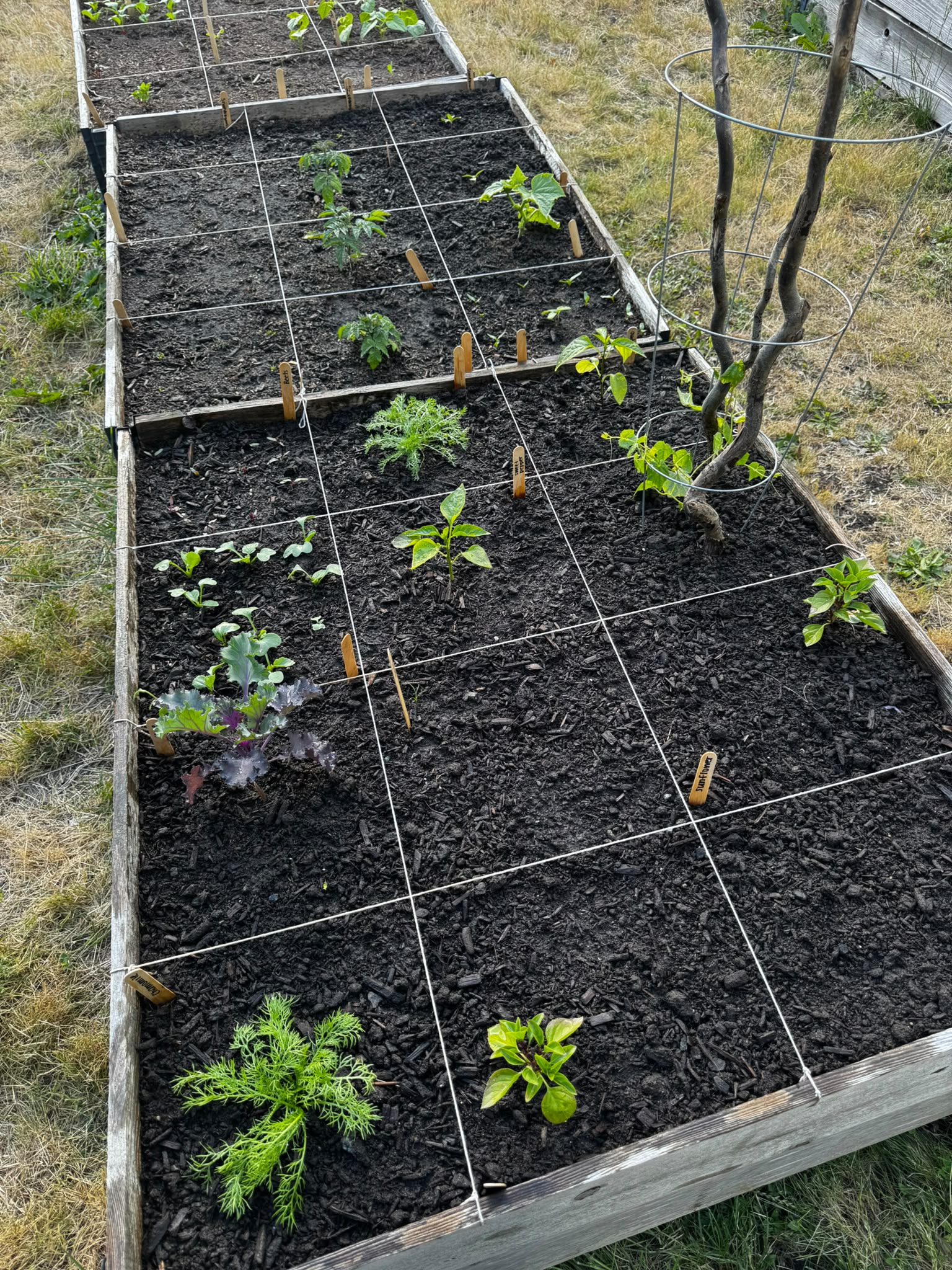
But the first time I walked into the Westerman Garden at KPU Surrey and saw our garden box, dark rich soil, a near grid of string, little wooden plant markers, something unexpected happened. I felt calm. Relaxed in a way I did not anticipate. There is something quietly healing about being around growing things, and ever since that first session, the garden has become one of my favourite places on campus to visit when I need to clear my head.
That feeling surprises me. And then it started to make sense through the lens of green criminology.
Standing there, looking at our seeding- dill, Kale, lettuce, peppers – I thought about how disconnected most of us are from where our food actually comes from. Back home in India, I had seen small family farms and local markets. Coming to Canada, food became something that just appeared on grocery store shelves, packaged and priced. I stopped thinking about the land, the labour, or the hands behind it.
White (2018) describes this as the commodification of nature, the process by which something like food, which has deep use-value in nourishing people and communities, gets reduced to an exchange-value, something bought and sold for profit. Growing our own food, even in a small campus garden box, pulls that use-value back to the surface.
Stretesky, Long, and Lynch (2014) help explain why this matters on the largest scale through the Treadmill of Production theory. Capitalism is structured to constantly expand production, which means continuously pulling more from nature and pushing more waste back into it. Industrial food systems run on this logic — factory farming, monoculture crops, long supply chains — and the ecological harm they cause is mostly legal and therefore mostly invisible.
Our garden is the opposite of all that. It is slow, local, and honest. You cannot fake a harvest. You have to show up, pay attention, and care.
Coming from a background where I was always asking why crime happens, I am now also asking why so much harm to the environment does not even get called crime. The garden did not answer that question, but it made me feel it differently.
White, R. (2018). Critical green criminology. In Routledge handbook of critical criminology (pp. 120–131). Routledge. Stretesky, P., Long, M., & Lynch, M. (2014). The treadmill of crime: Political economy and green criminology. Routledge.

Hello Rajpreet! I really enjoyed reading your blog post!. My parents also grow vegetables at home. I personally never had much interest in gardening, as it requires a lot of patience and care. After this course, I realized how simple gardening actually is and how enjoyable it is. After growing my own little garden in this course, I definitely realized how much work goes into the food we eat every day. I also like the connection you made to White’s (2018) idea, where you spoke about the commodification of nature. It was refreshing to read about because it gives us almost a reality check about the value that food has and that it’s more than simply making a profit. After growing my own vegetables in our garden, it just made me appreciate where food comes from more, even though my parents garden on a daily basis. Something about planting the seeds myself and watering the plants made me think from a different perspective. I’ve only been to India a few times, but from what I remember, the small family farms and local markets that we see on the streets bring so much value to all the different communities.